Let's dismantle the biggest marketing myths holding businesses back from bogus measurement obsessions to cheap production traps, weak media strategy, and the lie that “anyone can do marketing.” Learn how advertising really works and why excellence always wins.
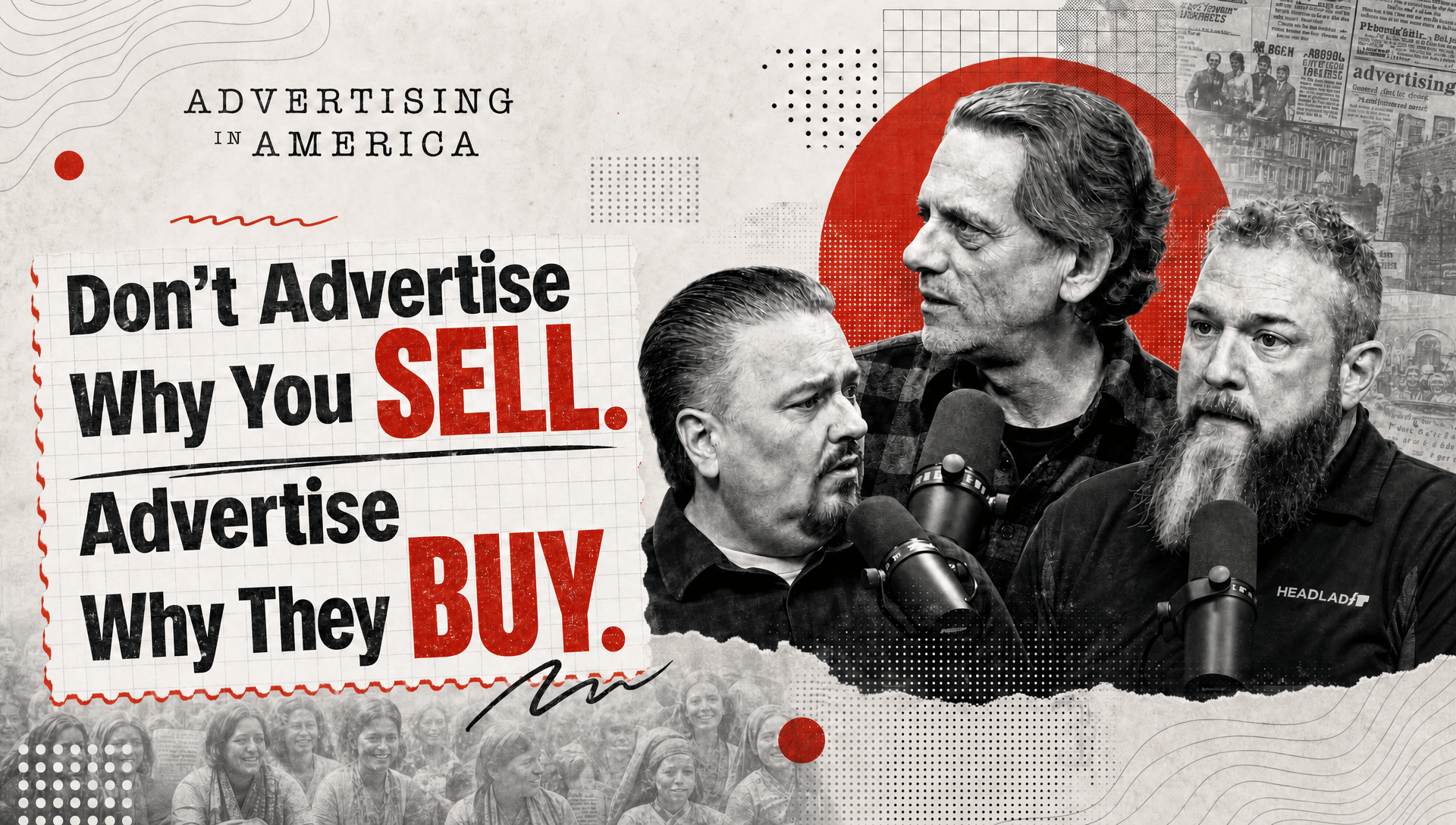
Advertising in America
December 4, 2025
Let’s be honest—marketing myths aren’t harmless little white lies. They’re stealthy budget-eaters, reputation-robbers, and strategy-warpers that make good brands do dumb things.
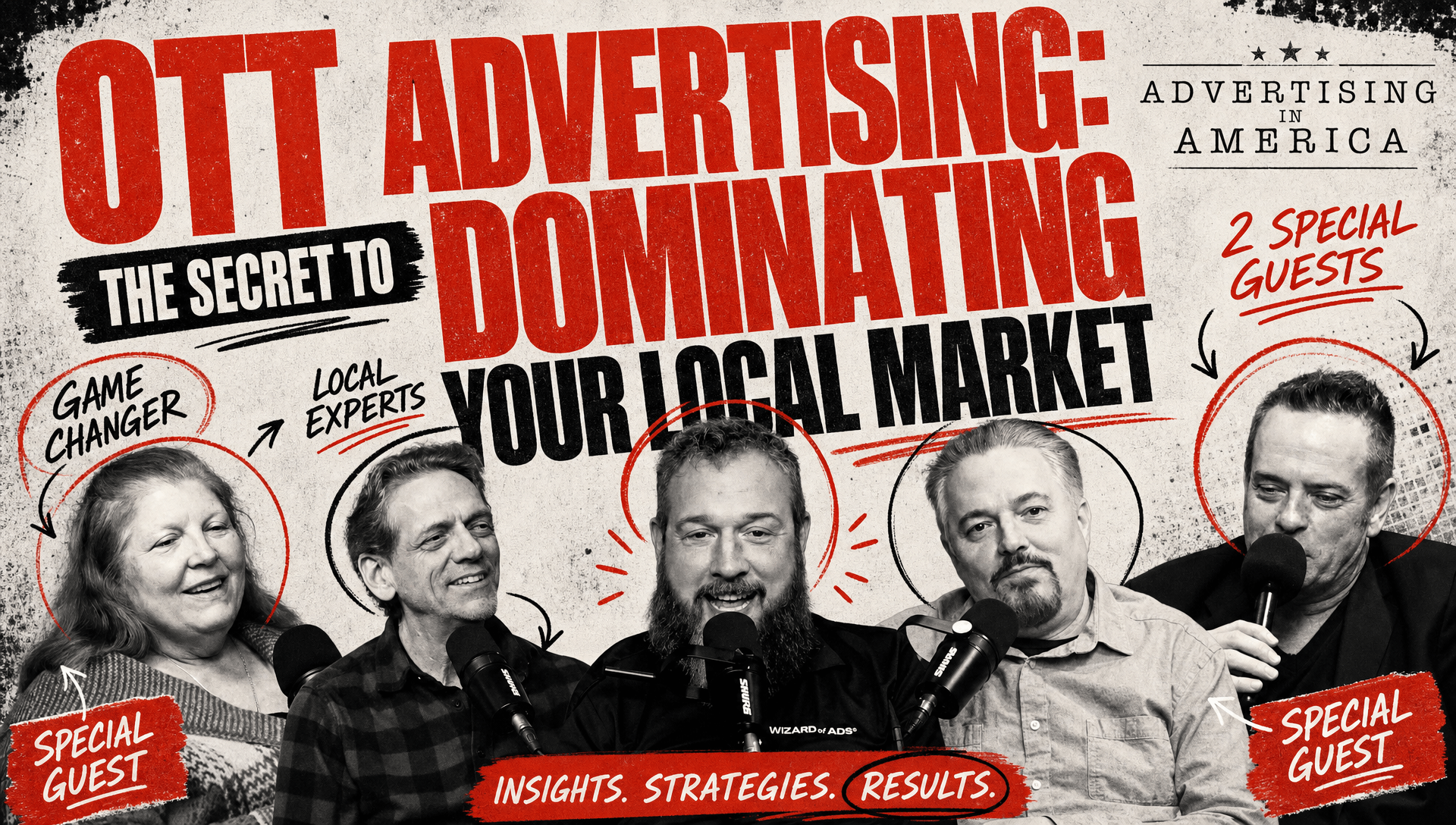
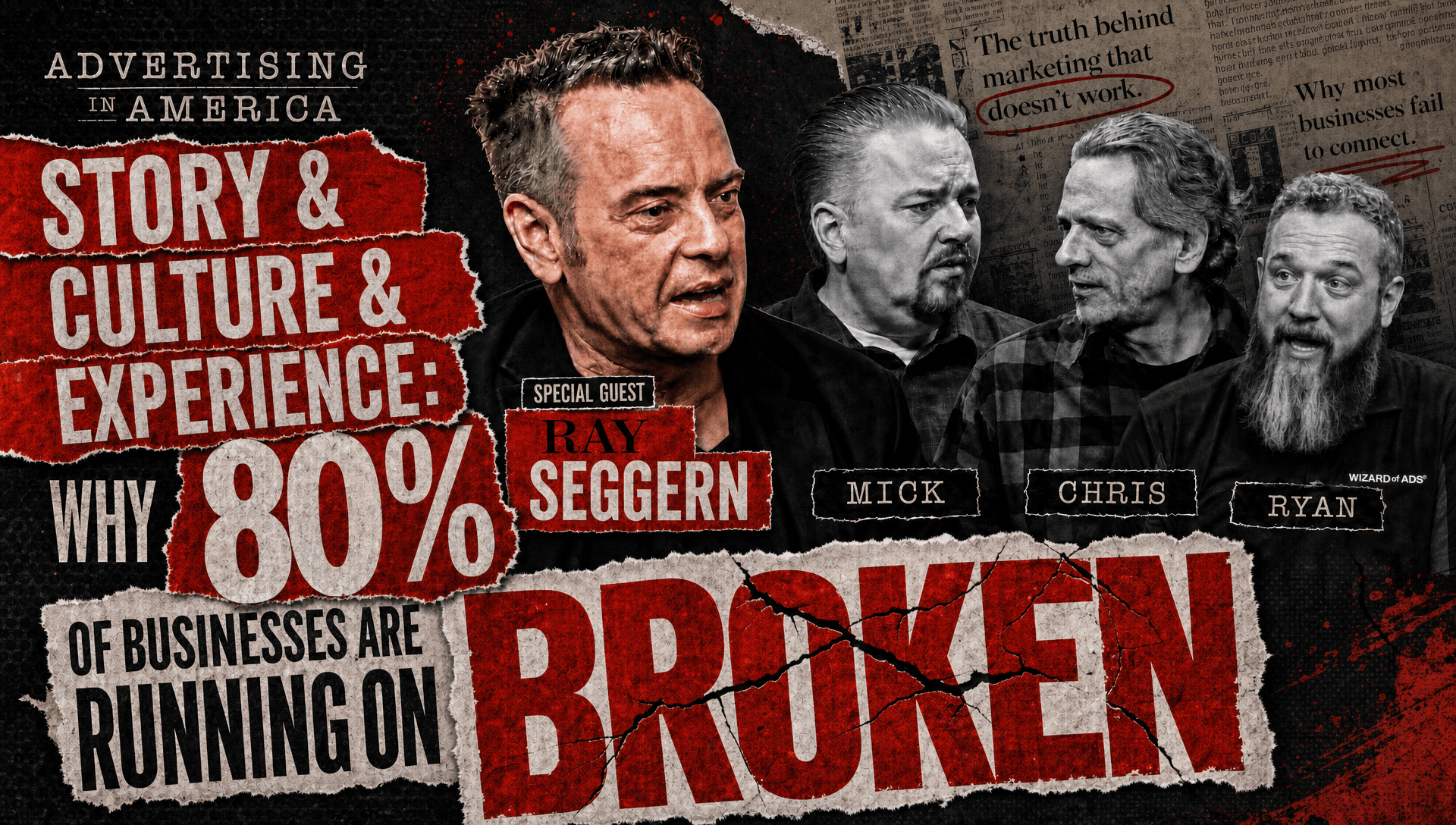
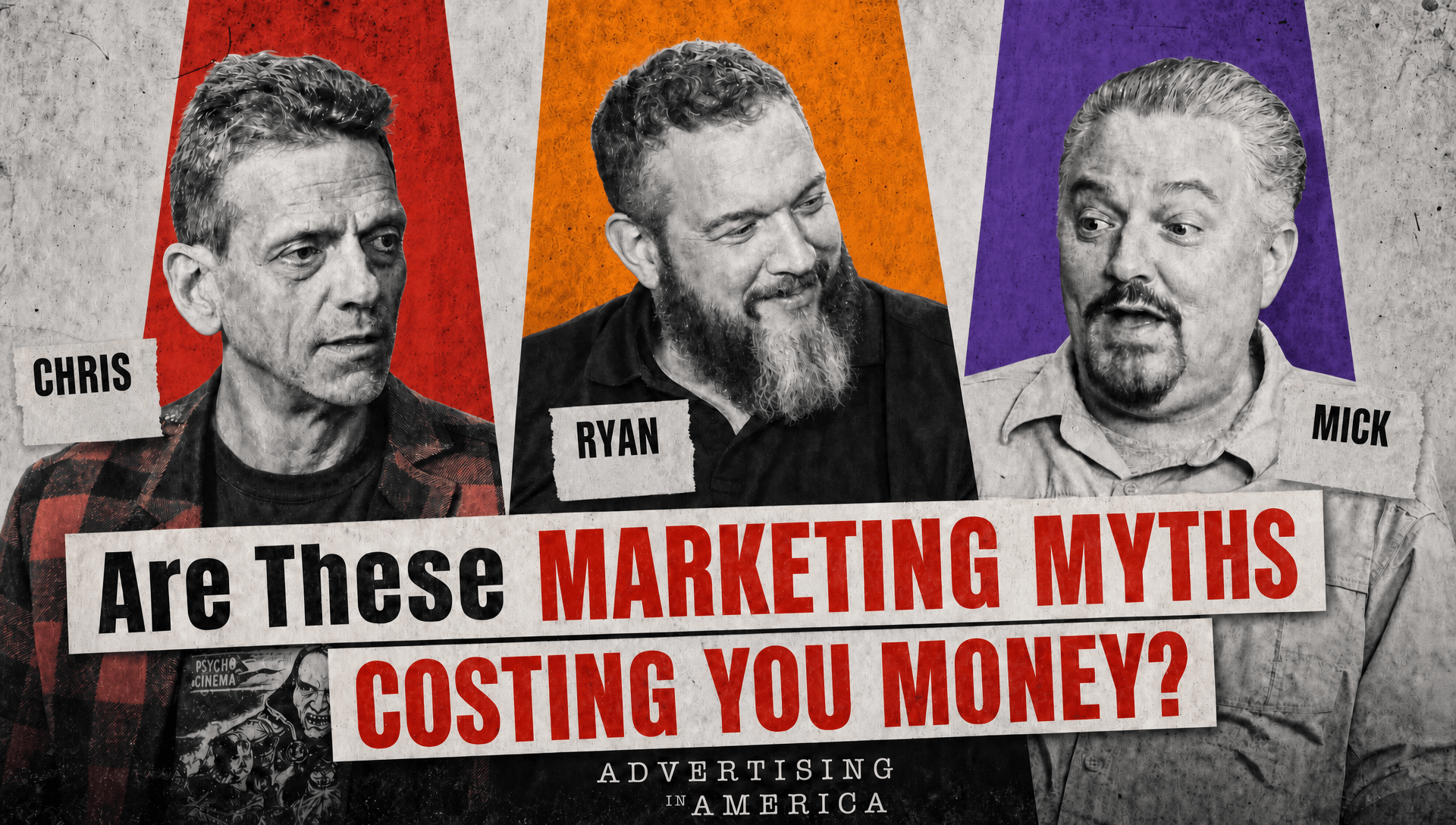
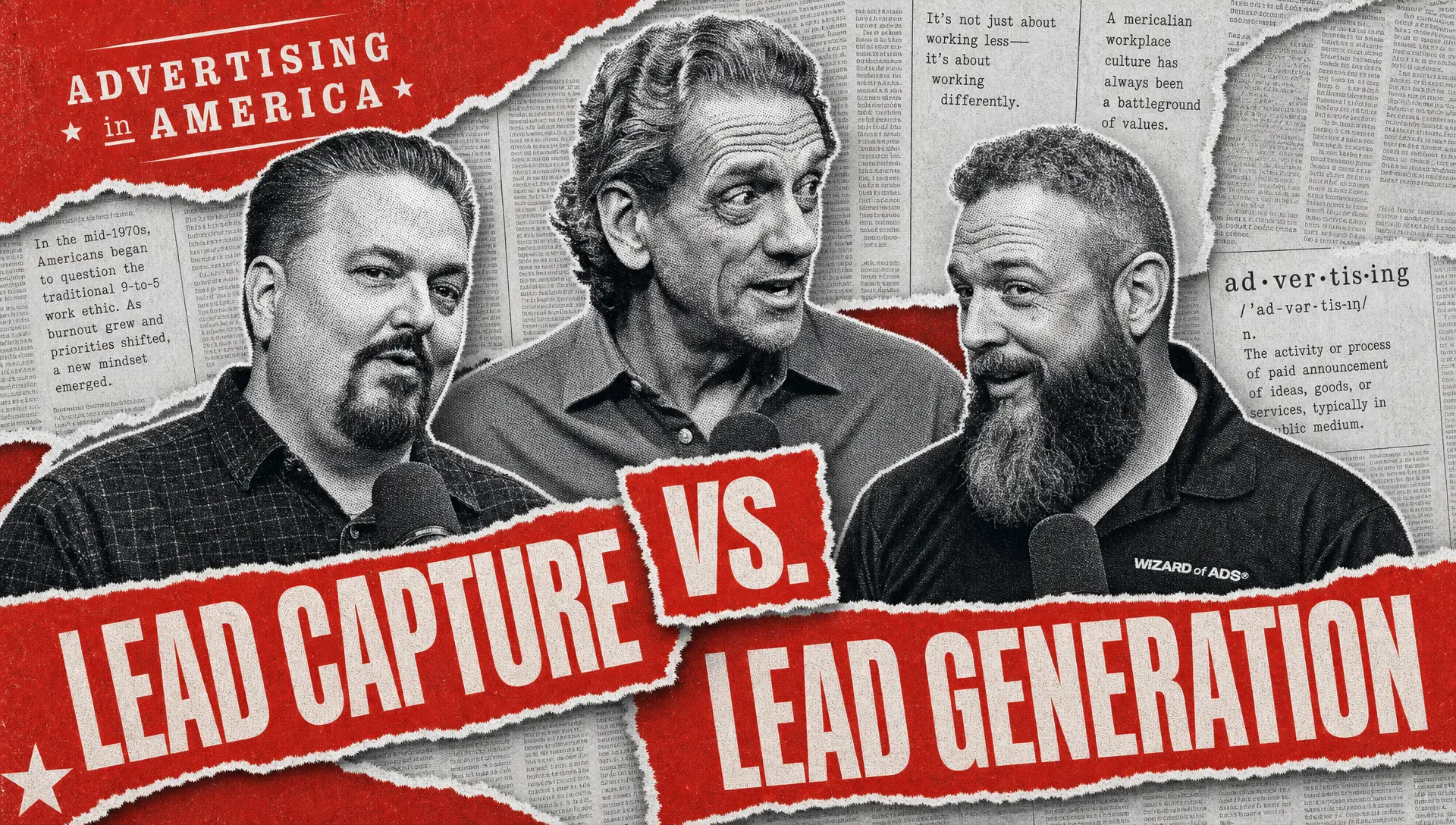
In Episode 23 of Advertising in America, Ryan Chute, Chris Torbay, and Mick Torbay pull back the curtain on the most expensive misconceptions in marketing—from chasing perfect attribution to thinking cheap production is a shortcut to success—and lay bare the truth about what actually drives results.
They dismantle the dangerous belief that reach beats frequency, expose why DIY media buying rarely works, and explain why excellence isn’t a luxury—it’s a competitive weapon. Plus, they remind you that marketing and sales are two very different beasts, and that customers rarely buy “the best”—they buy “better enough.”
Because if your campaigns are smart but your strategy is broken… you’ve just spent money entertaining your audience, not converting them.
Episode Highlights
The costly trap of perfect attribution
Why cheap production often costs more than premium
The false confidence of DIY media buying
Why frequency beats reach every time
How excellence becomes a competitive advantage
The subtle but critical difference between marketing and sales
Why “better enough” wins more often than “the best”
🎧 Hit play—and finally make your marketing work like you always hoped.
📱 Subscribe wherever you get your podcasts
👉 Two Questions:
Are your campaigns driving results—or just looks good on paper?
And when people notice your brand… do they actually act?
In this episode of Advertising in America, we're talking about marketing myths that just don't measure up.
Which advertising message brought about a particular sale? I saw this ad. I bought a product. That's what the business owner wants.
Pay enough to make it awesome and nothing fancy after that. Hire smart people to solve your strategy problems, write your campaigns, and buy your media. Don't do that yourself. You'll get electrocuted.
Format doesn't fucking matter. The only thing that matters is how many people are you reaching? How often and for how many dollars?
That one time and he sold a $50,000 roof, and then nothing for a month and a half because that's not how it fucking works. That's not how it works.
But if you want me to think that you're smart, skilled, meticulous, and committed to excellence, make ads that reflect that. Yeah, your nephew's got a Mac, an iMovie, and you'll probably do it all for just weed money, but it's not worth the money you'll save, and it's not worth the money you'll spend.
Ryan Chute: Henry Ford once said,
“Stopping advertising to save money is like stopping a clock to save time.”
In this episode of Advertising in America, we're talking about marketing myths that just don't measure up. In a marketplace filled with alternative facts, here's Chris to check some facts. Chris?
Chris Torbay: Hire actors who will make your ideas great on the radio and on TV. Hire photographers and musicians, and directors with talent whose talent will reflect positively on your brand. If your positioning is the bargain basement, cheapest, low-cost provider in the world, by all means make your ads look super cheap too, and you can be damn sure I'm gonna believe you. But if you want me to think that you're smart, skilled, meticulous, and committed to excellence, make ads that reflect that, yeah, your nephew's got a Mac, an iMovie, and he'll probably do it all for just weed money, but it's not worth the money you'll save and it's not worth the money you'll spend.
Ryan Chute: I love that you pretend like you're not working for weed money also. Between Mick and his wife, they have two doctorates. Be sure to ask him about that sometime. Now, here's Mick to talk about more marketing myths that don't measure up. Mick.
Mick Torbay: Okay. My myth is, measurement is everything. I love it when a client asks us how we're gonna measure success because we have a really solid answer for that. We are going to measure success by how much money you're making, but then sometimes that seems like it's not enough for them. They want to measure really closely. They want to connect the dots precisely. They want to know which advertising message brought about a particular sale. I saw this ad. I bought a product. That's what the business owner wants. Sadly, that's not a thing, and it makes them really mad when I tell them that. Still true though. And just because you want to be able to connect every dot doesn't mean you can actually do that or even that they're connected the way you think they should be.
But it does raise an interesting point. Where did this obsession with measurement come from? “I wanna have a different phone number on the radio ads and another number on the TV ads, and another one on the trucks, another one on the digital ads so we can see which one is working.” You think that's crazy? Sometimes they have a different web address for different radio stations. They're not wondering if radio works. They're wondering if sports-talk works. or if it's new country that brings in the sale?
It's all nonsense. It's a myth. Radio works. TV works, digital works, social stuff works, direct-mail works. When did you all become research scientists, trying to ask, answer the grand question of “What advertising works?” And remember, if you actually do think you're a scientist, and you're not, by the way, your research is completely worthless unless you have a control. Do you have a control? Do you even know what I'm talking about? If you don't, then stop asking for measurements. If you want to know if country music works, you have to run a campaign, reaching a fixed number of people, a fixed number of times a week, and you have to run that for about a year, and then the following year, you have to run commercials in a different market, this time on a sports talk station. Again, for a year, being sure to reach the exact same number of people the same number of times.
Oh, and you have to have the same message, two identical commercials. This is a control. Remember, at the end of the second year, you can compare your results and consider the data. I don't know about you, but my clients don't have time to do a study like that. And luckily, this shit has already been studied over and over again, and the results are, format doesn't fucking matter.
The only thing that matters is how many people you are reaching, how often, and for how many dollars. Ditto for TV, ditto for digital. When you wrapped your trucks, did you measure the results of that? When you changed your uniforms, did you measure the results of that with a control, of course? Send 50% of your staff out with the old uniform and the other half with the new ones, and track the productivity of the two groups. No, because that would be stupid, crazy, and a waste of time and money. Ditto for marketing.
Trust the big data advertising works. Do it well. Do it often and stop pretending that one commercial makes anyone do anything. It all works together. The marketing, the truck wrap, the uniform, the staff training, measure it all together. How much money are you making? That's how you measure success.
Ryan Chute: And then there's the facts, Jack. When we get back, we'll debunk more marketing junk. But first a word from our sponsor.
Ryan Chute: Chris is taking swings at cheap thinking and Mick smackdown measurement madness. So let's keep busting, because the myths don't stop there. Some of the most dangerous ones are the sweet little lies business owners tell themselves every day. Let's walk through a few more of our faves. We've talked about the myth of production, and we've talked about the myth of measurement. What are some of the thoughts that you have countering each other on each one of these myths?
Mick Torbay: I’m not sure I want to counter him necessarily, but there's an aspect of that myth that I think is interesting. When you look at things in terms of line items, then obviously any reasonable person is gonna say, “How do I make that line item less?” Because anytime you can reduce a line item that goes straight to the bottom line, that makes everybody happy.
But I put that in the context of what you're trying to accomplish. Are you trying to get a job done, or are you trying to win a game? Here's what I mean. The three of us are very familiar with private equity. And private equity is known for coming in, buying a company. And the first thing they wanna do is reduce efficiencies, right? That's how they make their money, is they reduce efficiencies. Can we buy toilet paper for less? Can we find ways of reducing costs and laying off staff, and downsizing things? And one of the first things that private equity companies generally do is fire us. And it seems very self-serving to say, I think that's a mistake.
I know why they do it. And that's because they can absolutely find somebody who can write their ads, who will charge less than me. And I think that's the conversation that goes on at these companies, “Can we find someone who can write commercials for less than these guys?” And the answer is, “Oh yes, absolutely. Unequivocally yes.”
But you are thinking in terms of how much does it cost to get this job done? And if you think of it in terms of getting the job done, then if you can get it done for a lower amount, then you do that. If you change the thought to how do I win? All of that goes away because if you talk to the New York Yankees and say, “Can we find somebody who can go out there and play baseball for less than that guy?”
Oh, yes. You could find people to play baseball for a lot less.
Chris Torbay: He wants millions of dollars, apparently.
Mick Torbay: You can find a guy who's who will give up his hundred thousand dollars a year job to do it. Will he win games? No, but he can swing, he can hit, he can pitch, he can run around the bases, he can do all of the, ostensibly, all of the things that those players can do. The only thing he can't do is beat the other team. The only thing they can't do is win the game. So ask yourself, when you're making these decisions about, for example, production, are you saying to yourself, “How much does it cost to do this job? Or how much does it cost to win the game?” Because when you're making a commercial, you're trying to fucking beat somebody. You're trying to beat the other guy. You're trying to win. You're not trying to tick a box. You're trying to win.
Chris Torbay: Oh, good. We got a commercial made. Done.
Mick Torbay: And I think that mental mistake that people are making when they just think of things as a line item and say, “Can I do this cheaper? Can my nephew with a camera do this?” Yeah, sure. But can he win? Can he beat somebody else? We have to beat people, right? Our job as the ad company is to grow our clients' business to make them more money. Where does that money come from? Somebody else. It comes from somebody else.
We're not flying new customers into your market. We're taking business away from your competitors. We're making them switch. That's fricking brutal. We're making them change their minds. And you think you can accomplish that by simply doing the job? No, we're winning. We are the winners, and they are the losers. This is harsh stuff we're talking about. If you wanna win the game, you need to get fricking winners, not just get people who can do the job. I get fucking pissed about this.
Chris Torbay: Take that losers.
Ryan Chute: That is really one of the myths that we outlined of the big ones that we constantly hear. Anyone can do marketing? Well, yes. Anyone technically can do marketing.
Mick Torbay: If you're ticking the box.
Chris Torbay: If you just need to put somebody in the chair.
Ryan Chute: There has been so many astoundingly obvious cases of massive failures of that exact thing. And it's not just a one-person thing either. It's not just the writer who matters. It's not just the media buyer that matters, but it's also the operator that matters. If the operator's not behind the brand, if the operator's not championing this at every single level, our most successful companies have always been obsessed with the brand. It's not just that this is my brand. This is my culture. This is everything.
Mick Torbay: My rant applies to everything. It applies to the media buyer. Some people say, “Oh, I've been buying media for a while, I can do it.” It's no, you can't. You can do it. You can do it. Yes, I could buy media too. I wouldn't do it well, but I could do it. And I can't do it in such a way that my media buy can beat another professional media buyer's buy.
Ryan Chute: It was fascinating to hear a person of interest, not what I consider a prospect, but a potential prospect for the Wizard of Ads say, “Oh, I buy my own media. I'm pretty good. It's a local station. I can get a really good deal outta 'em 'cause I'm a good negotiator.” I'm like. You have articulated everything that you don't know.
Mick Torbay: When you walk into the radio station, do your negotiation. You sound like a guy who walks into a Vegas casino and says, “I can win at blackjack. I've got a system.” Oh, they love people with systems. Please come in, try your system at our casino's new wing, I'll give you free tickets to Penn and Teller if you wanna try out your system with me. They love these things. You think that you can do that as well as someone who only buys media all day, every day and is constantly trying to win?
Chris Torbay: And this is the thing that gets me, is as soon as you reverse that argument and say, “I could probably install that water heater myself. You really just gotta connect the hot cold, plug it in.”
Mick Torbay: “I watched the YouTube video. It's not actually that complicated.”
Chris Torbay: There's lots of videos that show me how to do that. And they will go on about how “No, you gotta have years of experience to know whether such and such,” and they do, and they're right. Exactly right. So it's like, how come it doesn't apply for, nobody says, “I could do a little dental work. I've got a mouth.”
Mick Torbay: I got a drill.
Chris Torbay: “I brush my teeth every day. So I can certainly help you with your cavity.” What's. Wow. How hard can it be?
Ryan Chute: This is it. Fun fact, leaders in businesses absolutely call out marketing as the number one challenge that they have in their businesses every single day. And now marketing is a monstrous category. It includes sales, it includes advertising, it includes lead capture, and all of these different components. And yet they feel like getting it out to the lowest common bidder is going to be the solution to piece together this highly complex piece of machinery.
Mick Torbay: How many times have you been in a situation where a client says, “Hey, I'm gonna have an in-house marketing person. I haven't done that before. I'm doing that now.” It's oh, that's great. “It's my niece.” And it's okay, “oh, you're screwed.”
Your niece asked you for a job, and you said I'll put her somewhere where she can't do any damage because she doesn't know how to install water heaters.
Ryan Chute: She always wanted to do marketing.
Mick Torbay: And she knows something about social media,
Chris Torbay: She likes to Tweet.
Mick Torbay: We're looking to beat professional marketers.
Ryan Chute: You're putting yourself in a position of a special kind of screwed.
Mick Torbay: If your niece is 50 and really good at marketing, please do that.
Chris Torbay: If you're hiring away from Anheuser-Busch, there you go. By all means.
Ryan Chute: There's a skillset there, and there's a huge difference between a writer, a videographer, a marketing ops person, a strategist, a media buyer, and nobody is all of those people.
Chris Torbay: And that is one of those great myths that we're up against, which is, anybody can do marketing. And the number of times you've made this point, that's the number of times they promote a guy from the sales department to the marketing department, or from this department to the marketing department. It's “because he knows the stuff.” It's like new; it's a different job.
Mick Torbay: Sales and marketing are not the same job at all.
Chris Torbay: Those are not the same job. And just because you watch TV and you've seen tons of commercials yourself.
Mick Torbay: I watched all of Mad Men. I can do marketing.
Chris Torbay: Yeah, exactly. Guess what? I watched all of ER. Do not give me a scalpel!
Ryan Chute: They do think that it's the same. I grew up thinking that I knew lots about marketing. I knew lots about sales and promotion, but I didn't know anything about marketing, really to speak of, and you and I spoke about this before, Mick; there's a tension that needs to be between sales and marketing.
Mick Torbay: Their goals are not perfectly aligned, are they? No. And the worst case is when somebody puts somebody in charge of both of those jobs because that's a problem. Marketing's job is to make the phone ring. Sale’s job is to answer the phone and close a deal, and once the phone has rung, marketing's job is done. Sale’s job has just started. They're different.
Ryan Chute: And that's where most of our clients are hitting the wall with marketing, is that they think that marketing is selling.
Chris Torbay: They really do.
Ryan Chute: When selling is a subset of marketing. And marketing does not sound like selling at top of funnel. At the top of funnel, it’s about making a person feel enough that they trust you to show up at their door or come into your showroom or whatever the case might be.
Mick Torbay: To give you a shot.
Ryan Chute: Give you a shot, and it sounds nothing like sales. That's the very first lesson I learned at the first Wizard of Ads™ meeting with the Partners was, “Oh, I don't know what I'm doing here.”
Mick Torbay: It's one of the things I liked, actually, when I met you. I have to confess, I had a bit of that same myth in my own brain. I thought I knew about sales because I knew about marketing, and I was just as wrong. But when I met you and, “Oh shit. I didn't know anything about sales, actually.” I thought it was just getting people to walk through the door, and then they would magically purchase things. No, it’s not as simple as that.
Ryan Chute: There's a little bit of a dance, and that's why people struggle in sales. That's why people struggle in marketing, because people are gonna continue to struggle in the thing that is difficult for everyone, and that's communication. One, because people are a wild card, we don't know how they're going to respond individually. Masses of people are predictable, but the individual is not. What do we do? We have to play two different games as the game is being played, and that's a struggle for a lot of people.
Mick Torbay: So there's a myth right there. Sales and marketing are the same. No. They should be fighting each other.
Ryan Chute: They’re dramatically different. They should be in tention with each other. They shouldn't be; they shouldn't be in friction with each other.
Mick Torbay: But sales should want more leads, and marketing should want you to close more deals. That's it. But they're not the same thing…
Ryan Chute: And here's one of the more brilliant things that I've ever heard was from Rory Sutherland, the Vice Chairman of Ogilvy UK, and he said, most people believe that their customers want the best thing, when in fact, what their customers want is something a little less shitty than what they have right now. Now, he was British, and he probably said that a lot nicer with a fancy accent; we can all agree that he's the epitome. But he makes a very valid point.
Mick Torbay: Almost nobody buys the best.
Chris Torbay: Anything actually, and if you think of a category, automotive is great, and it's true all the way up the top and bottom of the automotive category, right? Which is, what's the best car? I don't know. It's the McLaren (McLaren Automotive Ltd). It's the Lamborghini Aventador (Automobili Lamborghini S.p.A.) or something like that. But you know what? People who want that car, they'll buy a Porsche ( Porsche Cars North America) because it's pretty damn good. Holy cow. I can drive a car that'll do it on a racetrack. And it's like then there are people who wish they had a Porsche, but they go, “I'll take the Civic Type-R, it's pretty sporty or whatever.” Like you pick the one that you want, that's a little better.
Mick Torbay: And on the same topic of myths, I'm sure there are an equal number of business owners who believe the exact opposite of what you just said, which is that consumers are looking for the least expensive. And that's why so much marketing is about “come to me, and you'll pay less.”
Think of the major Rent-a-Car companies, right? You got Discount, you got Thrifty, you got Payless, and you got Dollar. All of them are, “If you rent from me, it will cost less money.” Is that the only thing you have to say to people? “If you purchase products for me, you won't pay as much money?” So, that's just as stupid a myth because I don't believe that consumers are ever necessarily looking for the least expensive unless all other things are equal. If they believe all other things are equal, then marketing has failed.
Ryan Chute: True. And everyone would be driving a little Kia.
Mick Torbay: Whatever's the cheapest car, I don't even know what it is, but it would be the cheapest car. And they're not the most popular.
Ryan Chute: Base-level trucks and everything. And people don't. They gravitate towards the middle. If we're talking about the masses, having worked at Ford and a lot of other major manufacturers and automotives, they're going for the midline products 80% of the time. There's a few high-end ones that are sold. There are a few bottom-line ones sold.
Mick Torbay: Which means people do understand value.
Chris Torbay: And everyone’s got their own equation. What's worth paying for? Is this the best car? Even people who are buying a Mercedes, and a lot of people would think that's the best car. No, the Maybach is the best. There's always, there's another one above that. That's why I say there's a supercar that is better than the Lamborghini Aventador, right? There's always something more, but the equation doesn't work out. There are people at whatever stratus you're on in that thinking, it's, I would pay this much more to have this, but pay in this much more to have that, which is arguably better, but it's not worth the extra money for you.
Mick Torbay: There are always diminishing returns,
Ryan Chute: There's also a really interesting juxtaposition between an internally triggered purchase and an externally triggered purchase. An identity-driven purchase, like a vehicle. You go into a dealership, and you look to find the one that's just a bit better. And then a bit better than what you have right now. So something a little less shitty than what you have now. It's newer. It's shinier. It's got fewer miles on it, the whole gamut. The exact same thing in a hot water tank is the reverse of that. The only reason you would buy something more expensive is because you're getting a better warranty. You're getting something that's going to last longer and cause you less burden. So people are transactional in that externally triggered grudge purchase. We're relational or more relational-minded, because we're feeding our identity in one, and we're feeding our identity of being a good buyer in the other.
Chris Torbay: But equally, they will change their equation of, it is worth this much money for these advantages that you just named, versus is it worth this much money for some other advantages, I don't know. That's not as meaningful to me.
Mick Torbay: And we also have experience, like we have life experience. The famous tagline for Stella Artois, “Reassuringly Expensive.” Which I think is a great line. It really is. Fulfills all the obligations of a good tagline. Reassuring the expensive, but I have a thing that I have in my head, which is the opposite of that, which is suspiciously affordable.
If someone says to me, a water heater. What does it do? Makes your water hot. Is there a Ferrari of water heaters? I don't think so. So I should really just get the cheapest one, right? If someone said, “Hey, we got this new water heater, it's $150,” I'd be like, “Hold on a sec.”
Chris Torbay: This is my basement, what we're talking about. I got some valuables down there.
Mick Torbay: “I don't know about this $200 water heater. That sounds like a terrible idea.” Why would I, as a consumer, not want the same thing for less money? It's because all of my experiences told me that the cheapest one is shit.
Chris Torbay: It can't possibly be the same thing.
Ryan Chute: And it gets grayer when there's less available information. Boxes in basements and in garages, cooling your house or heating your water, are so much different than the overtly public of lululemon pants and Ford Motor Company F1-50s, and that has a fairly dramatic effect on how people buy. The challenge is that when we're serving home service customers, they think that they can do internally triggered and identity purchase marketing tactics, and that's just not real. That's a myth that needs to be debunked, but it's 90% of the marketing messaging that's out there about marketing, which creates a dynamic, a challenge for us.
Another really interesting myth for us is that we've seen for years and years is that the reach is the thing that you're looking to get most when your talking about media buying. When we are talking about media, we want to reach the most amount of people with our media.
Mick Torbay: And that's a myth that makes perfect sense, and that's why it sticks, because it is very easy to explain to somebody we're gonna be talking to people about your business.
Do you want us to talk to 50,000 or would you like us to talk to 100,000? Shit.
Chris Torbay: More please.
Mick Torbay: I want more, please. Whereas, say we want to talk to these same 50, we want to talk to them a lot more often. That is not as clear to me as a non-marketing expert, why that would be. It actually takes experience, or in our case, decades and decades of doing it and finding out, to find out why would I want to reach 50,000 people three times instead of 150,000 people once in a week.
Except that what we know is for the same dollars. Dollar for dollar, reaching 150,000 people once a week or reaching $50,000 three times a week, you will make money, more money, reaching 50,000 people three times a week. We've done the research, we've done the math. That's the sweet spot. You reach 10,000 people five times a week. That's down, that's now a diminishing return. There is a sweet spot. Roy figured this out. He figured this out 20 years ago. We don't have to keep running these same experiments, but it's not as intuitive, is it?
Chris Torbay: No. And it comes from something we've talked about in previous episodes, about just because somebody sees your ad, the job isn't done, you haven't ticked the box. It's not a killer ad. It is that relationship you have, especially with a campaign, right? The more you see that ad, the more you go, “I like this campaign, I like these characters. I'm following this ongoing plot.” If there's enough going on in the ad, maybe if you hear it once, you don't hear all the jokes, you don't hear all the references, you don't get all the points, you want to hear it that second time, that third time, because there's more for you to get out of it each time. The value of those repeated listens, and then the next spot, and the next spot, is about building a relationship. And you don't build a relationship by going, “I saw the ad, they heard my ad, they have internalized everything I wanted to say to them because I tagged them.”
Mick Torbay: And that comes back to measurement again. The idea that you do a mailer campaign, a direct mail campaign, and then you wait for the phone to ring. And if it does, and if the phone rings, you pat yourself on the back. And if it doesn't, you say, “I guess direct mail doesn't work.” Well, no. Direct mail's like everything else, you have to hit them over the head with it over and over and over again.
But it's I remember this time I had a client in the roofing business, and we had a really great campaign for them. And I happened to know that the first commercial ran at 6:30 AM on the first day, and somebody called my client at 8:00 AM. It had literally run once. And they called the client at 8:00 AM, and I swear to God, he said the person on the phone said, “I've been hearing your ads.” No, you haven't. You used the wrong, you shouldn't have put an "S" on the end. Like you heard the ad once, and my client sold him a $50,000 roof, and he was like, “I love this new ad of yours.”
It’s like, “Hold on, listen.” And let me look you in the eye. That doesn't happen ever. Okay. Never ever does that happen. I tell this story because it doesn't happen.
Ryan Chute: Just that one time.
Mick Torbay: That one time, and he sold a $50,000 roof, and then nothing for a month and a half because that's not how it fucking works. That's not how it works. But it was just, but God, he wanted to, he was like so proud of this message, and I'm like, “We don't know if this is a good message or not. We're gonna know in a year.”
Ryan Chute: Now you do know in a year, because you now have revenue and leading and lagging indicators that show that. But again, we're chasing these red herrings is just absolutely exhausting for business owners. It's about trusting in a system that has been proven to work over and over again. Now, I find in a lot of cases, we either have the companies that are both operationally proficient and culture-oriented that drive this home and blow up.
The companies who blame their marketing for not working are the companies who are not delivering in the operations. They don't have the capacity, they don't have the wherewithal or even the right mix to do it right. We find a lot of these folks end up going off the reservation and doing some other stuff, and then blaming the whole thing from falling apart when they didn't actually continue running the marketing system, and it's the system that works as a whole. That system is always going to be more durable, more it's going to be stronger when you're running it as a single unit rather than a bunch of ad hoc little projects with the hopes of capturing that discretionary short-term lead that you're desperate for because something broke, or a pay-per-click went off the rails, or a “whatever” happened.
All of a sudden, you're beholden to these channels, and you haven't built any foundation. You're just on a house of sticks, and there's a windstorm coming.
Mick Torbay: And very often people can draw an incorrect conclusion. I think that's where a lot of these myths come from. People will draw an incorrect conclusion, and then they'll go and spread it around, and you hear anecdotal stuff from a competitor, or not a competitor, but like a friend of yours who's in business, and they're like, “Oh, don't do direct mail. I tried direct mail, and it doesn't work.” Or “Don't bother with TV. I tried TV, and it doesn't work.” It's like, are we sure TV didn't work, or did you run too much reach and not enough frequency? What was your commercial? Was it good? Was it shitty? Was it a good ad? We don't know. They're drawing the conclusion that the medium is a failure or that the channel is the problem. And there are a hundred other variables; it might have been that the production was rubbish. It might have been that the writing was no good. That's like me saying, “Hey, listen, I tried to build a house myself outta wood. Turns out wood's not a good idea, because I built it and it was just crap. It was a crap house. Don't try using wood.”
Chris Torbay: Don't use lumber for gas sake.
Mick Torbay: “Because they were all twisted and pointed the wrong way and the rain was, nails are coming in, it was, and then it fell over.” Definitely don't use wood.
Ryan Chute: Yeah. So true. And there's, it's we poke a little fun because we care. Ultimately, what it comes down to is there's an awful lot of misinformation. There's more misinformation and flat-out false information.
Mick Torbay: More examples of advertising that fails than an advertising that really works. That's for sure.
Ryan Chute: Exactly. So we'll have more of these episodes that we talk about, the myths, because we could go on forever on this. But really, I have to find a place where we can put a pin in it.
Ryan Chute: Marketing myths are like urban legends. They stick around because they're easy, comforting, and sound just true enough to be dangerous. The truth is less glamorous, but far more powerful. Advertising doesn't have to be an expense, but being unremarkable is expensive. Perfect attribution is a fool's errand; measure what really matters.
Instead, cheap work looks cheap. This only works if you're the cheapest guy in town. Doubling down on your budget is no promise of doubling. Your lead flow or revenue reach is meaningless without frequency and impact. Marketing takes three essential elements to work best: brand awareness, sales activation, and lead capture.
And people rarely buy the best. They buy better enough. If you want your business to grow, ditch the myths. Spend enough to be excellent. Commit to the long game and trust your proven truths instead of chasing the fables of failure. This is how you bust myths and build empires. Until next time, this is Advertising in America.
Thank you for joining us on Advertising in America. We hope you enjoyed the show and captured a nugget of marketing magic. Wanna hear more? Subscribe, leave a review and share this podcast with your friends. Do you have questions or topics you want us to cover?
Join us on our socials @advertisinginamerica. Wanna spend your marketing budget better? Visit us at wizardofads.services to book your free strategy session with Wizard Ryan Chute today. Until next time, keep your ads enchanting and your audience captivated.
(Advertising History)
(Marketing Mistakes)
(Advertising in America)
(Ad Strategy)
(Ad Campaigns)
(Campaign Strategy)
Advertising in America
The podcast that turns marketing into magic! Hosted by the brilliant Ryan Chute and the ever-entertaining Michael Torbay & Chris Torbay, this show dives deep into the world of American advertising, revealing the secrets behind the most successful campaigns and exploring the latest trends.
Rare, bizarre, and unexpected tools, tactics, and techniques for profitable persuasion beamed directly to your pocket periodically, without warning.
Thank you! Your submission has been received!
Oops! Something went wrong while submitting the form.
(No spam. No strings. Let's just grow your service business.)
Frequently asked questions
Questions? We’ve got answers.
Why Wizard of Ads for Services?
Are you ready to transform your business into a distinctive, emotionally resonant brand? Here's why hiring Ryan Chute, Wizard of Ads for Essential Services is the game-changer your business needs:
Distinctiveness Beyond Difference: Your brand must be distinctive, not just different, to stand out. We specialize in creating an emotional bond with your prospects to make your brand unforgettable.
Building Real Estate in the Mind: Branding with us helps your customers remember your brand when they need your service again, creating a lasting impression.
Value Proposition Integration: We ensure that your brand communicates a compelling value proposition that resonates with your audience, creating a powerful brand-forward strategy.
Who Should Work with The Wizard of Ads for Services?
Wizard of Ads for Essential Services start by understanding your marketing challenges.
We specialize in crafting authentic and disruptive brand stories and help build trust and familiarity with your audience. By partnering with Ryan Chute, Wizard of Ads for Essential Services, you can transform your brand into one people remember and prefer. We understand the power of authentic storytelling and the importance of trust.
Let us elevate your marketing strategy with our authentic storytelling and brand-building experts. We can take your brand to the next level.
What Do The Wizard of Ads for Services Actually Do?
Maximize Your Marketing Impact with Strategic Alignment.
Our strategy drives everything we do, dictating the creative direction and channels we use to elevate your brand. Leveraging our national buying power, we ensure you get the best media rates for maximum market leverage. Once your plan is in motion, we refine our strategy to align all channels—from customer service representatives to digital marketing, lead generation, and sales.
Our goal is consistency: we ensure everyone in your organization is on the same page, delivering a unified message that resonates with your audience. Experience the power of strategic alignment and watch your brand thrive.
What can I expect working with The Wizard of Ads?
Transform Your Brand with Our Proven Process.
Once we sign the agreement, we visit on-site to uncover your authentic story, strengths, and limitations. Our goal is to highlight what sets you 600 feet above the competition. We'll help you determine your budgets and plan your mass media strategy, negotiating the best rates on your behalf.
Meanwhile, our creative team crafts a durable, long-lasting campaign designed to move your brand beyond mere name recognition and into the realm of household names. With an approved plan, we dive into implementation, producing high-quality content and aligning your channels to ensure your media is delivered effectively. Watch your brand soar with our comprehensive, strategic approach.
What Does A Brand-Foward Strategy Do?
The Power of Strategic Marketing Investments
Are you hungry for growth? We explain why a robust marketing budget is essential for exponential success. Many clients start with an 8-12% marketing budget, eventually reducing it to 3-5% as we optimize their marketing investments.
While it takes time to build momentum, you'll be celebrating significant milestones within two years. By the three to five-year mark, you'll see dramatic returns on investment, with substantial gains in net profit and revenue. Discover how strategic branding leads to compound growth and lasting value. Join us on this journey to transform your business.




%20(1).webp)
.webp)
.webp)
.webp)

.webp)