Let's get one thing straight, luxury isn't about price.
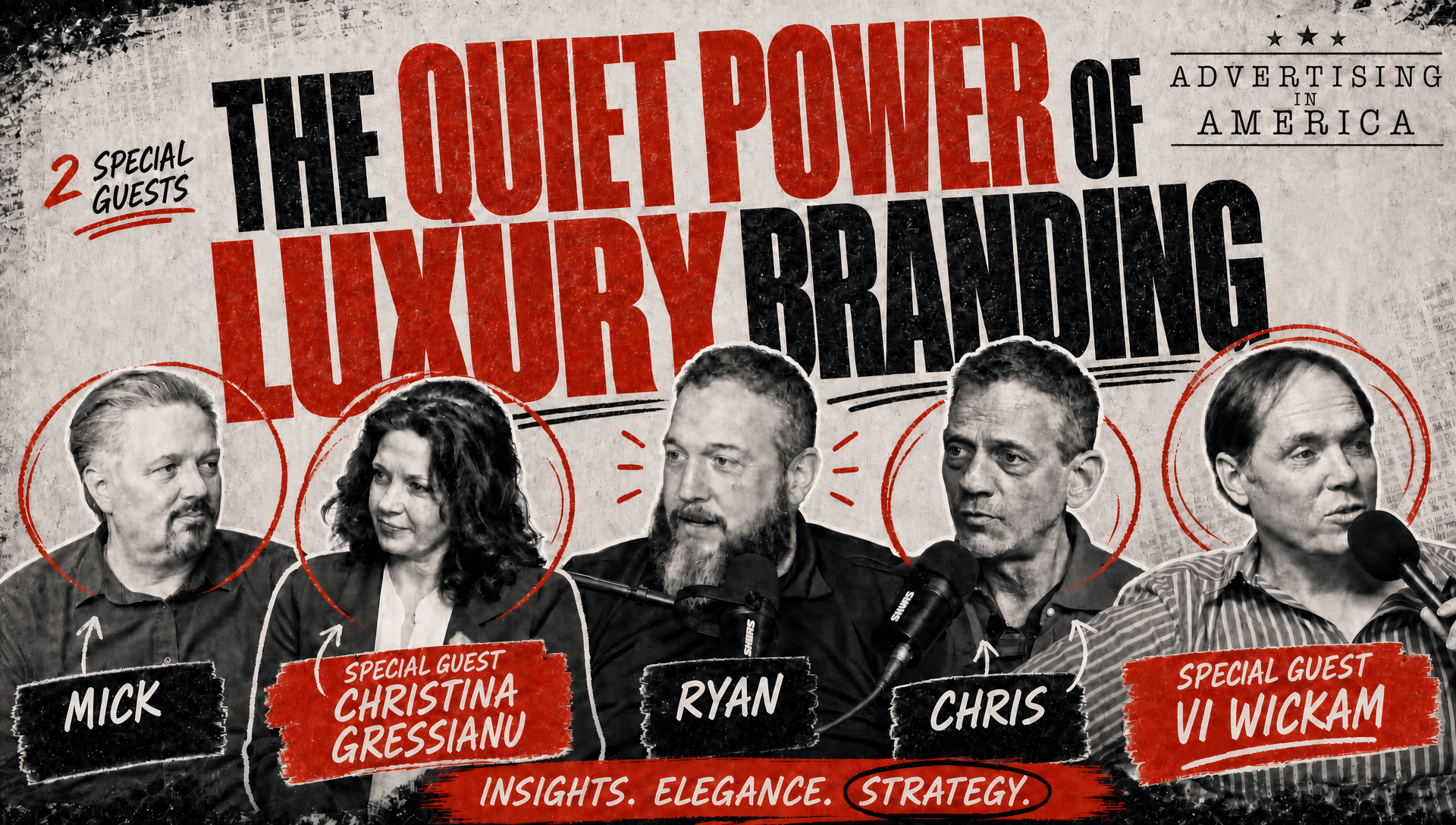
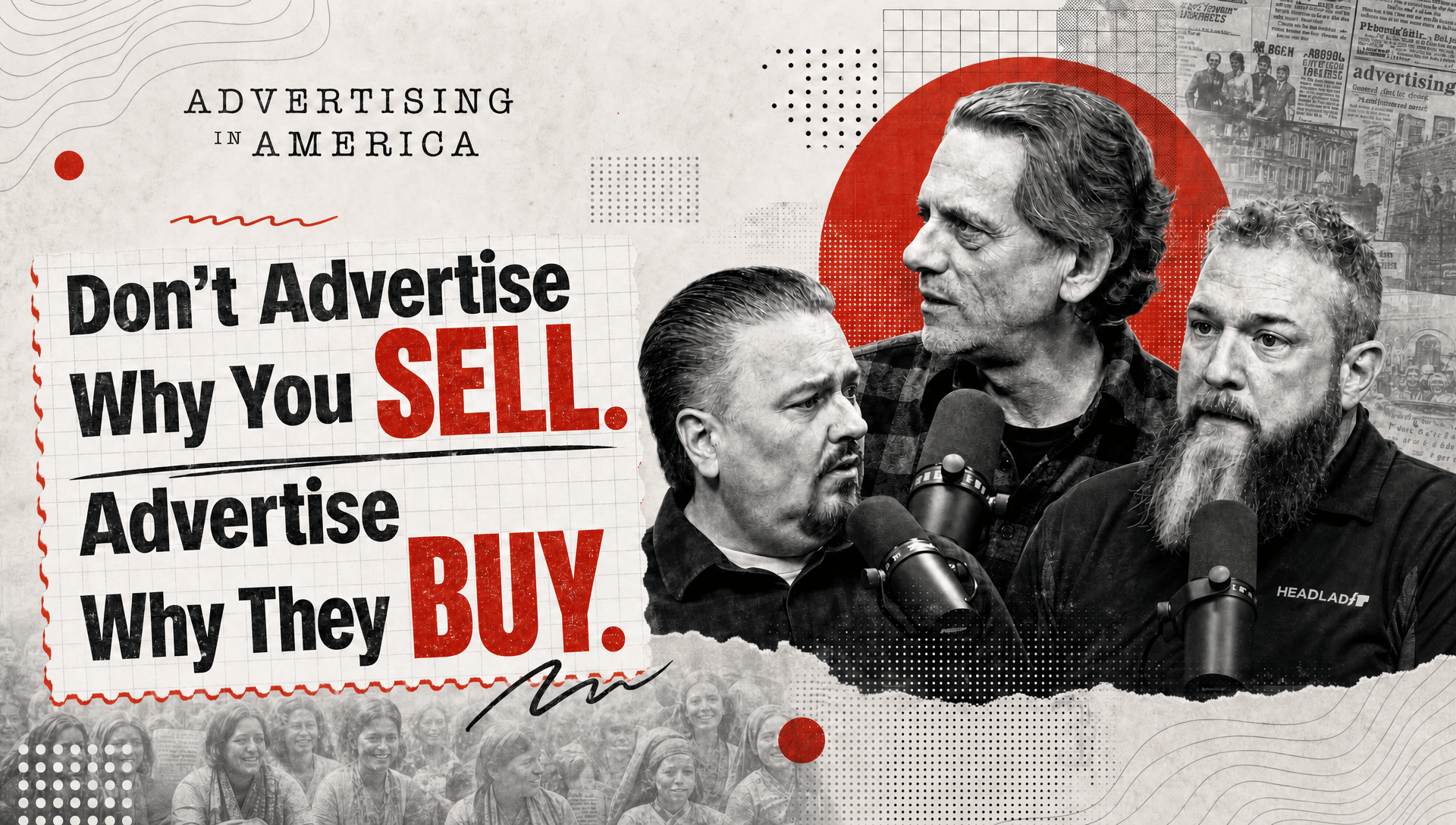
In Episode 26 of Advertising in America, Ryan Chute, Michael Torbay, Chris Torbay, Vi Wickam and Christina Gressianu unpack the real mechanics of luxury branding and why it’s nothing like the marketing most businesses are used to.
They break down the difference between internally and externally triggered purchases, explain why luxury brands must eliminate desperation at all costs, and reveal why the less you say, the more powerful your message becomes.
From $70,000 handbags to Rolexes, Lamborghinis, violins, Apple products, and even pancakes, this episode proves that luxury lives in feeling, not features.
Episode Highlights:
- Why luxury purchases are internally triggered and why that changes everything
- The emotional mechanics behind high-price, low-explanation branding
- Why great luxury brands never rush the sale
- How aspiration beats affluence in driving demand
- The difference between “premium” and truly “luxury” brands
- Why story, scarcity, and symbolism matter more than specs
- How to market a luxury experience without saying a word
🎧 Hit play and learn how to stop paying for attention that was never real.
📱 Subscribe wherever you get your podcasts
💥 Brought to you by Wizard of Ads for Essential Services
Welcome to another episode of Advertising in America, where today we'll be talking about luxury branding.
The first part of luxury market is a incredible product.
I'm sure that line of “our customers don't watch television.” That is a marketing line that is about identity. “I'm so cool. I don't watch television.”
So fancy. I'm so rich. I have the cast of Ted Lasso come over to my house and act everything out for me in my living room.
That's right. “I drive a Lamborghini, asshole. I'm not one of those television watching idiots.”
A $70,000 handbag breaks my damn brain. A $70,000 Now, it must have a lot of little pockets.
Like so many pockets When you're spending that kind of money. Does it have one to put your keys?
It could probably hold like 8,000 pounds of stuff.
Oh yeah. Even $10,000. It becomes varying degrees of conceivable as you become wealthier as well.
You can have an educated discernment where like, I can look at a handbag and say, “I don't know what brand that is, but that's an expensive handbag.”
Ryan Chute: Luxury branding is so much different than home services. Externally triggered grudge purchase versus internally driven identity purchase. There's different rules to the game when you start looking at different types of marketing and the things that you're trying to market. Today, we're joined by Vi Wickham and Christina Gressianu. Let's talk about luxury branding. Give us a rundown of what luxury branding is, and how it's different than the branding that we often are doing at Wizard of Ads with home services.
Christina Gressianu: Yeah, so home services branding, you're usually addressing of a pain, a need. There's an immediacy. Luxury branding takes its time. There's no rush. There can't be a whiff of desperation. It's slow, and you're always just marketing a feeling. And because I buy a luxury good, I want to feel something, and I wanna be part of something.
So if you think about the perfume ads of the eighties, I love to think about the perfume ads of the eighties, right? The obsession ads. What the hell were they? They were nothing. There was Kate Moss breathing hard, and the word obsession. That's it. But that's a feeling, right? Immediate.
Chris Torbay: And that's enough for me.
Christina Gressianu: Exactly. And it was enough for 30 million people to buy perfume, very expensive little bottles of water.
With luxury, you always, I feel like you always have to take a breath. And slow down, and you can be like, “Oh, okay. Luxury.” Because that's that branding, that's, it's a deep intrinsic need for a feeling. And whatever you're selling, you have to have a reason for the price. Like it needs to be made well, it needs to have quality, and then why does that quality matter? What am I going to feel when I hold a well-made handbag? What am I going to feel when I wear a suit that fits me perfectly? What am I going to feel when I buy a suit that is going to last me forever? What am I going to feel when I buy a Patek Philippe watch and I hand it down to my children?
That's why Patek Philippe is all about how you're buying it for the, you're just holding onto it for the future generation. But there's that feeling of this is an important part of my legacy. It's not a watch, it's not for telling time.
So luxury branding always has to come from this perspective of a long game and a feeling. What is the feeling that we can promise?
Chris Torbay: That's interesting because of the number of times we talk about how a lot of these projects are long purchase cycle products. And that, no, it's not like Doritos or beer, where the person is going to be peckish within the next couple of hours. You're going to be thirsty by the end of the day.
Vi Wickam: Do you have chips?
Chris Torbay: Like now? Do I have any? It is 4:20 stuffed into my pockets, and we try to tell those people, we have to remind those people that, no, you can't just run an ad for an air conditioner or run an ad for a, for an engagement ring, and the people are going to come in.
You've got to wait. You've got to build that brand recognition and then wait for that person to need a new water heater, or you've got ot wait for that person to fall in love and want to get engaged to somebody. And this sounds like it's even more of that if you thought that was a long purchase cycle. You have to earn that position in people's minds as the kind of handbag that I would really love to be seen with. And also then wait for them to get to a point where they can invest in that kind of thing. It's an even longer long game.
Ryan Chute: So is it about class and rank within the various communities that we're speaking to? Both, I suppose inside of ourselves, our self-worth, our value,
Vi Wickam: Identity.
Ryan Chute: Identity of those that are your closest loved ones, and then those of the greater tribes that you're trying to impress.
Christina Gressianu: It might be, but I also, when you say class and rank, it feels very high. But, American Girl dolls, right? I buy my child an American Girl doll so that they know I love them. Because an American Girl doll is like a stupidly expensive doll. But people flocked to buy them because it is how I demonstrate my love, right? So it's that feeling of what better way to show my child that I love them. There's lots of fun luxury brands that escape me right now, but when you guys talk, I'll remember one. There are fun luxury brands that capitalize on the fun of it. Virgin Airlines, right? They're not snooty. They're not highbrow. They're very like, fun. We're a fun airline.
Chris Torbay: Yeah, and they're spending a little bit more to, to fly on an airline that's going to have that little bit of fun.
Mick Torbay: I bet you the Disney Cruise Lines are not inexpensive.
Chris Torbay: No, exactly.
Christina Gressianu: And that's also like Disney World. Go take your family to Disney World. It's incredibly expensive.
Mick Torbay: Yeah. Not highbrow. But expensive.
Vi Wickam: Expensive.
Christina Gressianu: And fun and beautifully orchestrated. Again, the quality is there, right? You will never see a piece of trash in Disney World on the ground, right? You're never they've like mathematically figured out how far a trash can should be, and then, gosh, if anybody drops something, there is someone right there to pick it up. It is magical. They aren't kidding when they say it's magical. They have underground tunnels so that the cast members are never seen tired or sad or having to pee or hungry, right? Like it is all orchestrated from when they open to when they close. Every moment that you spend in Disney World is orchestrated for that magical experience, and you pay for it.
Mick Torbay: You glossed over something, which I think we should probably cover, because as advertising people, I think we're very familiar with these terms, but I think it's good to define them. Talking about internal triggers versus external triggers. Because normally on this program we're talking to, in a lot of cases, home services, and those are always an externally triggered purchase, which means something else has to happen outside of us to put us in the market to buy. So the best example of this is roofing. When your roof leaks, guess what? I'm in the market to buy a new roof or to get my existing roof repaired. It wasn't my idea.
I didn't want to do it, but if there's water flowing into my home from the top, I am now in the market to purchase roofing repair today.
With an internal trigger, which is what we're talking about when we're talking about any kind of luxury good. By definition, it's an internal trigger, which means it's not that someone else puts me into the market to buy it. I have to get there on my own. And when this is Advertising in America, so when we're talking about the advertising to an internal trigger versus an external trigger, with an external trigger advertising message, we only have to do one thing: The consumer is in the market to buy now. And all we have to do is say, choose my brand, or choose the brand that my client who pays me would like you to choose. So there's only one thing we need to do. Choose my brand.
When it's luxury, because it's an internal trigger, I have to do three things in the same ad. I have to make them want to buy, I have to put them in the market. Go from, I don't wanna buy to, I do wanna buy.
Chris Torbay: You should have a really nice watch.
Mick Torbay: Then I have to take them from that to, and you should buy that watch today, and you should buy that watch from the brand- from my brand. There's three things we have to do in marketing in luxury, and in an externally triggered, we only have to do one. It's a lot harder.
Christina Gressianu: Except that I would say, don't do any of those in a luxury ad. Don't do any of that.
Mick Torbay: I guess I'm not talking about a specific commercial. What I'm talking about is that marketing has to do those things.
Chris Torbay: Those are the three steps that people have to get through in their mind.
Mick Torbay: In order to get to a point where we could do what marketing does, which is have a phone ring or a computer open a search to begin or a door to swing open where we can come up to a salesperson who might sell me something, those three conditions must be satisfied.
Vi Wickam: So here's an example of how that can be done without doing it. Which would be the Apple campaigns for the iPod, where you saw the people dancing, having a great time with the iPod headphones.
Chris Torbay: Just the silhouettes and the headphones.
Mick Torbay: Just enough to know what it was.
Vi Wickam: And you wanted to be that person. And it wasn't,
Mick Torbay: And you didn't need an iPod. When they invented the iPod, you did not need one.
Vi Wickam: No, absolutely. Nobody needed one. No. Nobody had one. It didn't exist. It was a new thing, and what they were selling was how to feel like you are in the in crowd and you're cool, and if you don't have this, all of a sudden you're an outsider, and you're not cool.
Mick Torbay: And that campaign put people in the market. Made them want to buy the product and made them want to buy the product now. So it, it did exactly all those three things.
Chris Torbay: Yeah. It didn't say them literally.
Mick Torbay: I'm not talking about when I say I'm not talking about copy, I'm talking about the campaign has to do that, and that's a perfect example. That campaign accomplished all three of those goals.
Ryan Chute: That’s the overarching story arc. Christina, how does that fit in the more implementation tactical side? Because it seems like there's a subtlety to it, but there's equally as much as we're removing desperation from it. We're thinking relationally in a fluently and abundantly rather than from a place of survival.
Christina Gressianu: Sure. Because. A luxury brand, part of the brand has to be stability. Trust has to almost be the baseline. So when Apple does their campaign for the iPod, they just should sell fun, right? To me, all those ads with people dancing with a white cord, they were just happy, fun. It was just fun. They were just selling fun.
Mick Torbay: You're selling the emotion.
Christina Gressianu: That's it. That's all those ads did. And if I wanted to have fun, “I need an iPod.”
Ryan Chute: Would it be so bold as to say the freedom of fun or the freedom to have fun?
Christina Gressianu: Sure.
Ryan Chute: Because it's a bit of an untethering,
Chris Torbay: But you sell the emotional destination rather than any of the practicality.
Mick Torbay: It wasn't features and benefits. That's for sure.
Chris Torbay: They didn't mention any feature. Every once in a while, they would say a thousand songs in your pock. Or something like that. There would be one line or something, but that of those 30 seconds. 29 seconds was, “Oh, I can see myself there. She's having a great time.”
Vi Wickam: That was a Zune ad you were talking about that had the thousands songs in your pocket. It was. That was the Microsoft Zune.
Mick Torbay: Nobody even knows what you're talking about right now.
Ryan Chute: What in the world is this?
Mick Torbay: No one's ever heard of what you just said. No one knows what that is.
Christina Gressianu: I have, sadly.
Mick Torbay: Yeah. You were the guy who bought the micro
Christina Gressianu: I bought a Zune. Yeah, I bought the creative, whatever it was called. Anyway. It's just I would say that they were just selling fun, and they had to, I don't know how long that campaign lasted, but it had to last long enough to take me through the three stages, to take myself through the three stages Mick talked about. The ad didn't do it. The ad lasted long enough for myself to do it.
Mick Torbay: It did the thing that was necessary for you to go there on your own.
Christina Gressianu: Yes.
Ryan Chute: One of the things that Lamborghini's CEO said is, we don't advertise Lamborghini on television ads because our customers don't watch television.
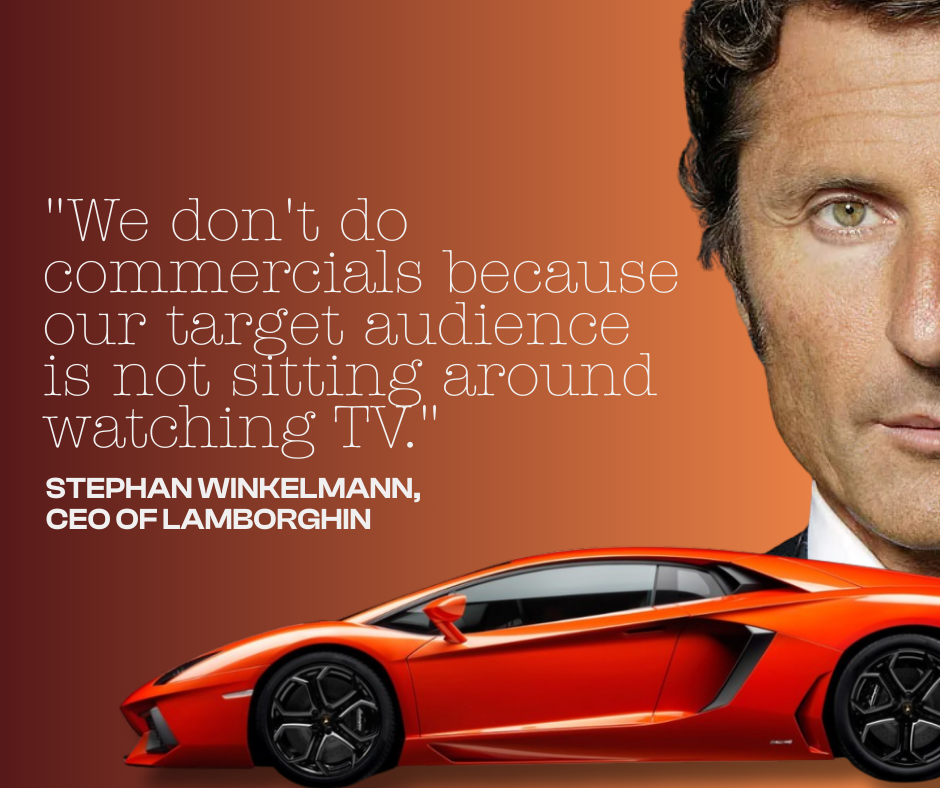
Mick Torbay: That's horse shit. That's because everyone watches television.
Christina Gressianu: Except that you're also influenced my opinion of a brand is influenced by the channel, by which I consume it. And so I would say, you don't see a lot of luxury brands advertise on television commercials.
You don't see Porsche or Lamborghini or Chanel in TV commercials. Not very often. You might see that Nordstrom might have a sale that features Chanel and a TV ad.
Mick Torbay: My guess though, is that's probably a self-aggrandizing statement. It's not that Porsche drivers don't watch TV. It's that there's just too much wastage.
When you're talking to people on TV, 95% of them can't afford to buy a Porsche, so why spend all your money doing that?
Chris Torbay: But frankly, all of the Lamborghini people do watch television course. They, the fact is, you don't know where they are. This used to happen when I worked on the Porsche business, and we used to buy this back when print ads were worth buying. When people used to get newspapers and magazines, we would buy magazines in Canada, in the Report on Business magazine. So the demographic of this magazine was bankers, lawyers, and high-net-worth individuals. And at that time, we knew that was 95% wastage. That even out of that audience, only 5% of those people had the capacity or the desire to spend $150,000 on a car that they only drove in the summer. But you still do it because you still have to reach them somewhere. There is no.
Christina Gressianu: But the brand is influenced by the channel.
Ryan Chute: So the emotional environment.
Christina Gressianu: So print ads still have that tactile, they feel fancy. And a print ad in Vogue.
Chris Torbay: Yes.
Christina Gressianu: Breitling has print ads in Vogue,
Chris Torbay: But they're very much like the obsession ad that you talked about. They're emotional and personal and artistic. And they just hit you with that. And they don't give you features and benefits.
Christina Gressianu: And it doesn't say like we tell the time, $999.95. Buy Breitling.
Chris Torbay: And the same thing with Ford's advertising. It was always, it was a headline that gets you right here about driving. And an awesome shot, and it's “Oh, I wanna be that guy right now.” And it's always been your boyhood dream. And so you just look at it, and it's not about features and benefits.
Ryan Chute: One of the more recent plays that we've seen Rolls-Royce and Porsche, Lamborghini, McLaren, some Bugatti, some of the higher-end companies do is start showing up at high-end yacht shows and boating shows, and high-end equestrian events. The places where the alignment is great, particularly in boats when you're looking at a mega yacht for a few hundred million dollars or you could just take the constellation prize of this $700,000 Lamborghini, all of a sudden people are buying Lamborghinis.
Christina Gressianu: Also, think about price anchoring. So if you put your $700,000 Lamborghini next to a $5 million boat, that Lamborghini looks so cheap now.
Ryan Chute: Emotional environment again, right?
Mick Torbay: Darn affordable. Absolute. Exactly.
Chris Torbay: It's not the money you spend, it's the money you save.
Christina Gressianu: It's money. If you walk into Costco, the first things are the gigantic TVs and the paddleboard, and next is the jewelry case, and the computers. And then do you want a giant bag of chips for $20? That's a very affordable choice.
Mick Torbay: But it's still easy. It's still about identity, and I'm sure that line of our customers don't watch television. That is a marketing line. That is about identity. “I'm so cool. I don't watch television. I'm so fancy.”
You know what, I have a funny feeling that if I saw a guy driving a Lamborghini today and I said, “Hey, have you ever heard of Seinfeld?” He wouldn't say. “No, I have no idea what you're talking about. TV. I drive a Lamborghini. I don't watch television.”
Chris Torbay: “I'm so rich. I have the cast of Ted Lasso come over to my house and act everything out for me in my living room.”
Mick Torbay: “That's right. I drive a Lamborghini, asshole. I'm not one of those television-watching idiots.”
Ryan Chute: That's right. I totally agreed. And it is absolutely in itself marketing. How does one position themselves when they are attached to the brand, the way that a person is?
Mick Torbay: It's identity. I'm so fancy. I'm so cool.
Ryan Chute: F1 in Monaco is very different than the Grand Prix in Montreal or Talladega.
Vi Wickam: Definitely different from Talladega.
Ryan Chute: Talladega for some drag racing.
Christina Gressianu: Wow. I'm really surrounded by men because you guys talk about cars a lot.
Ryan Chute: We do.
Mick Torbay: Yeah. They're expensive, and we're talking about luxury things. Aren't those the only luxury things? Cars? Prove me wrong.
Christina Gressianu: A $70,000 Hermès is relatively cheap then in the world of cars and boats.
But a $70,000 handbag is still something.
Ryan Chute: A $70,000 handbag breaks my damn brain.
Mick Torbay: A $70,000. Now it must have a lot of like little pockets.
Ryan Chute: So many pockets.
Mick Torbay: When you're spending that kind of money.
Chris Torbay: Does it have one to put your keys?
Mick Torbay: It could probably hold like 8,000 pounds of stuff.
Ryan Chute: See, this is an interesting component because women certainly of affluence can buy their own bags, but there's an awful lot of men out there who are the provider in the family and are the ones who of means, and looking at what do I buy my wife that is luxury?
Mick Torbay: Something worth $70,000 that she can put her phone in.
Ryan Chute: Even $10,000 or $15,000. Which it becomes varying degrees of conceivable as you become wealthier as well.
Vi Wickam: Clearly, your brain is broken right now.
Christina Gressianu: What are you asking me right now?
Mick Torbay: He's having a hard time processing the existence of this product.
Ryan Chute: What I guess I'm wondering is from both a luxury branding expert and a female perspective, how does a luxury brand go about convincing the man to buy Hermès for his wife?
Christina Gressianu: I don't like where you're going with this question.
Ryan Chute: Tell me more.
Christina Gressianu: Because you're making assumptions about where people are getting their money and how they're spending it.
Ryan Chute: Let's just make me a person.
Christina Gressianu: That’s hard.
Ryan Chute: So I'm trying to buy my wife a birthday.
Mick Torbay: Cruel, but fair.
Ryan Chute: Step well outside of reality for a moment and pretend I'm a person.
Mick Torbay: Let’s pretend he was human. It's a hypothetical.
Ryan Chute: And I want to buy my wife a really nice luxury bag for Christmas or her birthday.
Mick Torbay: You are going to buy the wrong one. I guarantee it.
Chris Torbay: The marketing is probably still to her, and she needs to communicate that to you. I don't know if a lot of these brands would bother marketing to the man.
Christina Gressianu: And in fact, I've worked with brands who are like, “We've been marketing to men.” It's a women's brand, a luxury women's brand. “We've been marketing to men, and we've reached a ceiling.”
And I said, yeah, that's because 75% of dollars are spent by women. Some such number. Don't quote me on that.
Chris Torbay: I also wonder if we're getting ourselves into a corner here because, and it's true a lot of the time, especially if you're going to talk about Lamborghinis and things, but a lot of times luxury goods are bought by people who are of regular means, like a lot. So I don't know about $70,000 handbags, but somebody will go and spend $1,500 on a Coach handbag, and she's just out of university or whatever, like first job,
Vi Wickam: She totally can't afford it.
Chris Torbay: But she will have one bag that she wants to buy, or the other one that gets me is Apple products like iPhones. I mean that company markets as if they are the elite brand. We all know that they charge twice as much for everything that you can get in many of their competitors' phones. But it's the Apple one, and we are the good one. And it sounds like it's positioned at the, as this elite level and half of the population has an Apple, has an iPhone, it's their treat. It's the thing. And they will invest in it, and it's their little luxury. And they don't have to be wealthy people to do it. They will spend. They will save up for it for the identity thing that it provides.
Christina Gressianu: People choose their lane. And I will choose my lane based on my priorities. So I might buy an Apple phone, and I might buy an Hermès handbag, and then I'll go to Target and buy socks and underwear. Or I buy socks and underwear from Agent Provocateur, and then I buy a Target handbag.
People choose their lanes now. So why are you buying your wife a Hermès handbag? Because she wants one, and you love her. That's it.
Mick Torbay: I can actually prove that she's right about that because it's probably almost always a dude who buys an engagement ring, and yet they don't advertise women's engagement rings in to men. They're in Vogue. They're in things specifically targeted to women. Why? Because she's going to pick the ring she wants, and she's going to somehow magically let you know what it is that she wants, and then you are going to buy that. They wouldn't bother telling us what we should buy. They have a conversation among the women.
Ryan Chute: Because we would get it wrong
Mick Torbay: Because we would get it wrong.
Chris Torbay: I agree with that.
Mick Torbay: We’d get the wrong bag. We’d get the wrong ring. We're dumb. We're not that bright.
Ryan Chute: We'd get the wrong color, the wrong shape, the wrong size.
Mick Torbay: Women make these decisions on their own. They don't need our help.
Vi Wickam: Nailed it, Mick.
Mick Torbay: Sorry, ladies. I'm married already,
Chris Torbay: But he is a good catch.
Ryan Chute: Yes.
Mick Torbay: Ryan won't be married pretty soon, actually.
Ryan Chute: No, it's true.
Christina Gressianu: I'll take him to Hermès.
Ryan Chute: Yesterday was Ashley's birthday, and she got an Hermès bag. But she got it on my birthday because I was away.
Mick Torbay: You got it for her, for your birthday.
Ryan Chute: That's the only present that was given that day, which was a present to her from me, which was funny. It was good.
Mick Torbay: And then Ryan cried himself to sleep, moving on.
Ryan Chute: She absolutely did pick it out. She picked up the color. She sent me the link, and it's and she made a very gentle and an indescript subtle suggestion that this.
Mick Torbay: Of a link directly to the product.
Ryan Chute: Of this being a great birthday present.
Chris Torbay: Especially if you expect to stay married to me.
Vi Wickam: This would be a great birthday present.
Chris Torbay: You might want my, this exact thing right here.
Ryan Chute: So it's all just very confusing to me. As one navigates the world.
Mick Torbay: Digging myself out of this hole?
Ryan Chute: Not at all. Ashley will literally watch this, but she won't because she doesn't watch this stuff.
Mick Torbay: With her face firmly in her palm.
Ryan Chute: That's right. And she'll make fun of me.
Christina Gressianu: Here's the thing, right? A Lamborghini made you all feel something. I don't care what, it made you feel something. An Hermès handbag does that for a woman. That's all you need to know.
Mick Torbay: And it's just as arbitrary. But it's the feeling that matters. It's not the thing,
Vi Wickam: The feeling is the thing.
Mick Torbay: The feeling is the thing that you’re buying
Ryan Chute: Is it symbolic both for me, the giver and her, the receiver? Is it symbolic for her in her lot in life, in where she perceives herself in her identity?
Mick Torbay: All of these things are symbols. Forgive me.
Christina Gressianu: All of the above.
Mick Torbay: Like, even the Lamborghini is symbolic. Unless you are a professional race car driver, the Lamborghini is wrong for you. In every manor
Vi Wickam: When the guy's going five miles an hour down the road in downtown Toronto, in a Lamborghini.
Ryan Chute: Revving the engines, coming super noisy. It's funny. Symbolic. It's funny when you see them doing that in like downtown London, where they literally have to pay a fine the minute they cross a line just to rev the engine in front of someone to show off.
Chris Torbay: Or, yeah. Porsches are of course, the joke of that, right? Which is all these people who are, having driven Porsches on racetracks on track days, sometimes myself, and sometimes with a professional driver at the wheel, it's very weird then to see that 95% of the Porsches on the road are driven by people who will never take it to the racetrack, and never ring that sucker out to what it can actually do. But I guess, to one of your early points, the quality is there. We know you can do it, and that's how you would justify buying that car.
Mick Torbay: When someone says, “Why'd you buy that car?” It's got the 7,000-horsepower engine. It's got the traction control. It's all horse shot.
Chris Torbay: It corners way better because of the weight distribution. It's like you've never taken it to the racetrack.
Christina Gressianu: So you have to give people a story they can tell. And that's part of that identity, right? Is like I sold my company and I sold this company that I built from when I was a 20-year-old, whatever, and to celebrate, I bought myself an Hermes bag.
Right? There's a story there. A lot of times in times of transition, people need to mark that transition with something that means something, right? When you have climbed your Everest, you will find your Rolex, right? Like that. That time, that moment of transition is beautifully marked with something that is just outside of your normal attainment.
Ryan Chute: So aspiration is. As important as a fluence in this,
Christina Gressianu: I would say aspiration is probably more important. Definitely.
Chris Torbay: And that's where I was going is that there's lots of people who aspire to these things, and many of them they can get, if they prioritize, if they save a little money on socks and underwear, they can spend a little more money.
Ryan Chute: They sell their house.
Chris Torbay: It's going to make them feel good.
Mick Torbay: And you said transition, and it's all transition, but in a sense, also transformation. It's changing who you are.
Ryan Chute: And how you’re leveling up.
Christina Gressianu: Yeah, it's leveling up. You're marking a transition with this thing that transforms how you feel about yourself, or transforms how you feel about your life, or transforms how you feel about driving or whatever.
Ryan Chute: So speaking of transformation, let's shift the conversation over to ways of marketing luxury items.
Ryan Chute: One of the things I think about is Virginia Postrel’s book called “The Power of Glamour”, if I remember correctly. And one of the things she talks about is black and white photos. And one of the other things that she talks about is faces that are away from the camera so that you can't see the person. Roy talks about silhouettes because it allows us to inject ourselves into those roles, those opportunities, those aspirations. What are other ways that we could tactically deploy luxury-level marketing tactics?
Christina Gressianu: This is not what you're asking me, but I'm going to say it anyway. The first part of luxury market is an incredible product. I like to tell a story about how I bought a tube of hair product at a garage sale.
I spent 50 cents on a half-used tube of a hair product, and I got it home, and it was amazing. It was amazing. And I looked online, and it was a $50 tube, which is not a cheap hair product. I buy it from the website, full price, every time I need it now. So the first thing that they did was have an amazing product.
So you can't just slap an expensive price tag on a regular product and call it luxury. That being said, the question you're asking is that when you're selling a feeling, you do, you have to make it easy for me to put myself into that scene, into that car, into that family, into that iPod. Which is why the silhouettes just have the white cord, which is why black and white works, which is why we turn our eyes away because if I don't see the eyes, I can put myself into that. If you close your eyes, you cease to be an individual, and then you are a representative of whoever.
And so anyway, you can do that. A lot of times, like the Patek Philippe ads are just people, but they're engaged, they're not camera aware. And so then it, that could be me and my family.
Chris Torbay: Y And when you talk about that line about how you it, you never own one, or you just look after it for a while. It's always a father and son. It's that could be me then if I have it and pass it on to one of my kids.
Mick Torbay: What is it about black and white photography?
Christina Gressianu: It's not real. It's completely imaginary. We never open our eyes and see the world in black and white.
Mick Torbay: So it feels symbolic. It feels symbolic, rather than a representation of reality.
Chris Torbay: That you have to fill in some details anyway. So you might as well fill in those details to include you.
Christina Gressianu: You have to fill in the color with your mind, so you are already halfway into it. But, I think because it's not real, it's so not real. It just sucks us in.
Mick Torbay: So if I'm hearing you correctly, what you're saying is we cannot trick consumers into believing that a product is a luxury product simply by marketing, or by price?
Christina Gressianu: No, because a luxury brand has to walk their talk, like you're scrutinized. If Louis Vuitton is suddenly, they'll be caught if they're suddenly like using pleather and calling it leather, right? If they say they're using vegan leather and they have a beautiful story about why, then they can justify their price.
But integrity, honesty, and truth to their core and to their values is so integral to a legacy brand because I have to be able to tell this story to myself one, and also because I need a lot more than a handbag when I'm spending this much money, I need the whole story.
Ryan Chute: A friend of mine Nick, has spent the last 10 years trying to figure out how to make the most beautiful Napoli pizza. And he's finally sourced the perfect dough, and he's got the tomatoes from Italy in a can.
Mick Torbay: He’s going to spend the next two years working on cheese.
Chris Torbay: We’ve got to send him a cow.
Ryan Chute: He makes the cheese.
Mick Torbay: Of course he does.
Ryan Chute: And he orders the ingredients in from Europe.
Mick Torbay: And he charges $7,000 for a pizza.
Ryan Chute: No, this is just he literally has spent, like probably $7,000 to buy this stone pizza thing for his backyard. He just does it for his family. But he has an obsession with the experience of finding this, and it's the luxury of pizza, but it seemed like it was very much. As much experiential as it was…
Mick Torbay: It was like the journey was half, half the fun.
Ryan Chute: It was half the fun because there's a story to be told about how he got there. And the pizza's exquisite, by the way. It's just absolutely extraordinary. And the thing cooks in two minutes because the stones heat up.
Vi Wickam: He loves that water buffalo himself.
Mick Torbay: That's right.
Chris Torbay: Does he do a Hawaiian pizza?
Mick Torbay: He milks that beaver himself.
Ryan Chute: Beaver. Picks the pineapples.
Christina Gressianu: So I think it's a video, but now I don't remember exactly, but somebody told the Midjourney robot to make a picture of a $5 pancake, and it's the way you'd see it in a diner. Pancake plate syrup, diner.
Make a hundred dollars pancake fancier pancake looks like it's got whipped cream and berries on it, and the setting is fancier.
Make a billion dollar pancake. It's a giant stack of pancakes with dollar signs on it. And I don't know where you are, but the setting is ridiculous.
But then it's, he told it to make a priceless pancake. Now the priceless pancake is served by mom in a kitchen with the sunlight coming through the window. And that's what we're doing with luxury branding. We are not gussying up the details necessarily. We are selling the feeling of home. We're selling the feeling of love of mom, taking care of you, of whatever that is. That's the heart of luxury.
Ryan Chute: That's a powerful statement right there. That is extraordinary. Because you can put an awful lot of stuff in a wrapper. We went to a very nice restaurant last night, and it was exquisite to be in and be around. and in its own charming way. You go to other places, and you're spending $20 or $30 for a cocktail, let alone hundreds of dollars for a steak. And is the stake any better? Probably. There's some quality of goods there, but it's not discernibly different. It's like you can notice a difference, but it's not all of that you're paying for. It's where you're sitting and the cocktails that they're making for you to have, the conversations that you're having with the people in that environment and that experience, experiences that you can hang onto for generations and certainly decades.
Mick Torbay: It was about how you felt while you were there in the surroundings. Looking around. The food was, you don't want to say incidental, but perhaps not the only thing,
Chris Torbay: Like a lot of things, and we've talked about this in terms of video production, and we've talked about it in terms of when you go from the cheapest and the simplest, and you add more money, it gets better, and you add more money, it gets better. And then there's a point where you got ot really add money to make it noticeably better. Again, there's an increase. And it's like the, and I hate to come back to cars, no, he doesn't. It's like you simply get from me cars, to good cars, to really good cars. And then once you get past the Porsche thing, and you'll need to get into the Ferraris and the McLarens and the Bugattis, it's like you got to triple the price. You're into the millions of dollars now to be four miles an hour faster than the Ferrari or the Porsche.
Christina Gressianu: But does that four miles an hour even really matter?
Mick Torbay: No.
Chris Torbay: But I guess what happens then is it does, that's when it goes to the story. I want to be the Bugatti guy.
Mick Torbay: Is that what you're buying though? Because these assholes don't drive the cars anyway. They line them up in the garage.
Chris Torbay: Like in handbags, there's the target handbags, and then there's the Nordstrom handbags, and then there's the Coach handbags, which are better than that. But then what is the quality difference from a Coach handbag to the $70,000? Like, from when you need to go from a $1,500 bag to a $15,000 to a $70,000? Boy, the quality doesn't really change much. Now it really is the story, the emotion, the positioning, the umbrella, the halo effect of what you're under. You're right. In all of those cases, any, anything over the, anything more than a Bloomingdale's handbag has to have quality.
Ryan Chute: So quality becomes less of a factor at the luxury point.
Chris Torbay: The quality increase doesn't follow the same curve as the price increase. They are awesomely made bags once we get over a thousand bucks
Ryan Chute: Then it bakes into rarity and vintage. Depending on the brand.
Chris Torbay: And just the story of saying, I'm the one. Yeah, exactly.
Vi Wickam: Only five or X.
Chris Torbay: It's a numbered series. It was signed by Isaac Mizrahi.
Christina Gressianu: Scarcity and rarity tie into the story.
Chris Torbay: And then the story that you build around it, is it good?
Mick Torbay: And it does have to be better. Like a $70,000 bag is better than a $15,000 bag. But that's not the only reason why you're spending the $70,000.
Vi Wickam: And we can talk about violins, too.
Mick Torbay: Oh, we should have!
Ryan Chute: That's interesting. An interesting topic, Vi, of course, is a world-famous violinist and has had the pleasure of touching some of the more expensive violins in the world. I don't know how expensive.
Mick Torbay: And then people ask them to stop touching them.
Ryan Chute: Then there's, “Sir, you're going to have to leave now.”
Mick Torbay: “Please put it back in its case.”
Ryan Chute: How does it work in the musical world where you have such a unique ecosystem of instruments? How does luxury play out in that space?
Vi Wickam: Wow. So there is a lot in the violin world, particularly where I'm most familiar, there's a lot to the provenance of a violin. The history and the documentation and all of that. But when it comes to as a musician, what you really care about is how does it play? How does it sound? And I will be the first to say that between, if you go from zero to $10,000, there's a major difference in quality. So a $500 violin is generally garbage. And by the time you get to $10,000, you have a pretty good violin, if you buy well. If you don't buy well, you could also have a $10,000 piece of garbage.
But between $10,000 and a $100,00 dollars, you may find a $100,000 violin that doesn't play substantially better than that really nice $10,000 violin. But it may be made by a famous maker. There may be a better story to it. And such is as it is. But once you get over a $100,000, then you get a lot of uniqueness. You get instruments that are either terrible instruments made by really fancy makers.
You know this was a Jean Baptiste Vuillaume, which a good one, is $350,000, but his garbage one is one is $120,000. His worst violin that he made, I've played a Vuillaume that was $450,00 and was amazing, and I played one that was $120,00 that I would've taken my violin, that's worth $20,00 over it in a heartbeat.
And I've played violins worth $750,000. I've not played any more valuable than that, and they're ones worth tens of millions.
Ryan Chute: You told me a story once of two violins that you played side by each, that were about the same price, if I recall.
Vi Wickam: Yes.
Ryan Chute: And they were profoundly different.
Vi Wickam: Profoundly different. So I played a [Lorenzo] Storioni, who is a relatively famous violin maker from 300 years ago or so. And a Guarneri, who is arguably, it was Pietro Guarneri, who's the brother of the most famous of that family. And the Guarneri sounded great, but was really hard to play. It took a lot of energy to get that sound out of it, and the Storioni was my violin, if I had a spare million dollars sitting around. I think when you're talking about luxury, whether it's handbags or violins, there's a certain amount of “I feel connected to this.” And for the, for me, on that violin, when I picked it up, and I started playing it, it was like I'd always had that violin. It had always been mine.
Mick Torbay: But again, that's still emotional. It's like this feels right.
Vi Wickam: It was right.
Christina Gressianu: That’s absolutely emotional. You can have an educated sort of discernment, right? Where like, I can look at a handbag and say, “I don't know what brand that is, but that's an expensive handbag.”
I can see from here that it's well-made. Vi and I will talk all the time about, “Why do you know that's well made?” And then I'll have to think, is it the stitching? I can tell the material. I can just look at it until it's quality material. Like, I know what it feels like just by looking at it. There's discernment, but then there's just the emotion of, " I love it, and it makes me feel…” Whatever feeling I'm after, it makes me feel affluent. It makes me feel educated, it makes me feel ritzy, whatever it makes me feel, I love it, and that's really what I'm buying.
Ryan Chute: Is there a difference between a premium product and a luxury product? In one, how would you market it? And we know that there's a quality difference, but a high-end BMW, for example, versus a Bugatti? Coach versus Hermès? Or is there a midpoint where people are trying to play the luxury game, but they're really not going to win? It's a fail.
Christina Gressianu: But probably, I feel like the more luxury you are, the less you say in your marketing, the less you have to say because you feel more.
Ryan Chute: You could just spit out superlatives and look mincing at a camera with no shirt on. Like I pointed at Mick because he was in a boy band.
Christina Gressianu: Were you a luxury boy band?
Mick Torbay: No, we were a garden variety. If you paid your ticket for the theme park, you got to see us once.
Ryan Chute: You've got to see Mick Torbay sing. We'll make sure to post a picture of that for you.
Mick Torbay: You won't be able to unsee it.
Ryan Chute: It is special.
Mick Torbay: I was wearing a dance belt.
Ryan Chute: An actual dance
Chris Torbay: On that note…
Mick Torbay: Speaking of my dance belt, sorry.
Christina Gressianu: Yes. So Cartier's marketing is different than whatever a premium look jewelry brand is.
Vi Wickam: Seko.
Christina Gressianu: That is not a premium.
Ryan Chute: Swatch
Mick Torbay: Omega. I mean Breitling. Breitling is a good example.
Christina Gressianu: Breitling, right? If you look at Breitling versus, you look at Cartier, Cartier says less,
Mick Torbay: And Patek Philippe says even less than that.
Ryan Chute: It's like, if you know, you know.
Christina Gressianu: There's a club, there's an insider, there's a discernment that you're privy to, right?
Mick Torbay: And you can't fake that. Can you?
Christina Gressianu: No.
Ryan Chute: Is some of this marketing driven through influencer marketing? Is influencer marketing powerful? I guess, what I'm asking in the luxury world?
Christina Gressianu: In the luxury world, I think they've been doing influencer marketing long before there were influencers. Wedgewood sent their China to the king and queen of England in the 1700s, right? That is influencer marketing before we had this term.
Ryan Chute: Dang, that's a great reference.
Christina Gressianu: Yes, that sort of placement is exactly how a luxury brand would market itself, find the fanciest person you could find that represents the person you're trying to represent, and see if they can be seen in public using your thing.
Mick Torbay: Send Jimi Hendrix a bunch of your guitars.
Christina Gressianu: Exactly.
Chris Torbay: It's worked for all the watches. The Breitling are, were worn by all the guys trying to break the altitude records.
Ryan Chute: SeaMasters and worn by James Bond or Aston Martins. Jimi Hendricks os dead.
Vi Wickam: He is absolutely dead.
Christina Gressianu: You try sending him guitars.
Chris Torbay: They'll just stack up. 100%.
Christina Gressianu: If you can get Jimi Hendrix to play your guitar now. That's pretty incredible.
Vi Wickam: You will win big time.
Ryan Chute: I would suspect that you would have a producer there.
Mick Torbay: 100% dead.
Ryan Chute: You'd have a product there too soon, right away.
Mick Torbay: We're joking about it. Too soon?
Ryan Chute: Listen, he's held in reverence.
Mick Torbay: We could just edit that out.
Ryan Chute: This is fascinating. I see the same thing in guitars. My friend Nick loves his guitars and has just extraordinary things hanging on his walls.
Mick Torbay: See if it's hanging on his walls, he's not playing it. If it's in a stand on the ground, that's something that's played.
Ryan Chute: Actually, you know what every single one of his wall-mounted guitars is designed to dismount and play immediately. All
Mick Torbay: But you know I’m right.
Ryan Chute: And he does regularly, because he has done it in front of me every time I've been there. And it's extraordinary. It's because it's usually just a display, and it's like untouchable, and no one touches it. Now I don't get to touch it. But I get to look at it.
Mick Torbay: You're a threat to yourself or others.
Ryan Chute: Yes. That's right. That's right. This has been a fascinating conversation. What I'd like to cap off with is a few takeaways for the audience, so they can if they're, if they have an extraordinary product or an extraordinary experience, then some of the best tactical things that they can do in luxury branding would be?
Christina Gressianu: I would say that if they're new and they have an extraordinary product or experience, it's to tell the story. Use the leadership team, use staff, use whomever you can to tell the story of quality, control, of sourcing, of sampling, of making, so show us how this is made. Show us why we should care about whatever. Building trust is the first step. And then from there, tell me how I'm going to feel when I have it.
Ryan Chute: Yeah. And show, not just tell.
Christina Gressianu: Show me how I'm going to feel when I have it.
Ryan Chute: Yeah. And insofar as you're telling them, but you're making a skit. A story, a physical, a vaudeville act. Vi’s Fairness. We're just
Vi Wickam: We’re a skit in here.
Chris Torbay: Hello! My Baby. Hello! My Honey. Hello. My ragtime gal!
Ryan Chute: There's something to be said about telling a person a story about a thing, and there's another thing to have a story.
Chris Torbay: Just show that emotion. It shows me where I will be emotionally. Yes.
Mick Torbay: Put me in that story.
Chris Torbay: You don't need to be literal. You just need to capture how I'm going to feel when I am part of that.
Ryan Chute: We could go on and on all day long. But alas, there are only so many hours in the day, and this one has come to a close. Thank you so much for watching Advertising in America. Thank you so much for our guests, Vi and Christina and our two general Rat beg, rap scallions. Mick and Chris.
Chris Torbay: I'm just happy to know that when I need to borrow a $70,000 handbag, I got a guy.
Christina Gressianu: No, you don't. I don't have one for you. I don't even have one for you to borrow.
Mick Torbay: I'm just glad that Ryan didn't try to say Christina's last name again.
Ryan Chute: Exactly. Grassy Noll. Grassy noll shoemaker. I know it now.
Thank you for joining us on Advertising in America. We hope you enjoyed the show and captured a nugget of marketing magic. Wanna hear more? Subscribe, leave a review and share this podcast with your friends. Do you have questions or topics you want us to cover?
Join us on our socials @advertisinginamerica. Want to spend your marketing budget better? Visit us at wizardofads.services to book your free strategy session with Wizard Ryan Chute today. Until next time, keep your ads enchanting and your audience captivated.
MARKETING & CAMPAIGN REFERENCES:
1993. Calvin Klein, Kate Moss "Obsessed": https://youtu.be/KsFHxUcMhLg?si=Ftq3CzGPXSh2fY4w
2004- 2008. Apple, iPod Campaign: https://www.youtube.com/watch?v=_dSgBsCVpqo
2001. Apple's first-generation iPod slogan, a Thousand Songs in Your Pocket: https://youtu.be/mM6InCC_ee0?si=rln7MPKO70_LTPDN
2017. The Power of Glamour, Virginia Postrel: https://www.amazon.ca/Power-Glamour-Longing-Visual-Persuasion/dp/1416561129
Patek Philippe: https://www.youtube.com/@PatekPhilippeGeneva
Ai Pancake Prompt Reaction Video: https://youtu.be/LHNtC7T0Tq4?si=lGt2B5FnHgzXxvBB
Jean-Baptiste Vuillaume: https://en.wikipedia.org/wiki/Jean-Baptiste_Vuillaume
Lorenzo Storioni: https://tarisio.com/cozio-archive/browse-the-archive/makers/maker/?Maker_ID=720
Pietro Guarneri of Venice: https://tarisio.com/cozio-archive/browse-the-archive/makers/maker/?Maker_ID=242
2025, Cartier, Understanding the synergy between Marketing and Sales: https://youtu.be/yI8ey5Oav4Q?si=Rhgz7_3vcrqKO1hf
1759, Wedgehood: https://www.wedgwood.com/en-ca/welcome-to-wedgwood/the-wedgwood-story
SeaMasters worn by James Bond: https://teddybaldassarre.com/en-ca/blogs/watches/james-bond-seamaster-1?srsltid=AfmBOoripQP9crKhfW44icH6JcR9ULWzLi7nFXuHEked3gI9DbEQNRaH

Advertising in America
The podcast that turns marketing into magic! Hosted by the brilliant Ryan Chute and the ever-entertaining Michael Torbay & Chris Torbay, this show dives deep into the world of American advertising, revealing the secrets behind the most successful campaigns and exploring the latest trends.
Share this:

%20(1).webp)
.webp)
.webp)
.webp)

.webp)


Nothing to see here!
Nothing to see here!