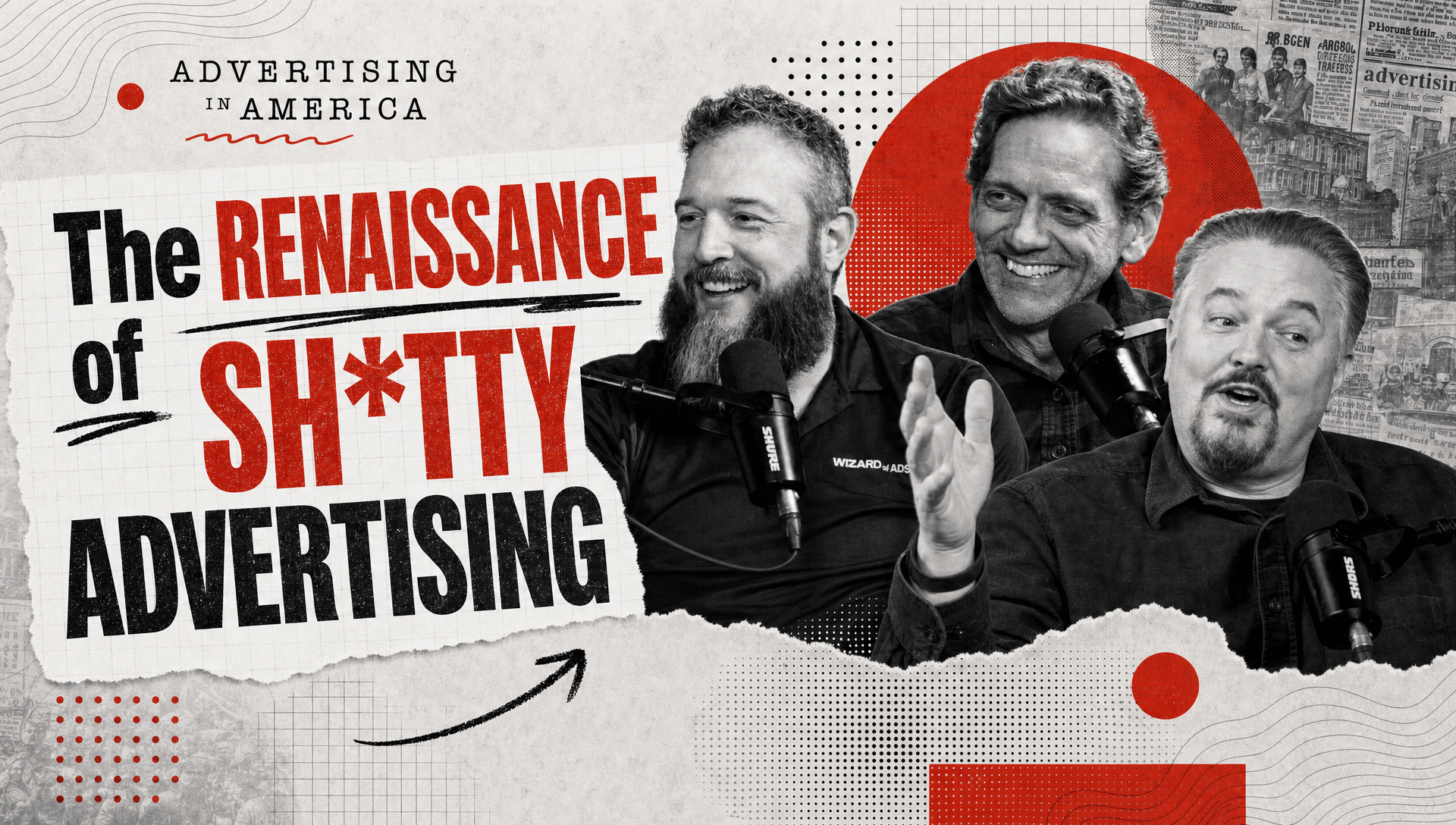
You don't jave an attention problem... you have an entitlement problem.
Most advertisers walk into the market like they’re the main act—expecting people to listen, care, and convert. The reality? You’re the interruption. And if you haven’t earned that attention, you’ve already lost it.
In this episode, the team dismantles the illusion that good products, polished branding, or bigger budgets automatically translate into results. From painfully generic HVAC commercials to bloated national campaigns, they expose the real issue: advertising that says everything and means nothing.
The conversation cuts deep into what actually works—earning attention through entertainment, holding it through storytelling, and delivering a single, memorable idea instead of a laundry list of features. Because the market isn’t ignoring you… you’re just not giving it a reason to care.
If you’re still relying on “quality, service, and low prices” to carry your message, this episode is your wake-up call.
Episode Highlights
- You Don’t Deserve Attention: Why assuming people are listening is the fastest way to be ignored.
- The Opening Act Reality: Your audience didn’t come for you—how to hijack attention and make them stay.
- The 50/50 Ad Trap: Start entertaining, then switch to selling—and watch your audience disappear.
- The One-Message Rule: Why cramming in features kills recall and guarantees failure.
- Earn It, Then Hold It: The critical difference between grabbing attention and sustaining interest.
- Campaigns That Compound: How consistency, characters, and storytelling build long-term loyalty.
- Emotion Beats Information: Why people don’t buy what you say—they buy how you make them feel.
- The Cost of Being Generic: If your ad could be for anyone, it will connect with no one.
🎧 Hit play to learn why attention isn’t given—it’s earned, fought for, and kept through craft. If your marketing feels invisible, this episode will show you exactly where it’s breaking down and how to fix it.
📱 Subscribe wherever you get your podcasts
💬 Are your ads actually earning attention… or just interrupting people and hoping they tolerate it?
💥 Brought to you by Wizard of Ads for Essential Services
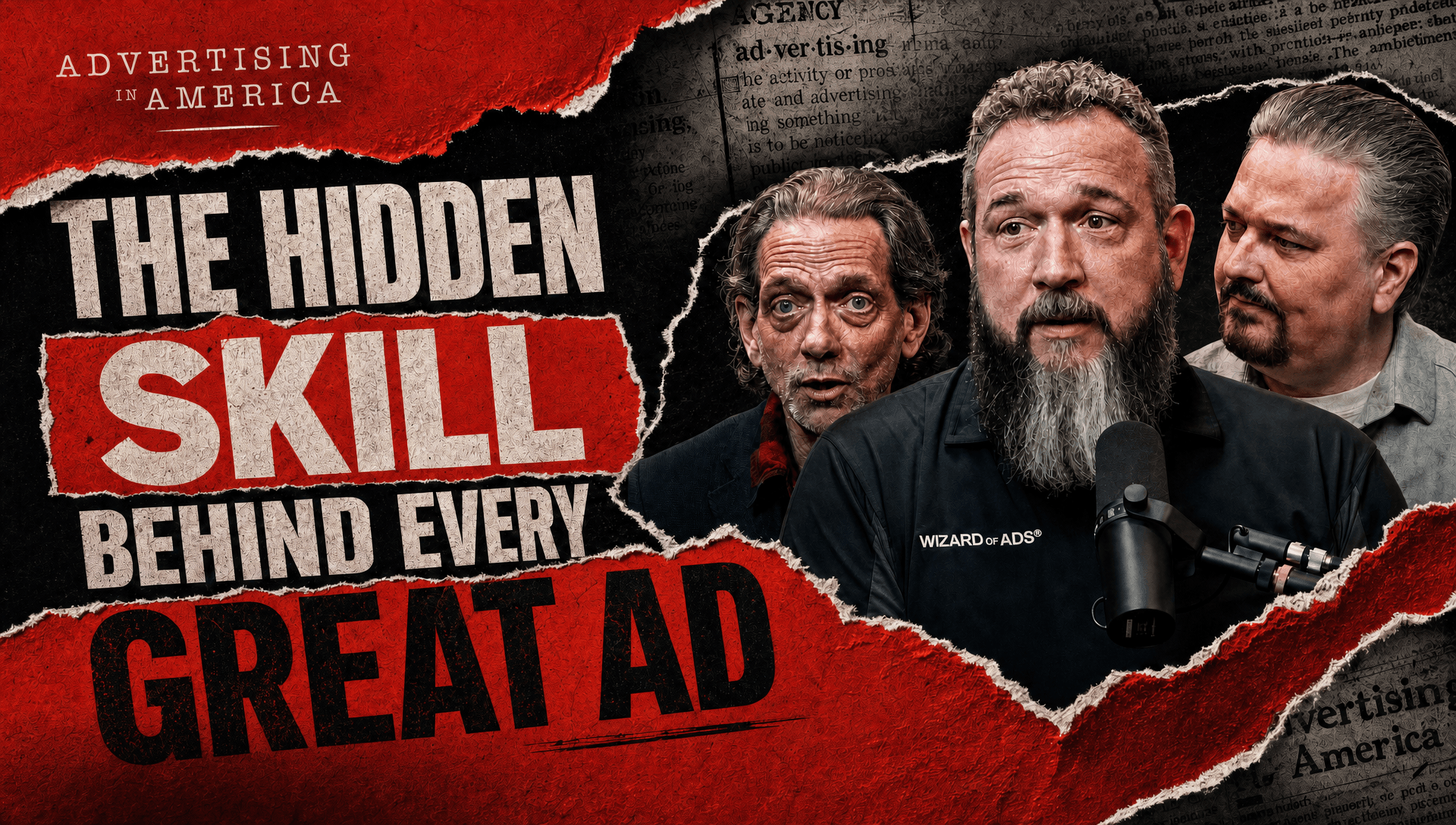
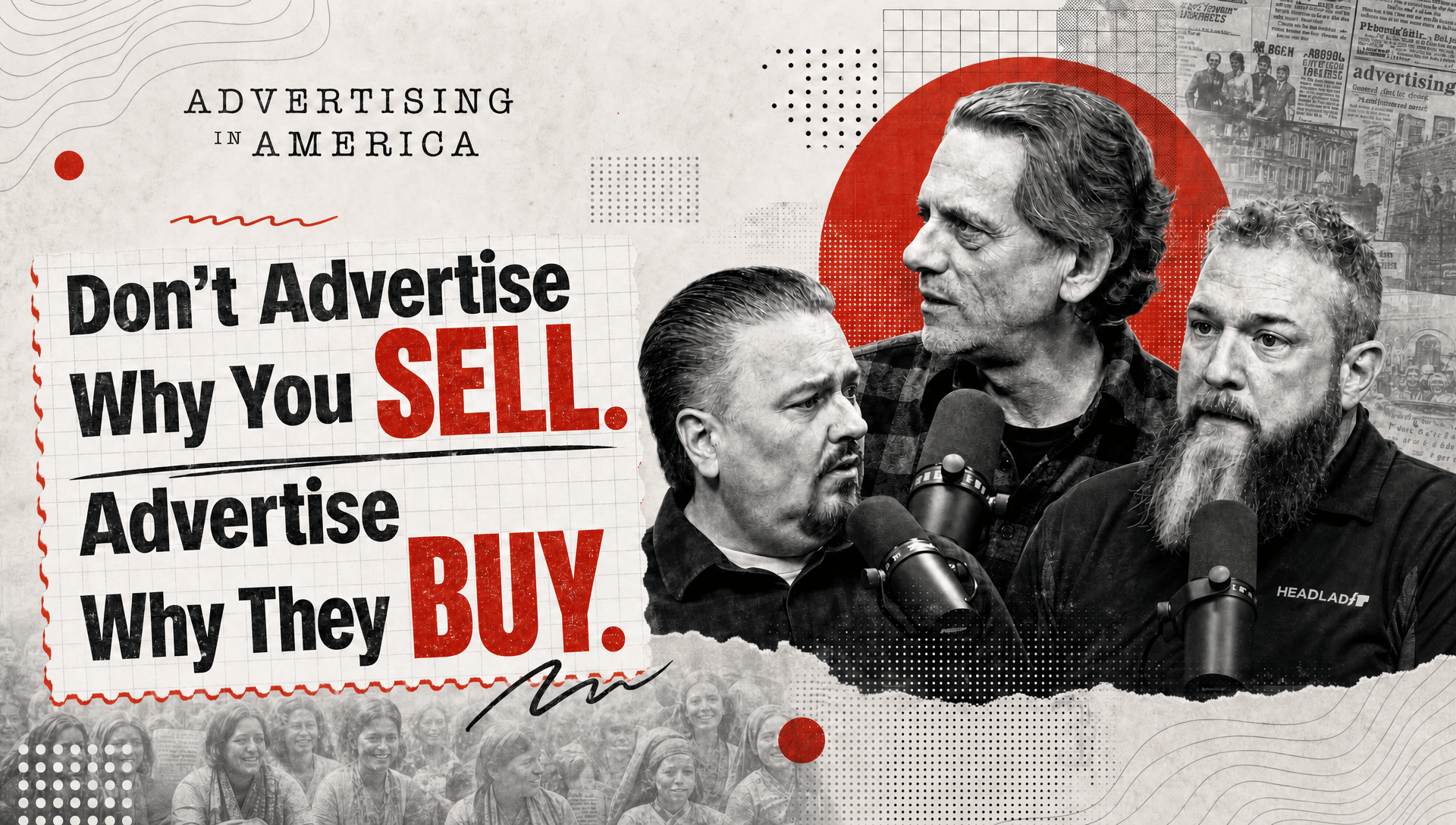
In today's episode of Advertising in America, we desperately want your attention. Like, seriously, do we matter to you? Don't you like our logo and brand colors? Aren't we the coolest three old dudes pontificating about how smart we are on a podcast in 2026?
In advertising, there is no such thing as if you build it, they will come. They won't.
When I watch TV or listen to the radio, I am constantly amazed at the mediocrity of the commercials, and it's not just from the small businesses, large brands, national brands are phoning it in as well.
If you talk about your company's quality, service, selection, low prices, free parking, and qualified staff who really care about your needs, I assure you no one is paying attention.
I think 2026 is a renaissance of shitty advertising. I don't think it's ever been this bad.
Ryan Chute: That's right. Attention. Do we deserve it? How do we get it? How do we earn it? And more importantly, how do we keep it and convert it into American currency that pays our mortgages? First, here's Mick to give us some tough love and a few choice swears. Mick.
Mick Torbay: The topic today is, do we deserve the audience's attention? No. Over to you, Chris. No, wait. I have some more cursing to do. When I watch TV or listen to the radio, I am constantly amazed at the mediocrity of the commercials, and it's not just from the small businesses, large brands, national brands are phoning it in as well, filling their ads with features and benefits based on the assumption that people are hanging on every word.
They're not. The people are there, but did you give them anything worth listening to? Last week I saw a TV ad for a heating and air conditioning company, and I pay attention to that stuff because I have a bunch of clients in that exact space. So I want to know what other people are doing in that category, and wouldn't you know it. It starts with a handsome actor, he is driving up at the truck and has shockingly clean fingernails. He comes to the door, and we see him putting on his cute little booties, close up on the booties. We respect your floors. Then a shot of the technician, pretending to use tools on the air conditioner, and then he polishes the compressor section clean with a nice clean cloth, and then the final handshake with the impossibly attractive homeowner. All the while, a voiceover is telling us about their commitment to quality, service, selection, price, and their professional staff who really care about your needs. Just canned rubbish. Could be for any HVAC company anywhere. And this was a national brand, not some mom-and-pop shop. These people should have known better. This is what I'm competing with. And man, is it ever easy to make something better than that?
Their mistake began before they even started writing. It was all, “Should we tell them this or should we focus on that?” with the assumption that people will be paying attention to whatever it is they decide to say? It's the perfect commercial for a bathroom break.
When you're making your ads, begin with this thought instead: Why should anyone watch this? What will make them want to stick around and watch the whole thing? What will they remember about this commercial? What about it is worth telling their friends at work around the water cooler tomorrow?
If you don't have solid answers to those questions, don't bother shooting it. It's going to be crap. It won't work, and you'll blame the TV station or the radio station for not having enough viewers. The problem isn't a lack of viewers, it's that you gave them nothing worth viewing.
When we make a commercial, there's an idea, and that idea is not interchangeable with any other company in the category. Frankly, any other category, for that matter. There's a story that began long ago, and this is the next chapter. We have characters that are interesting and unpredictable. You never know what he or she's going to say next, and there's some drama or comedy or fucking something to make you feel something. I wonder about the guy who wrote that HVAC ad I told you about? When it comes on the TV, does he say to everybody, “Shh, look, I, I wrote that, the closeup on the booties. That was my idea.” Take some pride in your work. If you wouldn't happily play that commercial for your entire extended family and expect to get a really enthusiastic response, then it's not good enough. Shame on you. You forgot the first rule of advertising. Say something worth listening to. You do not deserve the audience's attention. They are not your audience. They're someone else's audience. You're the opening act for a big stadium show. The seats are filled with an audience in the thousands, but no one came to see you. So your job is to deliver something that moves them, earns their attention, and entertains the living shit out of them. If you can do that, maybe they'll come back for more.
Ryan Chute: The funny thing is, they sell those exact same ads to multiple HVAC companies across America. Imagine thinking generic ads would actually help you sell more. So embarrassing. Turning our attention to mix older, much wiser, much more handsome brother Chris. What say you?
Chris Torbay: In advertising, there is no such thing as if you build it, they will come. They won't. No one cares. The Super Bowl ads aside, there is no advertising that people look forward to. No one owes you their attention. When you decide to write an ad, even better, create a campaign. The first question should be, how do we earn people's attention?
Maybe that should be the first three things we ask ourselves, like the real estate agents and their stupid location-location-location thing. How do we earn people's attention? No one owes you their attention. Hell, that's why Mick and I spend weeks crafting these profanity-laden rants for the top of every show.
No one particularly wants to listen to three guys yak about whatever. So we earn your listenership by researching and planning and crafting a brilliantly profane monologue about the topic of the week to draw you in, disrupt your preconceived notions and make you interested in the ongoing conversation that follows.
Just because three handsome, wise gentlemen have microphones doesn't mean people are going to listen to everything they record with them. The trouble is in marketing, the way we think about these things and work on these things means we always move past the part about earning people's attention and start talking about the content.
“We need to tell people that the all-new J2000 has a new defibrillator attachment with a 1.8 gigawatt flux capacitor that will really save people time and money. Let's put all that in.”
If that is a product your target is already passionate about, they might be eager to hear what you have to say. Tell a Porsche driver about a new gearbox design, and they're all ears. But tell a homeowner about a new breakthrough in air conditioner compressor motors, and they don't really give a shit. They just want the thing to work. And that, by the way, is the best-case scenario when you actually have something new and exciting to say. Most people fill their ads with messages that are not new and not exciting, and importantly, not differentiated, and expect people to take all that boring information in, not a chance.
If you talk about your company's quality, service, selection, low-low prices, free parking, and qualified staff who really care about your needs, just like every one of your competitors does in their ads, I assure you no one is paying attention. That's ad speak, and they tuned out as soon as they started hearing it.
The problem is you looked at all that stuff in the script and thought, “Great. Look at all the things our consumers are gonna learn about us.” They would have if you had earned their attention, but they aren't because you didn't. The weird part is this is a lesson no one ever seems to learn, and that includes the top of the advertising food chain. Big agencies working for big multinational clients. They get it wrong just as much with more money on the table. In the big agency world, people like to use focus groups mostly to cover their ass, but quite often to save themselves from having to actually think for themselves. “Let's ask a focus group if this is a good ad.”
A focus group, if you are unfamiliar, is when an agency and a research company get together and pay 12 people 75 bucks on a Thursday night to sit in a room with the agency and the client behind one-way glass and listen to the ad idea and tell you what they think. A moderator plays the ad and then asks a bunch of questions.
What did you think of the ad? What did it say about the new J2000 defibrillator? Would you recommend this product to your friends and family after what you just saw? These all seem like good questions, except you just paid people to watch the ad, and they paid damn good attention because you told them you were going to ask questions.
Hell, I've heard moderators start with, " Did this ad get your attention?” They're being fucking waterboarded with the ad. Of course, it got their attention. But all the intel you get out of those detainees is now bad data because you don't know if the ad met the most important criteria it was crafted to meet. Is it deserving of someone's attention?
Focus groups and marketing committee meetings, and pouring over the script, checking to see if all the stuff from the brief is in the script, will not answer the biggest question you need to ask when evaluating and approving the ad. Does this ad deserve the attention of our audience? Until it does, everything else in that script might as well be written in invisible ink.
Ryan Chute: It's so nice to see you pay such strict attention to the three-minute rant rule we uphold here so diligently. Reverend Bastards. When we return, we'll turn our attention to the finer points.
Ryan Chute: So the thing I'm most interested in is this thing about the table stakes.
Chris Torbay: Mick, you're a vegetarian. Tell us about steaks.
Mick Torbay: I think 2026 is a renaissance of shitty advertising. I don't think it's ever been this bad, and that is so good for us. Literally on our way, driving down in the car to the podcast today, I heard an ad, and I'll get some of the details wrong, but it basically said this, and this is for a national campaign. This is a coast-to-coast retailer. And they said I'm paraphrasing, but play along.
“We are asking people how they feel about how you can get triple the rewards points when you use your linked card to make purchases at any of these three retailers.” And then the person that they're talking to says, “That's a good idea. I think that's a pretty cool idea. I'm really excited about it.” “There you have it, folks. You can get triple the reward points when you use your linked card to get to use your reward miles to make purchases from these three retailers.”
And I'm like, God, that was like the brief, read, and then “we are asking people about the things on our clipboard that say we have to put these in the ads,” and then they say it again, this is what you guys have come up with.
Chris Torbay: And they sell it to the client by saying, “Here's the idea for the ad. It's like a man on the street thing. Like we're out asking people these things.” It's like you didn't actually get to any fun with a man in the street kind of scenario, which could be fun. And you could put jokes in there, and you could put entertainment in there because you had to do that huge intro with the very convoluted details of what it is that they're asking people about supposedly, and then repeated again at the end, you burned up 25 of your 30 seconds. In fact, the thing that is supposedly this scenario doesn't even get referred to.
Ryan Chute: It's the thing that we are taught when we were first being taught to write by Roy, and you write basically the four minutes of context out before you actually start writing the thing that matters. And then he says, take the lead that you buried and put it to the top. And they didn't, they just kept the context.
Chris Torbay: I think partly what it is that people get the ratio wrong of how much entertainment versus earns you how much content. And it goes back to my lifelong sort of rant, which is that people can remember one thing. They can normally remember one thing about a brand, I guess if you advertise enough, you enough advertising, you can do one thing per ad. But that's where Mick talks about those table stakes, there are seven boilerplate table stakes that people always refer to, right? The quality, service, selection, free parking, low prices, all that kind of stuff that you hear in every ad. That's too much content for how much entertainment you have. You need to flip it. You need to mostly just earn my attention. I was listening to the radio, I was listening to Taylor Swift, I was watching the football game, whatever I was doing. You have to earn my attention from that thing. And spend most of your effort doing that, and then give me one nugget that I can remember. That's the ratio.
Really make your advertising memorable and interesting, and something I can talk to the people at the water cooler about the next day. Spend most of your time making sure that happens. And then give me one nugget, which you can attach to that, and the problem is, I think most people flip that, and they go, “let's fill it full of stuff and put a joke at the end. Or let's do a gag opening and then dive into the strategy document.”
Ryan Chute: Open big and big. I liken it to sneaking it into the sauce. When you have a little kid, you don't want them to know that they're eating the broccoli. You chop it up real fine, you sneak it in the spaghetti sauce and all of a sudden they're eating their veggies. And they don't know it, but you snuck it in. And they're getting their veggies. It's not unlike that with entertainment. The whole thing is entertainment, and you snuck a little bit in the sauce, and they're going to accidentally learn something about you through humor and or something else. Something that made them feel.
Mick Torbay: And we're in a lucky position if, in our category, it's well understood what we are. If you're in the trades, if you're a plumber or HVAC technician or a roofer or a garage door guy or an electrician, any of the things where people basically understand what it is, then really you don't have to do any heavy lifting. I don't have to explain what a water heater is. All I have to do is let people know my company does water heaters. Then, what I have left is to entertain them for 60 seconds, and maybe like that company and make them like those people. And it's amazing when you get a client who gets that, and I have a client who gets this. My client in southwest Texas, whose marketing person was trying to suggest some particular angles that were very specific to them, very specific to the company. And he said, “Just have the characters be interesting and don't worry about it. That's the good part.”
And it's that's actually the good part. It's hot in southwest Texas. They fix air conditioners. I don't have to go into any detail. All I have to do is make people like them. Liking the brand is so much more important than ticking the boxes of all the things we wanted to talk about today. So I know that the brand manager probably said, “It's really important that people understand that they can get triple the reward miles, but they have to use a card that's linked. It's not just using the card. It has to be a linked card to do, and it's only these three retailers because there's own all owned by the same parent company,” and it's so fricking specific. And what do I care about that?
Chris Torbay: And you've ended up, to your point of burying the lead, you've buried the lead, which was probably triple the miles because you've included a bunch of specificity that I'm not going to remember. What are the three retailers? Is the card linked, actually, or is it like those sorts of things? I'm gonna forget all that stuff. But it did, all it served to do was muddy the waters, and so now I probably missed, “Hey, I can get triple the points!” because if I actually have that rewards card, and you're suddenly there's a triple the points offer out there. Man, if you'd have just somehow been clearer or more entertaining about making, about one thing that you wanna say about it, the triple points opportunity, maybe I'd have remembered that and been excited about it because I collect those points.
Ryan Chute: It's worth the effort. We have three currencies, right? Three tangible currencies as human beings, whether we're the consumer, whether we're the employee, it doesn't matter. Money, energy, and time. That energy is expended. We're paying people attention. We are given the gift of their money or their time. And they will pay us only so much as it's not too much of a burden. When it becomes stressful, and anxious, and frustrating, they tap out, they're going on to the next thing.
Chris Torbay: And I'm not going to use my energy just because your ads are on the air. I'm not going to use my energy to try to decipher something from it. You need to use your energy.
Ryan Chute: To pull me in
Chris Torbay: To get that time out of me, I guess in right, in your equation.
Ryan Chute: Why pay anybody anything that's without some sort of return on investment? My investment in time, my investment in energy, my investment in money.
So it's it is an equation. This goes back to the same notion that Eugene Schwartz talks about back in 1956, where he's dealing with the state of awareness and the state of sophistication in hot water tanks. It's a very sophisticated market. Everyone knows what a hot water tank is, right? New innovative technologies. Different story. Right now, we're teaching people about it. It's a different message. That message that we talk about in hot water tanks won't work in the latest computer, specialized camera, or whatever the case might be. So we have to pay attention to who our biggest audience is, who is most likely to be moved. If we think about home services, people aren't going to be moved by maintenance. That is a proactive thing. The majority of people are only gonna be moved when they are forced to move in an externally triggered grudge purchase.
So speak to that pain and make it painless in that way. How are we getting their attention? Is based on the words we choose to use. Words are absolutely the most powerful elements of what your brand has to offer. It's not your logos, your colors, it's not any of these things. It's the things that represent relief for the customer in the home services space, for pleasure or identity in the other.
Chris Torbay: And very seldom is the specificity of something. You talk about there could be new technology and water heaters sometimes, that's interesting, but rarely, and that's why I make that example about Porsche. If you're talking to a Porsche driver, they are interested in gearboxes, and cubic centimetres of displacement and all that kind of stuff, and suspensions and whatever, new technologies. But largely, most drivers are just concerned about the driving experience, and so in most things, the details of the product are not what's interesting.
You just want to buy a brand because you like that brand. Rolex will tell you why Rolexes are great and why they are expensive to make, and things like that. But most people buy a Rolex because they want to have a Rolex, because of an emotional thing. And Mac are the same. Apple will tell you about their processors and their engineering and all the kinds of things. But it's like Mac people are Mac people, and you want to be that if you want to be in that group. It's an emotional reason. There's some justification, but you don't put it in the advertising. The advertising isn't about the new process, or the advertising isn't about those sorts of things. It's about something memorable and interesting.
Ryan Chute: So one of the things that I'm hearing is that we need to recognize that attention comes from identity. That even the person who wants to get their air conditioner repaired has the identity of, I don't want to be duped, I don't want to be taken advantage of. I want somebody who I can know is going to play fair.
Chris Torbay: Yeah. And in southwest Florida, it's hey, that guy from the, the mixed client, it's like that guy from the ads, he seems like the kind of guy,
Ryan Chute: he's an all right guy.
Chris Torbay: And I'll ask him what is good with air conditioners, and he can tell me about the new J2000 compressor or whatever. If there is such a thing, but it doesn't go in the ad. It, it doesn't need to. It's that character that was created in the advertising, and in this ongoing story that makes me go, “If there's a guy I'm going to call, it'll be that guy. He seems cool.”
Ryan Chute: It's the two on the nose type of messaging that we need to avoid. If you have to say, trust us, then you've done it wrong. If you have to say we're honest and have integrity, then we've done it wrong already. It's how do we make a person feel trust for us? We show up empathetically. We show up in good humour. We show up in competence. We don't say we're competent. We show up in that, in the message that we do, and we paint the interesting picture. The novelty comes from. The interesting picture, and this goes back to [David] Ogilvy, back in the fifties, when he's talking about the headline has only one job, to get you to the first sentence. And the first sentence has only one job: to get you to the second sentence. And that's the same thing as we hear from all of the social media gurus talking about hooks and this and that and the other thing. Nothing has changed. The psychology, the biology of this whole thing, stays the same.
Where I want to shift next is to shift into the difference between getting attention and holding interest, because there is a fundamental difference between getting attention and earning attention.
Great. We can get attention. I believe any idiot can get attention. You do something audacious enough, and you've got attention. How do you hold it? How do you keep them in your corner until such time as they buy the thing that you sell? Because in a lot of our categories, they're long purchase cycles. We need to hold that intention until such time as they're ready to buy. We need to have them make that decision. Days, months years.
Mick Torbay: There's really two questions there, which are, holding their interest through the length of the ad or holding their attention for three years. And those are two legitimate problems. Holding the interest through the ad, that's hard enough. In the example that I used at the beginning, I instantly started another conversation because it's not relevant to me this is clearly an ad that was not written for the delight of the consumer. It was written for a committee somewhere that had a bunch of boxes that needed to be ticked. And we know they're going to evaluate the ad, not by how persuasive or how powerful or sticky it is. It's did they mention all seven things that we had that we said had to be in the ad twice?
You are writing for the wrong fucking person. That person has to buy this product. The challenge we've got is that the people don't care about our client, don't care about the category, don't care about any of this stuff, and in fact, are not even listening to this radio station or watching this TV program because they particularly want to hear anything from us. That's why I use the example of the opening act, like, they're not here for you. Get that through your head.
When you're at a marketing meeting, and you're just poring over a script and discussing it and bouncing the ideas off of it, you've got this broken sense that everyone is going to care about these minute changes that you're all talking about. It's like they don't even give a fuck about any of it, let alone did you use this word rather than that word. You don't deserve their attention. They're not here for you. You have to hijack it. You have to hijack their attention. They want this, and they're getting you. And you have to make them happy about that. That's really hard. And you don't do it by simply telling them the things that you would like to get off your chest.
Chris Torbay: And the point where they, where you lose their attention within the ad is soon as you go from being entertaining to, and now clearly this is the advertising stuff that you wanted to piggyback on, that you start with a joke and then you launch into talking about the product and it's I know I can tune out now because you've stopped being entertaining and you've started being advertising, which is going to wash over my head. What you have to resist is saying I think I've earned their attention, and now I can just bombard them with all this stuff.
No, that is the turning point, which we, and there are lots of people who will tune out, that they will tell you they heard the joke, and they go, “I forget who it was for because then they went on and they talked about the product.”
Mick Torbay: Chris calls this the 50/50 ad, and you hear it all the time. And not for small advertisers. Big, big advertiser will use the 50/50 ad where it starts off with a really funny line, and then is just details and back to the boilerplate, and it's just “oh, great, so I don't have to listen to this part. You've given me the entertainment, and now you think you've earned me that.” No, you have to weave it. It has to all be part of the same idea so that they will pay attention.
Chris Torbay: People will tune out halfway through. They will pay attention to the part that's interesting and then ignore the part that's not interesting. It's not that if you get their attention in the first 10 seconds, the next 20 seconds of attention are a given. They can change their mind halfway through your commercial. It doesn't necessarily extend to the end just because you got them in the first third.
Ryan Chute: And we see that on social media with view rates. We see if you can get a person to watch you for six seconds, you're better than 99% of the internet.
Mick Torbay: Wow.
Ryan Chute: Six seconds. The average gets less than two. Yes.
Chris Torbay: We're really good at swiping
Ryan Chute: Because it's not fitting into our dopaministic urge. It's not hitting our relevant center. It's not on point to anything that matters to my existence right now. And that again, it comes back to the state of awareness, state of sophistication. Where are we with that? We're not gonna get everyone. That's okay. But if we can get more people to stay because we've done something that not just gets their attention but holds their interest, now we've got momentum and that builds over time, which is why it takes time to build a brand.
Mick Torbay: And that, that's leading to the second part of your question, which is how do we hold someone's attention for weeks and months and years. And the answer to that is a campaign. A campaign that has that consistency, has that familiarity that makes people want to listen, make them, that makes them want to turn the volume up when they hear the commercial, because they know that these commercials are always entertaining, always interesting. What the heck is he going to say next because they just don't know. And so they're paying attention. That's how you get that. And since I made this point slightly differently in our last podcast, but if you do that even not perfectly, it still counts.
It's still better than not doing it at all. And the proof of that is there's, if you talk to somebody from whatever small town you came from or whatever, small neighbor, whatever neighborhood you used to talk to or you used to live at, and you talk to somebody who used to live there, they will inevitably say, “Oh, you remember that, that coffee shop on the such and such, oh, they had just the best ham and cheese sandwiches,” and it's no, they didn't. They didn't have the best ham and cheese sandwiches. It's just that you used to have a ham and cheese sandwich every day, and all your buddies were there, and that was growing up and familiar. That was life, and familiar, and nostalgic. It was nostalgic. That's nostalgia. That's not good.
“Oh, remember that pizza place? Oh, they had the best pizza.” If they had the best Pizza… No Napoli is. That was not the best pizza in the world. It was your local pizza joint.
Chris Torbay: And you miss it and you came to love it.
Mick Torbay: But it wasn't great. It's exactly the same in advertising. If it's familiar and warm and you feel something because you're in it, the ad has made you feel it. Then being consistent and always there, is actually half the battle. You could also make the commercials excellent.
Chris Torbay: Yeah, it's interesting when you say that, turn the radio up, turn the radio down thing, it works both ways, which is if you say, “Oh, I like these guys. They're always have funny things to say.” You turn the radio up, and you listen all the way through. Equally, if you say,” Oh, these are the guys where they always start with a knock, knock joke, and then they go on about the product and a bunch of details and sales and promotions and shit,” the audience will learn that. They will learn that after hearing the joke, they can tune out just as much as they will learn. “I always like these guys, they always do 60-seconds of interesting conversation, and I like them.”
Mick Torbay: I wonder sometimes if almost by design, they don't give per people permission to tune out. Because sometimes they'll be having these two characters and they'll be, the one's a kangaroo and he's talking to the penguin and they do something interesting, and it's, oh, that's hillarious. And then an announcer comes in and says, “0.8% financing on the such and such.”
Chris Torbay: Even that is the permission point.
Mick Torbay: That's the point where you're giving the listener permission to tune out because of nothing entertaining is going to happen.
Chris Torbay: Now you might as well say, and now a word from our sponsor person so that I know that can, I can stop paying attention.
Ryan Chute: And a lot of these same lessons that we're seeing in social media about how do you get the person to last past six seconds, how do you get them to hang onto the end of the video, are the same rules that we've always followed, that we've always had out there. You give a partial reveal, you do a random entry, you do something that's novel in its entry point. You have characters that you can invest in emotionally in some case, and want to see what the outcomes are. When you start with something outrageous and tease the exciting ending, the customer's more inclined. The audience is more inclined to listen through to the end. And that's really quite important. It also is equally important what environment you're in on social media it's easy to swipe. On the radio, the most you're going do is turn it down, turn it up, turn the channel. But, if you've got proper repetition, like our good friend Beth has helped us with frequency on the radio, you're going to be haunted no matter what channel you turn it to, so it's inevitable that you'll hear our ads.
Mick Torbay: It just goes to show there is actually nothing new here. Like what you just said about social media is exactly what Ogilvy said about the ad, about the newspaper ad. The picture gets you to read the headline. The headline gets you to read the body copy. It only works in that way, and if your picture's shitty, it doesn't matter. They won't read the headline. It does work in order, and that's grabbing attention, keeping attention, and then managing to deliver something important, whilst keeping the person motivated and engaged. That's the thing. It's been the same since the fifties. It's exactly the same on any digital source. It's the same stuff. The digital people understand it more. It's almost like the TV and the radio people have just said, “nah, fuck it. We're just gonna tell people what it is.”
Ryan Chute: Let's just get to the cut to the chase, and we do, we have this natural urge as business people to cut to the chase, to forget the romance.
Mick Torbay: The chase is the best part. There should be the chase in a movie is the part the consumer wants to see. When a client says, cut to the chase, they mean. Cut away from the interesting thing,
Chris Torbay: Cut to the end of the case where we've caught the guy.
Mick Torbay: And cut to the part that I want to talk about, which is what shit that matters to me. We have these sorts of difficult con conversations with our clients all the time where we have to look them in the eye and say, “Nobody cares about you. Nobody cares about your products, nobody cares about your services, and how do you like that?”
Now that doesn't make for a good meeting, but it's honest, and it's true. And we have to remind them that our job is to be that opening act that will distract that consumer who did not come here for advertising and yet stick through it. And you're not going to get through that by telling them who you are and what you sell.
Ryan Chute: A hundred percent. This has been fantastic. Thank you, gentlemen.
Ryan Chute: So what does this mean for our listeners? Say something that matters. People are looking for leaders who stand for something and stand against the things they stand against. Craft a story that can continue in an entertaining way. Any idiot can get attention. It takes a skilled storyteller to hold a prospect's interest until such time as they need what you have to sell. Make people feel. The stickiness of your brand comes from the feelings you stir up in your audience's soul. In a transactional world where you sell all the same things as everyone else, the only differentiator you have is how you make people feel. People are desperate for connection, confidence, and certainty. They're going give their money to the people who deliver that, with the goods and services that they sell. Until next time, this is Advertising in America. Go start a subreddit and tell the planet how gay we seem to be.
Thank you for joining us on Advertising in America. We hope you enjoyed the show and captured a nugget of marketing magic. Wanna hear more? Subscribe, leave a review and share this podcast with your friends.
Do you have questions or topics you want us to cover? Join us on our socials @advertisinginamerica.
Wanna spend your marketing budget better? Visit us at wizardofads.services to book your free strategy session with Ryan Chute today.
Until next time, keep your ads enchanting and your audience captivated.
MARKETING & CAMPAIGN REFERENCES:
- 1956 Eugene Schwartz, Breakthrough Advertising [Book]
- David Ogilvy

Advertising in America
The podcast that turns marketing into magic! Hosted by the brilliant Ryan Chute and the ever-entertaining Michael Torbay & Chris Torbay, this show dives deep into the world of American advertising, revealing the secrets behind the most successful campaigns and exploring the latest trends.
Share this:



%20(1).webp)
.webp)
.webp)
.webp)

.webp)

Nothing to see here!
Nothing to see here!