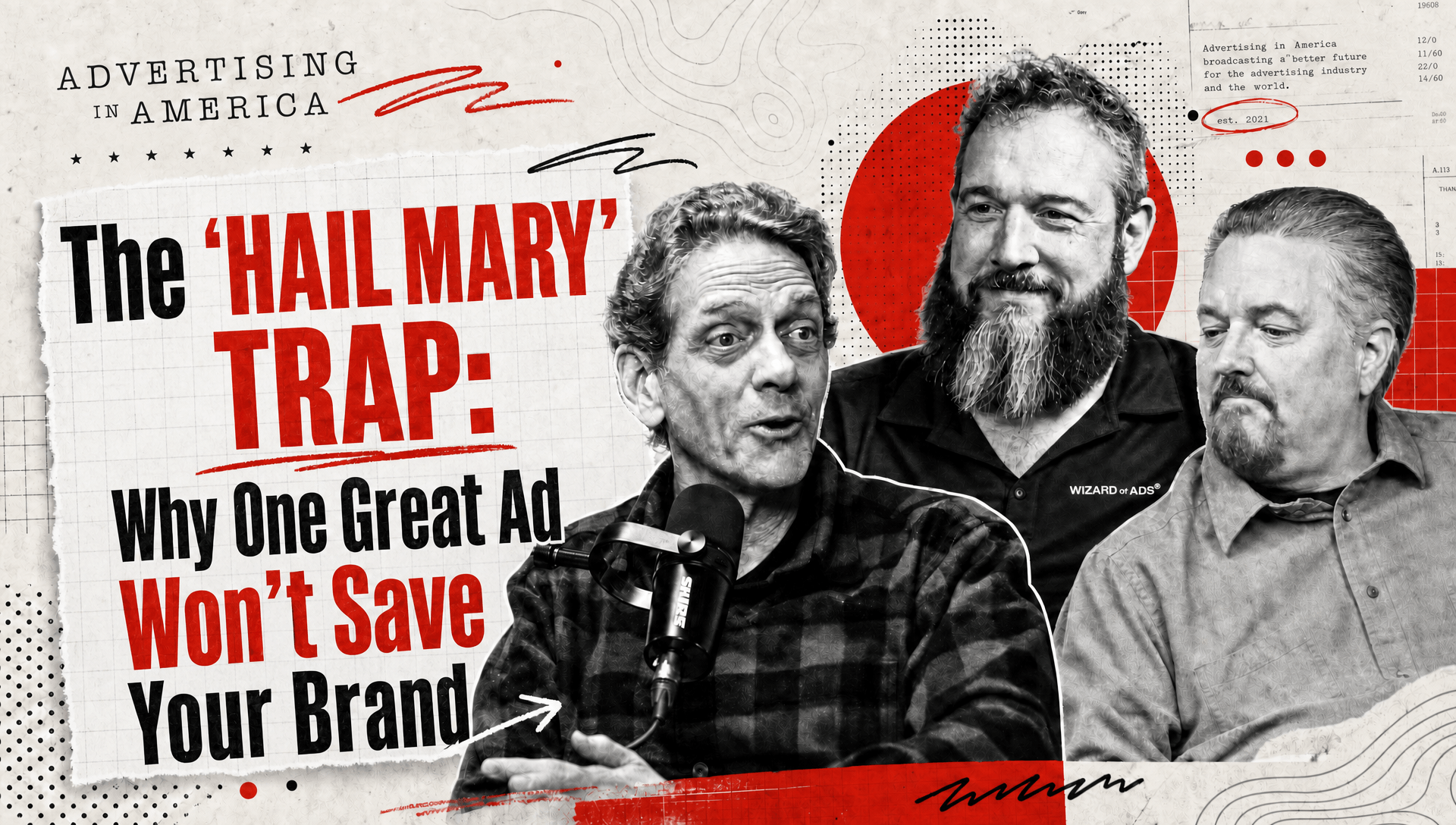
The "Hail Mary" Trap: Why One Great Ad Won’t Save Your Brand
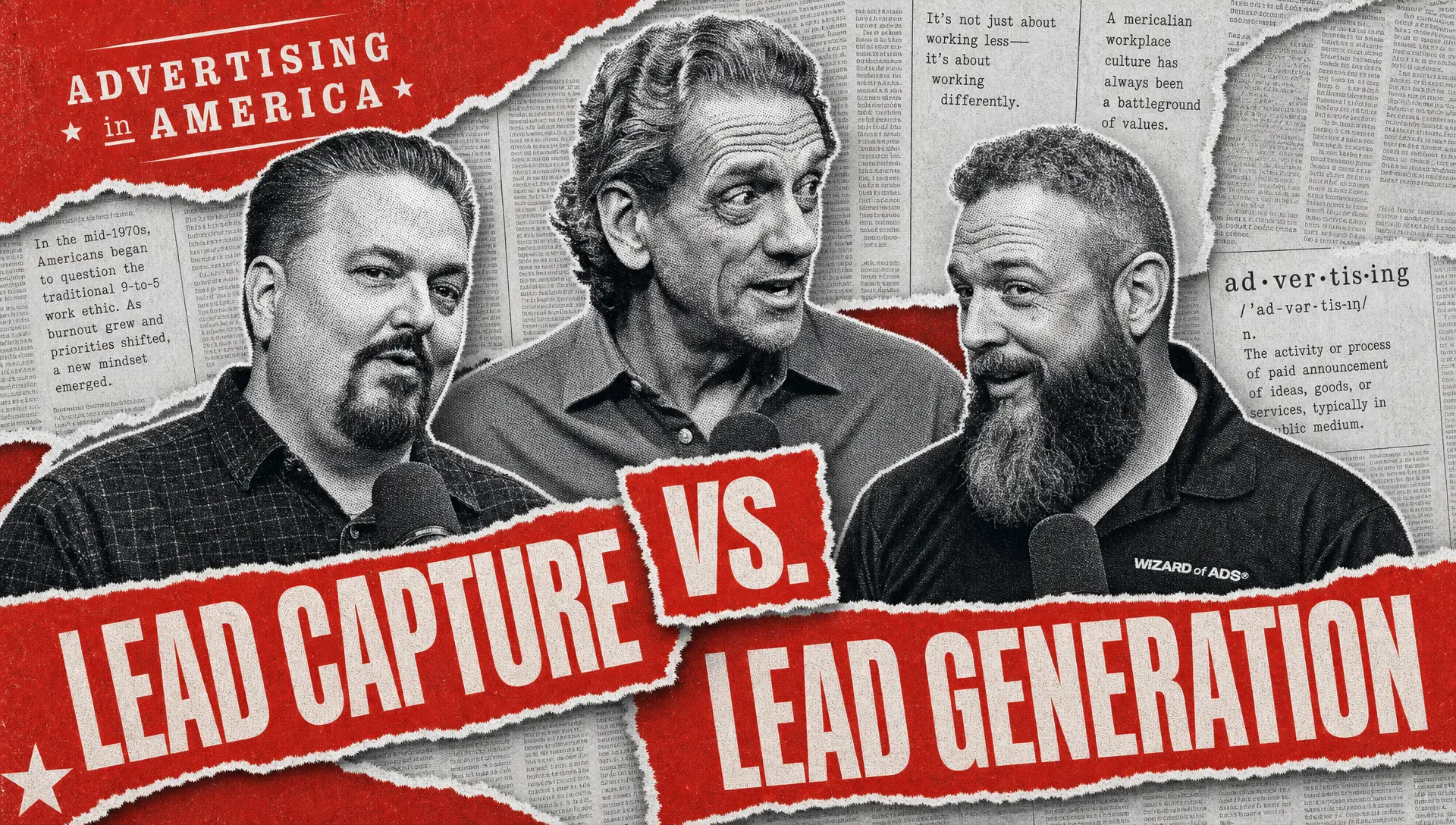
Is there such a thing as a "killer ad"? Join Ryan Chute and the Torbay brothers as they debunk the myth of the one-hit-wonder ad and explain why long-term serial advertising campaigns are the only way to drive sustained market share growth and ROI.
Advertising in America
April 2, 2026
Everyone is looking for the "killer ad".
The single, brilliant script that will fundamentally change the course of a business. The problem? It doesn’t exist.
In this episode, the team explores why ad agencies and starry-eyed clients are addicted to the "siren song" of the award-winning one-off. They compare these "Hail Mary" passes to the actual strategy that builds empires: the long-term, serial campaign.
Using iconic examples like Apple’s "Get a Mac" series and the decades-long "Got Milk" campaign, the guys explain how repetition and consistency create "mental real estate" in the consumer’s brain. If you’re tired of chasing short-term "blips" and want to understand how to build 10-year gains, this is the conversation you need to hear.
Episode Highlights
The Killer Ad Myth: Why agencies prioritize awards over client results.
The Mac vs. PC Case Study: How 66 commercials grew market share from 2% to 10%.
The Pavlovian Strategy: Why branding is actually about "ringing the bell" consistently.
The Failure of "Cool": Why you remember the CGI Seal but can't remember the brand it was for.
Small Business Advantage: How medium-sized money can win by staying the course while big brands abandon the campaign.
🎧 Hit play to find out why the "killer ad" is a myth and how long-term, serial campaigns are the only real way to move the needle and grow your revenue. Don't just watch, start building a brand that lives firmly in your customer's memory.
📱 Subscribe wherever you get your podcasts
💬 Are you building a brand for the long haul, or are you just chasing a "one-night stand" with a "killer ad"?
On this episode of Advertising in America, we're in search of the mythical killer ad. You know the one, it solves all sales. It closes deals before they happen, and it grows back severed limbs.
There is no such thing as a killer ad. What amazes me is that ad agencies around the world think there is, and curiously, the big multinational agencies with big multinational clients are among those who behave the most, like creating one is the best goal to have.
My better-looking, more successful older brother, Chris, likes to complain about agencies focused on creating one killer ad, and he's got a point, but what I'd like to talk about is the other side of that coin. Long-running time-honoured tradition of serial advertising. Serial, like a series.
The chances of you having a company that has an amazing origin story that is going to absolutely rock the world for the next five years are basically non-existent. There are very few of those characters, unless you're a tremendously interesting person.
Ryan Chute: On this episode of Advertising in America, we're in search of the mythical killer ad. You know the one, it solves all sales. It closes deals before they happen. It grows back severed limbs. It fills the appointment board with droves of customers ready to lay down and buy everything you sell. Let's ask Mick about his better-looking older brother, Mick?
Mick Torbay: My better-looking, more successful older brother. Chris likes to complain about agencies focused on creating one killer ad, and he's got a point. But what I'd like to talk about is the other side of that coin. Whatever happened to the campaign? The long-running, time-honoured tradition of serial advertising. No, not breakfast, cereal. Cereal. Like a series. McDonald's used to have commercials featuring those lovable McDonald's Land characters. Fucking Hamburglar. For crying out loud, The Wendy's Companyhad Dave Thomas cooking burgers exactly the way their employees do it. Huge corporate CEOs never do. You kinda like Dave.
Remember the Mac versus PC campaign.
They made 66 of them, and it lasted almost five years. Oh. And it sold a lot of computers. When the campaign started, Mac had less than 2% of the market share in personal computers. By the time it was done, their market share was over 10%. That's a lot of computers, but tell me about the great campaigns of today.
Frankly, every example of great advertising that I hear about in the last eight or nine years has been, “Did you see that cool ad on the Super Bowl?” What do you mean, the one that can't possibly have a next chapter, because that's all of them?
I've got a theory as to why agencies are delivering a killer ad rather than a commitment to a campaign. Nobody's thinking long-term. Clients want results in weeks, not years. Agencies want to win an award this year. Writers want a promotion or a new job somewhere else, and they want it now. The same traps that business owners fall into short-term thinking and get-rich-quick schemes. Yeah, everyone falls for that shit.
Except for our clients, we are in this for the long haul. We want five-year gains, 10-year gains, not a blip this quarter, so we can all pat ourselves on the back. Where is this all going? What's the next chapter? One killer ad. Might get a bit of hype the day after the Super Bowl, but what are they going to do to represent the brand?
Old Spice killed it with The Man Your Man Could Smell Like. But what was the brand message? Old Spice is the one for people who want to be on a horse.
During the National Football League (NFL) Super Bowl, an ad from a couple of years ago, Seal, the singer, turned into a seal, the polar bear food. What did that say about the brand? Do you even know who the client was, or do you just remember how cool the CGI Seal transformation was?
Pay attention, people. "I'm a Mac, I'm a PC." The PC is old and stuffy. The Mac is young and cool, and every couple of months, they tell that story in a new and funny way. You sure as hell remember who the client was in that campaign. Don't ya. In their haste to produce fast results for attention span-deprived clients. The big brands have abandoned the campaign entirely, and for the owner-operated business, this is a fantastic opportunity. You don't have to fight against million-dollar campaigns anymore.
The only ones doing it now and doing it well are Wizard of Ads Partners. I've got a client in southwest Texas who can't walk down the street without a passerby calling him by the nickname that has only appeared in the TV commercials. The campaign is not just memorable, it's working. He grows by 30 to 40% a year. So really, it's okay that the big money has walked away from the campaign because now, medium-sized money can just take it all for themselves. That's what we're doing, and you should do that too.
Ryan Chute: Ooh, I call shotgun on being the Mac. You’re the PC. Now, to hear from our resident Commodore 64, here's Chris.
Chris Torbay: There is no such thing as a killer ad. What amazes me is that ad agencies around the world think there is. And curiously, the big multinational agencies with big multinational clients are among those who behave the most. Creating one is the best goal to have. But that approach to creativity is based on a premise with very little precedent that making one great, award-winning, attention-getting ad could fundamentally change the course of your client's business. It almost never has.
Oh, there are exceptions that prove the rule, but as a rule, the odds of creating a single great ad that completely reverses a market trend for a brand are worse than a Hail Mary Pass. But it's still the beacon agencies and creative people follow. Great ads are the siren song. We are all drawn to the Budweiser Brewing Company APACfrogs, or the guys yelling, Whattsss Up, Cindy Crawford drinking a PepsiCo, or Mean Joe Green accepting a The Coca-Cola Companyfrom an awestruck little boy. The Aaron Burr ad for got milk?
Chris Torbay: Where's the beef for Wendy's? Macintosh, 1984. These are the watershed commercials, agency people yearn to be in good company with, and therein lies the problem.
Agency structure and the road to success within it are inconsistent with client success and the road to achieving that. In the agency business, creative people get promoted when they make something great, when they win an award. And awards are given for single entries, like an Oscar or a Grammy. You win for a great ad just like you win for a great movie or a great song. So people all strive to come up with one distinctive breakthrough script that will stand above the rest, and they get the client to pay for it by saying that great idea will shake the public from their current perceptions and change their business for the better. It almost never does, but there are just enough exceptions to the rule to tease starry-eyed clients into thinking they might be successful too. When Old Spice ran The Man Your Man Could Smell Like, it was a last-ditch effort to resurrect the brand. It had declined so completely in the marketplace that Procter & Gamble was literally prepared to switch the lights off. It was the stuff your grandfather used; it was dead. So they threw the Hail Mary and scored big, turned the brand around. Brilliant. Never happens. When Apple ran Ridley Scott's 1984 ad on the Super Bowl in, I guess that would be 1984, they came from nowhere in the computer market to the front and center. The Macintosh launch was a huge success, and Apple hasn't looked back.
Brilliant. Never happens. But now people think it could happen to them if they find themselves an agency and a writer who can make an ad that's good enough. And this is how we lose clients. Actually, this is why we hear business owners all the time say stupid things like, “We tried radio before, and it didn't work. We tried a TV ad but didn't see any ROAS.” Return on Ad Spend. Here's a safety tip, by the way. If a business strategy has ‘ass’ in the name, it's probably you.
What invariably happened, of course, is that they tried one ad, probably not a very good one, probably written by themselves or the sales guy down at the radio station jam, packed it with undifferentiated table stakes advertising blather and ran it for 13 weeks. And the world apparently didn't beat a path to their door. Their one killer ad didn't change the world. Because it never happens. What does work? Great campaigns, positionings that live long and firmly in memory because you started it, you stand for it, and you stick with it. 1984 was a great ad, “But Here's to The Crazy Ones” was a campaign and was much more successful.
“I'm a Mac, and I'm a PC” was a campaign that ran for five years, and it was much more successful. Budweiser Brewing Company APAC has been making Clydesdale's ads for decades. And if you want to know why that brand is part of the fabric of America, it's that. “Aaron Burr” was a brilliant ad for milk in a got milk campaign that ran for decades. Stop chasing the killer ad. It never happens.
Ryan Chute: You know why you should never assume, right? Because it makes an ass out of you and me. And I guess the same holds true for ROAS. When we return, we'll be arm wrestling kangaroos to see who's right about the killer ad thing we're clearly disagreeing on.
Ryan Chute: We're back. I wanted to start by talking about the short-term versus the long-term thinking that you were referencing.
Mick Torbay: I think one of the reasons why the campaign seems to have disappeared in the large agency world is very simple. It's harder. You actually have to put more thought into it. When you're just coming up with a great idea with nothing connecting it to anything earlier and nothing connecting it to anything later, that's easy. Creating a long-term thing is harder. Like, writing a screenplay is a lot harder than writing a vine. So I think this comes down to laziness in a lot of cases. Which is not to say that what Chris is saying is not true, but it doesn't help that doing it the way they're doing it is much easier than doing it the way we do.
Ryan Chute: I think one of the easy excuses is that people don't have the attention span that they used to have. And we know, scientifically speaking, the research does not support that there's such a thing as an attention span. There is no such thing as attention span. If that were the case, Netflix would be out of business and podcasts wouldn't exist.
Mick Torbay: It's attention span on the message, on the creative. But frankly, it's also an attention span on the media. If you think about it, to do a campaign like the Apple campaigns, which we were talking about, I'm a Mac, I'm a PC. You have to be committed not only to the story. You have to be committed to a five or six-year media buy. Like you have to be saying, no, we're going to do this on TV like this for a long time. And I don't know anybody who is thinking long-term. It's more just, what am I getting today? What's my return on my investment today? Is it making me money? 'Cause if not, I'm going to switch it. I'm going to switch it, I'm going to switch it, I'm going to switch it. And it's specifically this, “if it doesn't work right away, I'm going to switch it.” That guarantees it's absolutely not going to work.
Chris Torbay: Well, that's also a discipline thing on the part of the agencies, which is my part, is what that necessitates is the agency saying, "We're going to stick with this idea. We're going to see it through, we're going to keep evolving it” as opposed to, “Wait, you don't want that? I got another one for you. You don't like that? I got another one for you.”
And that's where it also goes back to, and it's an unconscious selfishness, but it's a selfishness from the creative people, which is, if we went with Dave's idea last year and it produced a sort of ho-hum reaction. It's “Okay, maybe this year we'll go with my idea, and then we'll see if I can beat what Dave's idea” as opposed to an agency saying, “We believe in Dave's idea. It started off slow in the first year. Now, in the second year of this campaign, I'd like everybody else to write more ads in the context of Dave's, and let's keep doing that.” And all these creative people have to say, “I'm good with executing against this other person's idea now for the next little while,” as opposed to trying to say, “I've got something better.” And very few people have that discipline to say, “I'm happy to go with what's there.”
This is why I think the whole agency review process contributes to it, which is when you switch agencies. The last thing a new agency would do is to say, “Good. Now that you've given us the reins on this account, I'll tell you what we should do. Let's keep doing that campaign that America's always loved, and let's stick with it.”
Mick Torbay: That's the last thing the agency was doing, which is excellent.
Chris Torbay: Of course, what they're going to say is, “All right, now that you've given us the campaign, I'll tell you what. We're going to throw out everything your last agency did. We're going to do a brand new thing,” to prove that you're worth winning the account. But from the consumer's perspective, where's the consistency? Where's that build that happens over time? If everyone wants to prove how good they are right now, right here.
Ryan Chute: It's a survival mechanism of chasing the dopamine. What's the next big high? What's the next big win? Where's the killer ad? When the truth of it is that retention and recall are the things that we're actually going for. We're looking for that echoic retention that cues us into conditioning us, as it were, with Pavlov's dog, into remembering that you matter and that you're relevant when we are remembered. Relevant to the situation.
Mick Torbay: And we have to remember that marketing meetings are conducted not by robots, but by people, and people think and act emotionally. And there is something slightly disappointing when you're having your annual marketing meeting to say, “Okay, so what are we going to do for 2026? What are we going to do for 2027?” And to say, “we're just going to keep doing what we were doing before, but change the words a little bit,” that doesn't make for a really exciting meeting.
Chris Torbay: And it doesn't sound like you're earning all the money that you're making, because we're just going to keep paying you, and your contribution should write me more of those, stay the course. That's what I'm paying you for, to stay the course.
Mick Torbay: Which I think draws attention to the way we bill our clients, which is based on results and not based on “Woo, that was a great meeting!” Our clients pay us based on their growth, their top-line revenue. And so we get to say to our client, listen, if we say we should just do more of these ads along the same lines as we've been doing, it's because I think I will make the most money if we do it this way.
If there was a new idea that's better than that, then we should throw this idea out over because a new one's so much better. You want to believe I'm going to recommend we do that because that's how we get paid! You make a dollar, we make a penny, and you make the dollar first. So we have to get you paid first before we get paid at all. But that gives us the opportunity in the meeting when they say, “Gee, that doesn't sound that very exciting.”
It's like, you don't pay me to make exciting meetings. You pay me to make you money. So if that's what we're going to deliver, that's keeping us all honest. But the fact is, agencies, for the most part, and this is not evil, it's just the way the system works, they pay based on the amount of work, billable hours. You know what a brand new campaign requires? A lot of freaking billable hours because we're throwing away everything we were doing before. Now we have to come up with a whole new idea. We gotta cast,
Chris Torbay: We're putting every team on it. So they're all billing.
Mick Torbay: We're doing market research, we're doing focus groups. “I wonder if this new idea will work?” Billable hours. Billable hours. Holy crap! There's going to be so much money to bill. And they get the client excited, because “This is going to be so great, it's going to be so brand new, and no one's going to see it coming!? It's like, yeah, but is that what consumers want? Do they want not want to see it coming?
Chris Torbay: That's interesting.
Mick Torbay: Or they want to feel good about it.
Chris Torbay: Thing is, you ask, and this is an unscientific statement, but here you go. If you ask an average person in regular conversation, tell me about some advertising that you like? Sometimes they will name a specific ad. They will say, “I remember one of those guys shouting, ' What's up? ' That was very funny.” But then, more often than not, they'll say, “Ah, I like that lizard for the insurance company” (GIECO). Or, “I like the one where you,” oh, it is like they will, the ones that they're actually remember if you say to somebody, tell me some advertising you like. They're at least as likely or probably more likely to name a campaign because they've seen a few of those, and it's built up over time, and it's gone into the chemical memory, and that's what they remember? “Oh, have you seen the lizard for Geico?” Yes. Everyone's seen the lizard for Geico. They may not have seen the most recent one with the most recent specific joke, but they all know the campaign.
Mick Torbay: And they know he's an East Ender.
Ryan Chute: And that's what market research has also proven to be true. If we just look at the data, we see the results of these things,work tells us through their study that it's not the award-winning single campaign, single ads, that move the needle in any way. In fact, they've disproven that, that they don't move the needle at all. They get a blip of attention and an award. Great. You've got an award. The most prolific part of winning an award for an ad is the award, not the revenue that you wanted from it.
Chris Torbay: You very rarely get, but the problem being, and this is the thing, because there are exceptions that prove the rule, then everybody's holding out for that one. And to go back to the football analogy, every once in a while when the clock's running out and you're down by a few points, and you just send all your receivers to the end zone and lob the ball. And it's a jump ball, and sometimes you can actually haul it in and win the game, and sure, but that's not a strategy.
Mick Torbay: It doesn't mean throwing from the midcourt is a great idea.
Chris Torbay: It's not like it's a great idea. We've all seen it in a highlight reel, and everybody says, but you don't make that your game plan. Let's fuck up for three and a half quarters, and then in the last 10 seconds, let's throw it to a whole Hail Mary, except make sure this time you catch it. That's not a strategy going into the game. That's a strategy that kind of works occasionally, but not something to learn from.
Ryan Chute: And that's, that's effectively what we see from Les BinetandPeter Field's research, which shows us that long-term brand awareness building generates two to three times more profit for the company than a short-term sales activation strategy of the killer ad. Let's see what we can do to generate sales right now. And Byron Sharp, another famous market researcher, has taught us that we don't win at the moment of persuasion. We win many months before when we've built up momentum in the mental real estate of the brain.
Mick Torbay: I think what surprises us, maybe the people at in on this panel, is that we spend so much time working specifically on the campaign, building something that is going to generate a certain reaction in year one. And we know that if we can just get our clients from that to year two, it's going to be even bigger. It's going to be even bigger. It's going to be even bigger. And we've demonstrated it over and over again. It's pretty much. I don't want to say it's the only thing we do, but it's darn close to the only thing we do. We don't do these one-off things because that just will cause consumers to be distracted and confused.
It goes against the entire concept of branding, which is attaching this idea that the consumer cares about, to this idea that the consumer doesn't care about. What's the thing they don't care about? Our client. Water heaters, or specifically water heaters from Dave's Water Heater. So we're trying to connect a thing they care about to a thing they don't care about, and that takes time, it takes investment, it takes consistency. This is all Pavlov shit. That defines the campaign. That's what Pavlov did. He had a campaign where he would ring the bell and give the meat. And then only give the meat when he rings the bell. And only ring the bell when he gives the meat. But it happened over and over and over again. And if next week he decides he is going to blow off an air horn and then give the meat. The dog would be like, “What the fuck's going on with the meat? I don't know what's going on.”
Chris Torbay: And I can't change, train, train my dog to do that by just having a better bell. If I had a really great bell, my dog had learned to salivate the first time. It’s not going to happen
Mick Torbay: Exactly. And if they change their mind every three weeks on what this thing's going to be, it will never work. So why do big agencies understand the concept of branding, but they don't understand the concept of a campaign, which is just branding expanded?
Chris Torbay: And the holy grail, and it almost goes back to the very first thing you talked about, it was laziness, that's the really best thing to have is a great campaign idea into which you can then put individual ads, which are even better than all of that. And if you think of it, think of it in terms of sitcoms, right? You have a great concept for a sitcom, and then there are the standout episodes within it, right? We all love Seinfeld. It was a great idea for a sitcom, and then Master of My Domain became a standout episode. Or The Simpsons has been on for however long, and the Monorail episode stands out. And if you can create a campaign where all of the ads are good, I mean, got milk won tons of awards, over the years, because the Aaron Burr ad won, and then the next year another one won because it's a great idea. You put people into this awkward situation and then, got milk? Then you've created a great campaign idea into which you can then create individual great spots.
Mick Torbay: If you're a good writer,
Chris Torbay: If you're a good writer, and that's the hard thing to do, which is to come up with a great idea that works with mediocre spots, and then works even better when people write really sweet ones.
Ryan Chute: And this isn't new information either. In 1956, Eugene Schwartz talked about this in his book, Breakthrough Advertising, and it's very much about the state of awareness and the state of sophistication of the market that we're talking about. Milk is a very sophisticated market. Everyone knows milk. So, who are we speaking to, and what is the mass desire of that need? It's put in cake. It's put with cookies; it's put in all of these different recipes. There are all of these different situations that we can make fun and interesting to remind people that is the place to find that solution. So product awareness and solution awareness. People who are most aware that they need that thing right now, “don't forget the milk when you come home, honey.” We need to have that thing.
Air conditioning, jewelry, all of these things fall into different categories, and they're on different people's spectrums of awareness and sophistication of understanding. And we have to, as writers and creative people, find an interesting way to be able to introduce these ideas back into the brain, and go, “Oh, remember that?” If we can anchor that to our brand, the bell, as it were, with Pavlov's dog, that's when we start to get the sales from that. And that takes repetition, that takes consistency. That takes something that has some sort of emotional hold because the feelings are what's anchoring it into our long-term chemistry.
Chris Torbay: And then you're going to want to watch each quote-unquote episode of that campaign. If you think of Nike's Just Do It campaign, which has been running for 30 years. They're all good, they're all emotional, they're all interesting. They all draw you into a storyline. And then within that, every once in a while, there's one that's really great.
10, 15 years ago, Shadow Runner, the woman who's jogging and managing to always find her way through the city, and sweating in the hot city, and always jogging in the shadows, including a jet goes over by and she crosses the road under the Jet's shadow. It's everything we love in a Nike ad.
Everything we expect from that campaign. Everything we know that campaign does. And yet that one you go, “Oh, that's a really good version.” Even within that, that one wins the award. Cool. You can still win an award for a one-off, but that campaign, that whole approach of here's how we are going to market Nike, we're not going to talk about the s sponginess of the air cushions or the technicality or whatever. We're going to tap into people's inner drive to reach personal bests and all that kind of stuff, that Just Do It stands for. That was in the campaign idea. And then there was a great one-off within that.
Ryan Chute: And there was an emotional environment, right? There was context, there was reference. There was that ability to make it salient, to make it relevant, to make it real to me. That’s what allows us, gives us permission as viewers, as consumers, to look at it and go, “Oh yeah, that one's good.” Because they have that's a vibe now, right? We're hanging onto something that's bigger than just this little tiny sliver.
Mick Torbay: See, I would submit that even a shitty campaign is better than no campaign at all. If you can find something consistent, something you can commit to, something you can do all the time. Something where consumers can put you in a box. That's not a bad thing. Consumers want to put you in a box. What's a Volvo (Volvo Group)?
Chris Torbay: Safe car.
Mick Torbay: It's a safe car. That's it. That's just it, that's it. It's a safe car. Good. That's fine.
Chris Torbay: At least you're in a box.
Mick Torbay: At least you're not in a box that people understand not, and when someone says, “I'm buying a car for my kids. She's going off to college. I wanted to have a car that's not necessarily super fast.” Well, it's like, she’s getting a Volvo. Safe car, at least you got that thing covered. It ticks that box.
Chris Torbay: A great example of that too, is what's the pizza place in your town where you always sing the jingle, right? Like you, you remember, and every town's got a pizza place where everybody can sing the phone number that is not particularly brilliant bit of information to have put into people, but it's enough. It's at least something to Mick’s point, it's at least something to have that campaign. If you can also, then convey other higher-order benefits. It's got real Italian flavor. It's got other things, other than just memorability.
Mick Torbay: But that would be a good campaign. I'm saying even a shitty campaign is good. Who's the car dealer? I think he's dead now. Who’s likes “it’s gonna be HUGE!!” Awful idea. If they'd come to us, we would say, " You can't build a brand on ‘HUGE’.” But fuck it. He did it for 30 years, and everybody knows who I'm talking about. I don't know his name, and I know he is dead.
Mick Torbay: But the point is, it was not a good campaign, but I'll bet you if you were one of the 10 guys competing against that bastard, you'd be like, “son of a bitch. I wish we at least had that.” At least had fricking HUGGEE.
Ryan Chute: There are sales guys in there going, " Man, we can't beat those guys. They always get all the customers.” They are huge.
Chris Torbay: “Why is huge getting people, and we're trying to talk about our expertise and our quality. They're just a bunch of idiots, and yet huge is winning.” It's because he's been consistent, and at least people know him, and it stands for something, and it reaches a certain part of somebody's psyche somewhere.
Ryan Chute: It’s enough to get them in the door.
Mick Torbay: Give them a shot. Get them on the short list. Even if it's “ah, I hate that guy's commercials.” You hate what guy's commercials, right? “That guy.”
You're on the short list, which is why I believe for the small and medium-sized business, this is a unique time in the world where the biggest agencies in the world have abandoned the most powerful thing that there is. And that you can do this, and you can do it yourself. You can do it with us. That's the only thing we do. But in fact, you can do it by yourself by simply finding something that matters, connecting it to the thing that doesn't matter, that's you. And then do the same thing over and over again. Even if you think it's boring or at least not novel anymore, stick with it. Because after five years, people will tend to want to. See it again and like it, and they'll be like, “Oh, that's crazy, Chris, with this thing.”
Ryan Chute: And it's this juxtaposition of people are looking for something new, interesting and different, and the equal and opposite truth is consistency helps embed, and help with retention and recall. So which one's true? And the answer is they're both true, but you can have one with the other. It's not one, they're not mutually exclusive.
Mick Torbay: Having both is ideal. Having one is really good. It's still better than most, which has nothing. And in the trades, a lot of our viewers are in the trades. Which is not a category that is inherently interesting or exciting. So to have something in the trades that jumps out is not easy. If you're writing for a parachute school, fucking easy as hell. But if you're writing for oven cleaner, it's harder. But major advertisers, national coast-to-coast advertising in the trades. Absolute shit. Just table stakes, quality service, selection, and price. It's just so done, so badly and with no effort whatsoever, that the small business owner working with his local radio station or TV station can absolutely come up with something that beats a national brand. It shouldn't be possible, but I'm telling you it is. It happens all the time because we're beating these guys, and we're a bunch of freaking dudes on a podcast.
Ryan Chute: It's true. And it is. That's the competitive advantage. When you think about gorilla warfare, that's exactly how gorillas win the game. That's why Gorilla Marketing is a thing. We win them out through sentiment. We don't win them out through sheer force, right? They're going up against formal armies that have the resources, have the manpower, have everything that they need to win. The only way to win this game is through a gorilla effort of communication at a higher level. And I think that's really to make our final point is where people struggle the most with their stories, and with their interesting, and differentiators. So new, interesting and different is in the campaign idea. It's not new, interesting, and different every time you run an ad.
Mick Torbay: No, it's still water heaters.
Ryan Chute: It's still water heaters. But every single time, you started off with having the mad scientist in the basement and the logical, stable wife who does all of the things and holds the ship together. That's an interesting dynamic that we can lean into. That's the new interest characters.
Mick Torbay: Characters that don't go together there, simple as that. Characters that don't go together, this person and this person do not fit. Now jam them together and watch what happens, sir.
Ryan Chute: Watch what happens. Watch the chaos ensue, and therein lies that, so where's the consistent come in, the jingle, and the sound effects, and the slogans, and what we call brandable chunks that are repeated over and over again, that embed into the fabric of your brain that think. That bad thing happens. I call these people because good things come from it. And that's fundamentally this juxtaposition, this mix working together in an interesting way. The chances of you having a company that has an amazing origin story that is going to absolutely rock the world for the next five years is basically nonexistent. It just doesn't happen. There are very few of those characters.
Mick Torbay: Unless you're a tremendously interesting person. Which Chris is.
Ryan Chute: Chris is a tremendously interesting compare to the rest of us.
Ryan Chute: So what does this mean for small business owners? It means that ad campaigns will be cute and clever every single time. You have to commit to a lot of affordable retention and an amazing message that makes people feel. Not everything all at once. Rather, more and more familiar and confident that you are the company to know, like, and trust when they need what you have to sell. The message has always and will always make the media channel work, not the other way around.
Your greatest and best use of your marketing dollars will continue to be getting your message right. And the best way to get a potential buyer to love you for a long time is to invest a long time in communicating with your prospective buyer. Skip the short-term instant gratification and invest in your courtship. The longer your purchase cycle, the longer the courtship. Great businesses are built on repeat buyers. Not one-night stands. Until next time, this is Advertising in America.. Thanks for tuning in.
Thank you for joining us on Advertising in America. We hope you enjoyed the show and captured a nugget of marketing magic. Wanna hear more? Subscribe, leave a review and share this podcast with your friends.
Do you have questions or topics you want us to cover? Join us on our socials @advertisinginamerica.
Wanna spend your marketing budget better? Visit us at wizardofads.services to book your free strategy session with Ryan Chute today.
Until next time, keep your ads enchanting and your audience captivated.
The podcast that turns marketing into magic! Hosted by the brilliant Ryan Chute and the ever-entertaining Michael Torbay & Chris Torbay, this show dives deep into the world of American advertising, revealing the secrets behind the most successful campaigns and exploring the latest trends.
Rare, bizarre, and unexpected tools, tactics, and techniques for profitable persuasion beamed directly to your pocket periodically, without warning.
Thank you! Your submission has been received!
Oops! Something went wrong while submitting the form.
(No spam. No strings. Let's just grow your service business.)
Frequently asked questions
Questions? We’ve got answers.
Why Wizard of Ads for Services?
Are you ready to transform your business into a distinctive, emotionally resonant brand? Here's why hiring Ryan Chute, Wizard of Ads for Essential Services is the game-changer your business needs:
Distinctiveness Beyond Difference: Your brand must be distinctive, not just different, to stand out. We specialize in creating an emotional bond with your prospects to make your brand unforgettable.
Building Real Estate in the Mind: Branding with us helps your customers remember your brand when they need your service again, creating a lasting impression.
Value Proposition Integration: We ensure that your brand communicates a compelling value proposition that resonates with your audience, creating a powerful brand-forward strategy.
Who Should Work with The Wizard of Ads for Services?
Wizard of Ads for Essential Services start by understanding your marketing challenges.
We specialize in crafting authentic and disruptive brand stories and help build trust and familiarity with your audience. By partnering with Ryan Chute, Wizard of Ads for Essential Services, you can transform your brand into one people remember and prefer. We understand the power of authentic storytelling and the importance of trust.
Let us elevate your marketing strategy with our authentic storytelling and brand-building experts. We can take your brand to the next level.
What Do The Wizard of Ads for Services Actually Do?
Maximize Your Marketing Impact with Strategic Alignment.
Our strategy drives everything we do, dictating the creative direction and channels we use to elevate your brand. Leveraging our national buying power, we ensure you get the best media rates for maximum market leverage. Once your plan is in motion, we refine our strategy to align all channels—from customer service representatives to digital marketing, lead generation, and sales.
Our goal is consistency: we ensure everyone in your organization is on the same page, delivering a unified message that resonates with your audience. Experience the power of strategic alignment and watch your brand thrive.
What can I expect working with The Wizard of Ads?
Transform Your Brand with Our Proven Process.
Once we sign the agreement, we visit on-site to uncover your authentic story, strengths, and limitations. Our goal is to highlight what sets you 600 feet above the competition. We'll help you determine your budgets and plan your mass media strategy, negotiating the best rates on your behalf.
Meanwhile, our creative team crafts a durable, long-lasting campaign designed to move your brand beyond mere name recognition and into the realm of household names. With an approved plan, we dive into implementation, producing high-quality content and aligning your channels to ensure your media is delivered effectively. Watch your brand soar with our comprehensive, strategic approach.
What Does A Brand-Foward Strategy Do?
The Power of Strategic Marketing Investments
Are you hungry for growth? We explain why a robust marketing budget is essential for exponential success. Many clients start with an 8-12% marketing budget, eventually reducing it to 3-5% as we optimize their marketing investments.
While it takes time to build momentum, you'll be celebrating significant milestones within two years. By the three to five-year mark, you'll see dramatic returns on investment, with substantial gains in net profit and revenue. Discover how strategic branding leads to compound growth and lasting value. Join us on this journey to transform your business.



%20(1).webp)
.webp)
.webp)
.webp)

.webp)