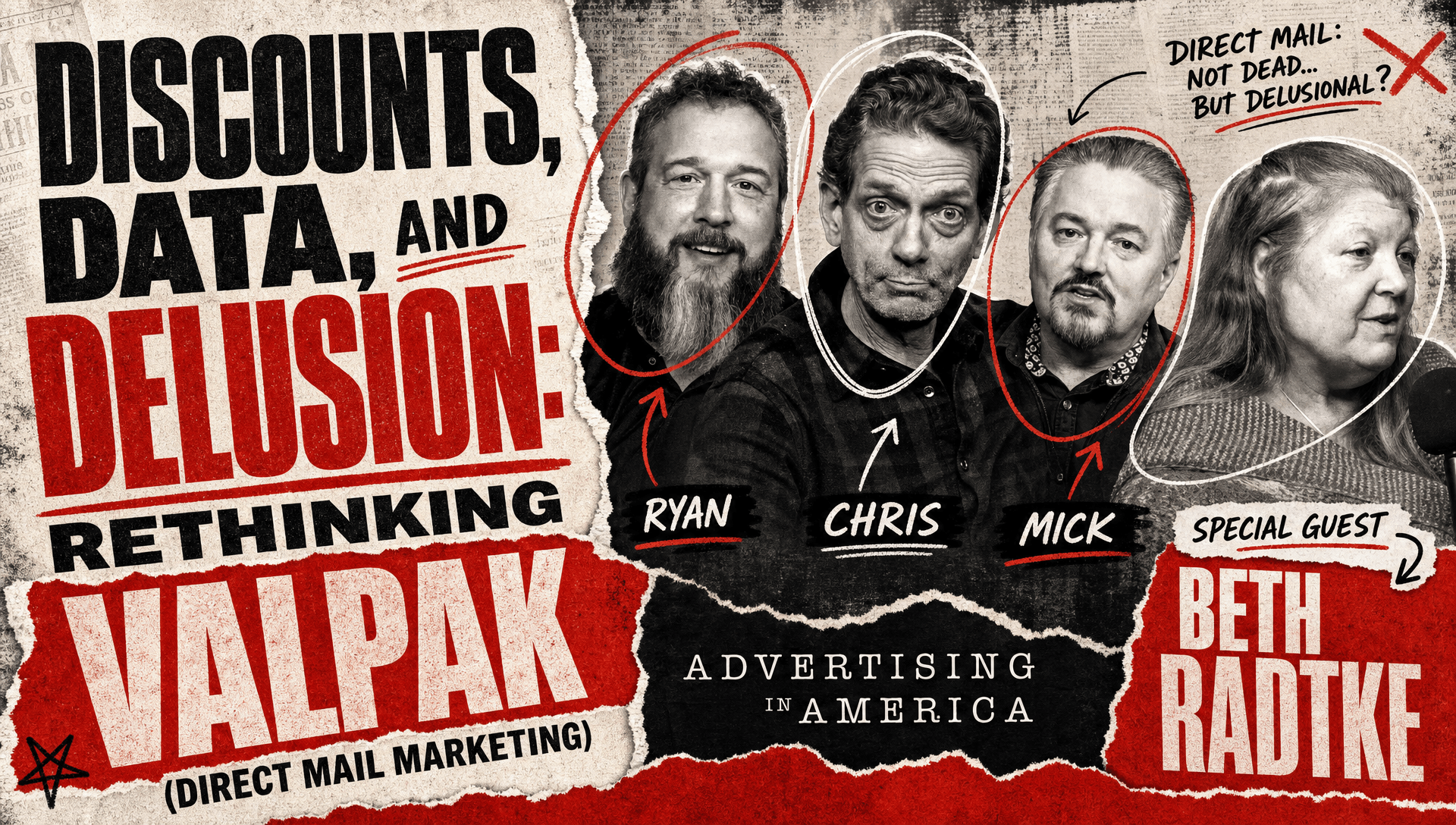
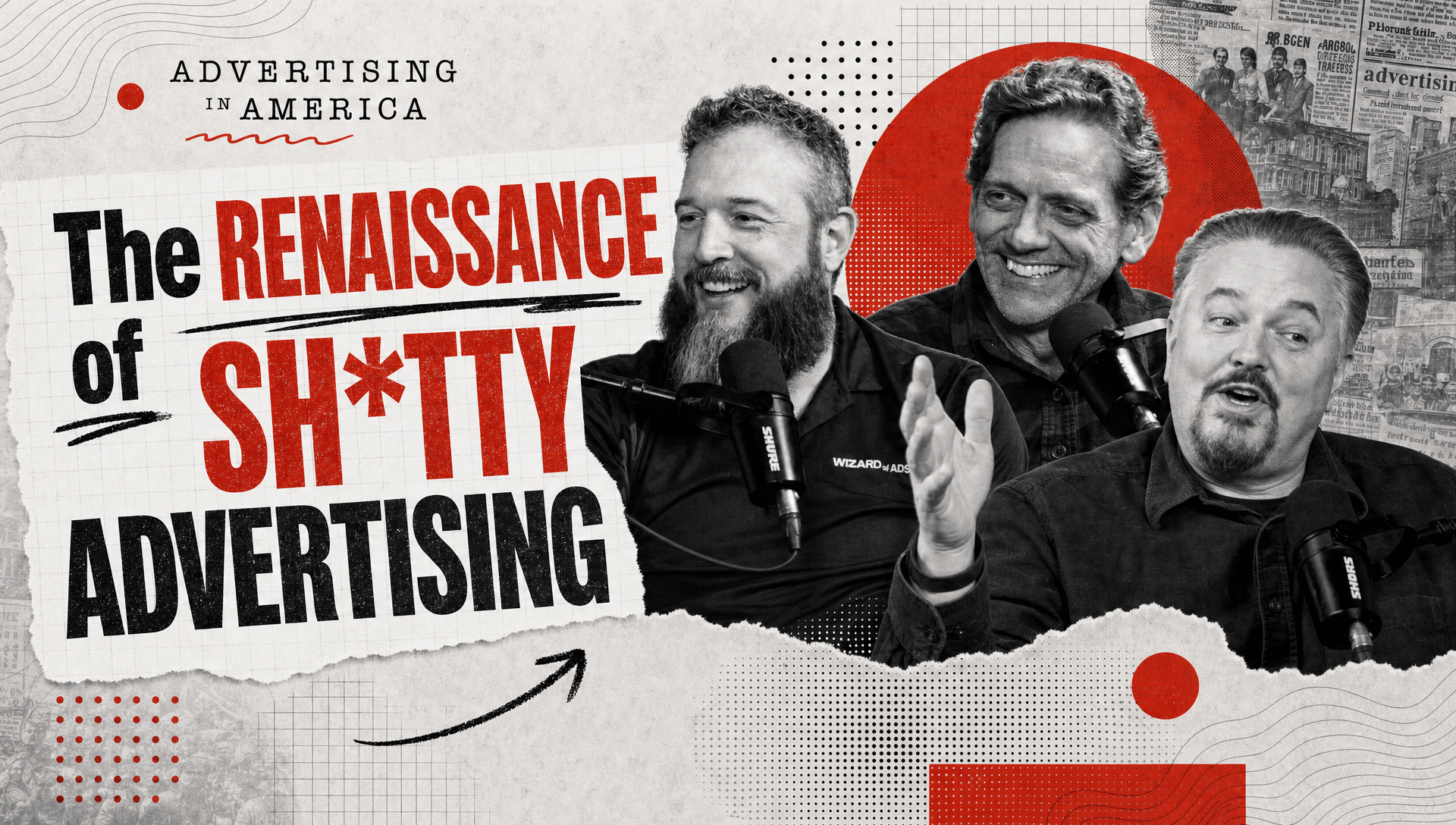
Is Valpak a relic of desperate discounting… or a misunderstood tool hiding in plain sight?
In this episode of Advertising in America, the team takes on one of the most polarizing marketing channels out there—the infamous envelope of coupons. Is it junk mail destined for the trash, or a strategic weapon when used correctly?
Chris Torbay fires the first shot, dismantling Valpak as a brand-killing, bargain-bin tactic that attracts the wrong customer at the worst possible moment. But Mick Torbay pushes back hard, arguing that no media is inherently broken—only the strategy behind it.
Then comes the reality check.
Media buying expert Beth Radtke steps in with data, experience, and a perspective most advertisers never consider: what actually happens after that envelope hits the mailbox.
This episode isn’t about defending or attacking Valpak. It’s about understanding the real game.
Episode Highlights
- Why media doesn’t make marketing work—message does
- The difference between brand building and sales activation
- How cheap reach can still be strategically expensive
- Why consistency and familiarity matter more than clever offers
- And how the wrong message in the right medium still fails
Because the question isn’t whether Valpak works.
It’s whether you know how to use it.
🎧 Hit play to rethink not just coupons—but how every marketing channel fits into your strategy.
📱 Subscribe wherever you get your podcasts
💬 Do you know how to make any marketing work?
💥 Brought to you by Wizard of Ads for Essential Services
On this episode of Advertising in America, we're talking about Valpak. Is it worth it, or is it just another lame attempt at killing our planet?
If you want to be the brand, people know, like, and trust the brand. People think of first and like the best, and are most predisposed to buy from, Valpak is the wrong thing to do.
Who is Val anyway? And what's so great about her pack? If you're talking about the medium, good or bad, you're missing the point. There isn't one magic media that works, and all the others don't.
There are reports from many advertisers, over a period of time of coupons being redeemed from previous years. They put it in that drawer, they put it in that place, but they know it's there. So when the thing happens. They're going to go back through again. Our job is to make sure that our clients are picked out of there first by the brand that we've helped them establish in the area.
Ryan Chute: Yes, that envelope of shameful discounts in coupons, is it worth it, or is it just another lame attempt at killing our planet one shitty coupon at a time? Joining us today is Media Buying Maven Beth Radtke, who will chime in with her experience and expertise. But first, let's hear out our resident curmudgeon, Chris Torbay.
Chris Torbay: If you're trying to build an industry-leading brand, if you want to be the brand, people know and trust the brand, people think of first and like the best and are most predisposed to buy from in the future, when a need arises in your category, Valpak is the wrong thing to do. The medium is wrong. Their performance claims are suspect, and they're talking to exactly the wrong person for you.
Now, I'll be honest, this first part is anecdotal and not legitimate research, and I'm the first guy to call bullshit on that. When people tell me, “No one advertises on TV or radio anymore, because no one watches TV or radio anymore,” I'm the guy who says, “Here. Look at the numbers.” Nielsen says this many millions still are. So don't tell me that just because your nephew cut the cord, that no one watches TV. But, having said that, everyone knows that people throw Valpak in the garbage, immediately unopened.
The number of homes they deliver to is not the number of consumers you will reach because it goes in the garbage. It is conveniently packaged to look like a bunch of junk mail all bundled together to make it super easy to chuck it without even opening. People try to avoid the ads in Sports Illustrated, but they don't throw Sports Illustrated straight into the garbage because they know there's also some sports stuff in there.
With Valpak, right away, it's just flyers, mostly irrelevant. It is literally a commercial cluster, and when we get to a commercial break on TV, we go take a whiz. We all know being third in an ad cluster of six is death. No one remembers the third commercial. They were watching the football game. They kinda like the Doritos ad that came on before you, so why will they remember you?
This is the same thing in physical form, but if someone does open it, they will find a mishmash of household products and services that are mostly not relevant. Different flyers for different brands and different businesses. If you need a new screen door, that one thing will be relevant, assuming you don't already have a brand in mind.
The driveway sealer, water heater, company, carpet cleaners, diaper service, and everything else that's in there is irrelevant. So your conclusion is mostly junk. Toss it, and no homeowner doesn't eagerly say, “Hey, we might not be in the market for a gazebo this year, but let's just file this away in that kitchen drawer with all the rubber bands and dead batteries, and nine months from now, we'll remember to pull out this guy's ad.”
No in the bin. Six months from now, when their water heater fails, the odds that they also remember seeing a water heater offer in that same bundle of advertising is zero. And even if you do page through, the materials inside are universally lousy and oddly similar, looking even across different offerings, cluttered messaging, too many small pictures, multiple price promotions, table stakes claims, and limited time coupon specials, quality service selection low prices, free parking, and qualified staff who really care about your home.
It's mush. No one remembers anything or anyone. And even if someone does read your ad, which I think I have established is not happening, you are appealing to the wrong target. No favored brand, no criteria to choose a provider. Valpak is literally aimed at the customer who needs new windows, has no idea who to call, but if you offered them a 15% promotional price, they would call you, because I don't know, I guess like, why not?
Valpak appeals to the bargain hunter. The lowest of the low-hanging fruit, it's called fucking Valpak. The bargain hunter target is being dog-whistled right in the name. The person with a need so last minute, they're literally dripping off the bottom of the purchase funnel, and you want to swoop in and catch them at the last second.
They have no preferred brand. No criteria for choosing among contenders. No sense of what they need to spend. No intention of establishing a relationship. They have no favorite, and a coupon would win their custom at the last minute. How many of those people are there? Why is that the shot glass of the market that you want to fish in?
If you want to build a business, create a brand people identify with. A brand people know, like, and trust before they need what you sell. A brand where they will trust your recommendation when you make one, a brand where they appreciate the value they get for the money you charge. Tell your story. Talk about how the thing you do will make my life awesome. Make me feel something. Make me remember you for being you. Don't line up against the wall of the gym with all the ugly kids at the school dance and hope one of the cool kids will come over and ask you to slow dance. That's not how they choose, and you don't want to date the ones who do choose that way.
Ryan Chute: Funny at your age, I figured you'd be up for a bargain on mush Chris, easier on the old digestive track now to complain about his brother hogging all the good stuff. Let's hear out, our friend Mick
Mick Torbay: Once again. My brother is wrong. Val pack, who is Val anyway, and what's so great about her pack, if you're talking about the medium, good or bad, you're missing the point.
There isn't one magic media that works, and all the others don't. Just because a guy who had no success using a particular media doesn't mean it's worthless. What was the message? I'm not a media expert, never claimed to be, but here's what I know about media. If they consistently provide zero results, they don't keep existing.
Business owners are not so stupid that they'll keep throwing their money down the drain over and over again without ever receiving anything in return. So yeah, Chris throws away his Valpak. Good for him. All I care about is how many people don't. How many people open it? How many people read all the stuff inside it?
Just because I don't, doesn't mean everybody doesn't. It always comes down to how much does it cost, how many people does it reach, and how often, in this case, reach doesn't mean the mailbox. Everybody's got a mailbox. Just like everybody has something that can play TV, that's not useful data. How many people are opening it, reading it, and acting on it?
Now, I don't have that data, but I'll bet Beth does because it's her job to know that stuff. You're asking for trouble anytime you say nobody does this or everybody does that. When you use absolutes, you're on thin ice. Nobody watches network TV anymore. No one listens to the radio, except we're building massive brands using those two media, or as many people watching or listening as before. Nope.
Does it matter? Not a fucking bit. Now, how could that be? It's because we never wanted to reach a hundred percent of the market on one medium in the first place. Back in the sixties, you could buy three networks and get 80% of Americans. But here's the secret. You don't want to reach 80%, you only need half of them, 50 tops.
Once you reach half, they'll tell the other half. Costs you way less money, and is totally possible today using radio or TV or maybe even Valpak, for all I know. I don't.
My point is, make sure what you're saying matters, no matter how you decide to say it. And find yourself a smart person to buy your media. Do not do this yourself. Find someone who knows the real hard data on who's reading, who's watching, who's listening, and for how long. And if the person advising you works for a media company, don't be surprised when the perfect buy includes whatever media is on their business card. Ideally, find someone like Beth who doesn't work for the media. She works for you. She's paid on your growth, not on how much you spend. This keeps everyone honest. Stop worrying about who's not watching. All that matters is who is.
Ryan Chute: Have you seen Val's Pak? It's spectacular. I'm just saying, don't diss it till you've tried it. When we return, we'll have adult supervision and ideally intelligent discussion about Valpak costs and how to put it to work for your business.
Ryan Chute: As promised. Joining us now is a mature adult. Beth Radtke is one of the deadliest media negotiators I have ever had the pleasure of working with. Beth, welcome.
Beth Radtke: Thank you. Thanks for having me.
Ryan Chute: Before we let these hooligans into the conversation. Can you give us a quick rundown of the kind of money we're looking at making a Valpak play in and the average city in America?
Beth Radtke: I think when you look at Valpak, it can be really reasonable for any size of advertiser. They start with zones of 10,000 households, which they pre-select because they want to get to actual homeowners. We're talking about hundreds of dollars for one zone, all the way up to, you can reach millions of people across the country. It scales up from there.
Ryan Chute: So when we're talking about how much 10,000 households and a few hundred dollars, we're talking 2 to 3 cents per hit to each one of these households. When you look at that on a yearly basis, we're spending maybe 25 to 26 cents a year to reach a household 12 times.
Beth Radtke: That's what I'm about. That's what I'm seeing now, about 25 cents per year average across the country. And obviously, there, that's a huge efficiency, and when you think about doing direct mail and the way most people do, direct mail gets really expensive. So it's like at least a buck per house, and that adds up really quickly.
Ryan Chute: If you're looking at even the lowest cost I've seen in direct mail, taking EDDM (Every Door Direct Mail) out of the equation for a moment is about 56, 57 cents at the low end. And that's for one time versus. 2.30 cents for one time. It's going to quickly penetrate into a much larger reach and the same repetition, which is arguably too low for any kind of long-term effect, as far as retention and recall go. And the facts that Chris brought up with it being a sales activation piece, it's an offer-based. It's not appealing to the emotion of the brand. It's really just a supporting actor to the whole picture.
Beth Radtke: And that's really how people can differentiate within the envelope itself, is that we have to be working to build the brand outside of that. So if there are five HVAC companies in there, they're going to recognize our HVAC company first because we've been obviously establishing them using branding of some other mass scale in the market.
Mick Torbay: So Chris brought up an interesting point in his 45-minute monologue at the beginning of the program.
Chris Torbay: I like the term comprehensive, but alright.
Mick Torbay: How many people are opening it? That's what I really want to know.
Beth Radtke: Valpak does pretty extensive studies every year, and I have followed this over a period of time. About 92% of people, they say, do open the open envelope. I know your focus group of one says, I know that is true.
Mick Torbay: What we happen to know is that at 99 Hilton Avenue, they're not doing it at all.
Chris Torbay: One hundred percent of them are throwing it away at 99 Hilton Avenue.
Beth Radtke: The other really interesting thing is that over 80% look through every single coupon. When you were talking about the Sports Illustrated thing, I started thinking about this because in this example of Valpak, Valpak is the Sports Illustrated. People are reading it for the offers, and they're retaining it because, I don't know if you've noticed a little bit of sensitivity about the economy for whatever wonkiness is going on out there, people want to save money. They know that the air conditioning unit is going to cost them a lot when it finally goes. Wouldn't it be nice to have an offer on hand? So that's why they hang onto it.
There are reports from many advertisers over a period of time of coupons being redeemed from previous years. They put it in that drawer, they put it in that place, but they know it's there. So when the thing happens, they're going to go back through. Again, our job is to make sure that our clients are picked out of there first by the brand that we've helped them establish in the area.
Chris Torbay: That's one of the things I think that's pretty important, is that the sameness of those, the times I have opened it obviously, and the times you go through it, that they are indistinguishable until you flip to the other side and it's Dave's Windows or Dave's Moving or Dave's Driveway ceiling or whatever it is.
Whereas if it was something that assumed that the brand had entered the public consciousness in other places, and all you had to, all you were trying to do with this piece was say, if you love Dave's, now here's an offer. And it's that sort of final mile approach as opposed to what it what it always appears to me like, is that all of them are trying to scream for attention, give you some offers, tell you a range of things they do. So now it's not even single-minded. because they'll do all the different offerings that they have to try and jam all that onto one thing.
Whereas what you're describing is a tactic I see very rarely done, which is to do that last activation linking to a brand that has already been built. It's what we've talked about this and other things. Like IKEA does one sale a year, and so all of that other brand building, and then they run a sale, now it means something. Whereas if all you ever did was sale advertising, which is what every other furniture company does in the world. Then it wouldn't stand out that conversion wouldn't happen.
Ryan Chute: Every, every day is a sale, and it's a dealer's choice.
Chris Torbay: Whereas it strikes me that when you go through those, they're all people. Yeah-Ta-Da-Da-Da. Trying to get everybody's attention with all of the tactics, a price promotion, tons of pictures of tons of different things, bullet points of all the things that they sell, and bullet points of all the things that are great about them.
It's just, it's all, everything from everyone all the time, as opposed to, you take the brand that's on TV with the penguins, and when you open it up, there's a giant picture of a penguin and a conversation.
Ryan Chute: And it comes down to strategy is always going to beat tactic every single time. It's not the medium, the media, that is going to make the message work. It's the message that's going to make the media work. So what is our sales activation message? Where are they in the buying journey or the product awareness stage?
99% of the people looking at the stuff in Valpak don't need our thing right now.
I categorize Valpak viewers into three general buckets. The people who throw them directly into the garbage, instantly goes in. No one cares because they're not in that mindset right now. Then we have the morbidly curious are going to open it and sift through 80% of them apparently, and just see what they can see to satisfy some sort of shopping urge to, to get a little dopamine hit to see if there's something that they forgot that they should be knowing about, that they should be doing to do the thing with the thing, and then all of a sudden, “Oh yeah, I should probably do it. So the guy who could give me free filters is the one I'll get my air conditioning maintenance from,” or, the guy that I recognize from those TV ads that are radio ads that are crazy and kooky, and I love those guys, and oh, they've got a little thing on it. It's my excuse to give myself permission to spend money in a repressed economy. And the third of course, is the person who's actually actively looking, which is only really 1- 2% of the population at any given time.
When we start to look at those three different groups, knowing that the smallest, most immediate group is going to be the least percentage, but we can pick up a little bit of bandwidth on the other percentage, and even if we only picked up 30% of those to stick our coupon in the drawer against everyone else's, because eventually they're going to need it. Then we just have to think about what is our good messaging is that's going to have them stick ours in the drawer over the others. And it's not necessarily going to be the cheapest price because if everyone bought the cheapest of everything, we'd all be driving Chevy Sparks and having the worst possible shoes and everything else.
Mick Torbay: And we’d all have shirts like that. We'd have shirts like that that are costly.
Ryan Chute: You buy them in bulk, though. So it's good. Its value.
Mick Torbay: He’s only got the one shirt.
Ryan Chute: It's a Canadian classic. So it's your new one you got for Christmas, did you?
Chris Torbay: I did.
Ryan Chute: Boy, I'm proud of you.
Chris Trobay: It looks completely unlike my other one.
Mick Torbay: It seems to me that what Valpak is, it's easy to criticize because I think it would be fair to say you probably can't build a brand on Valpak. So if you've got a limited budget and you want to build your brand. I would not start with Valpak as a brand-building exercise, and that comes down to what you said, Ryan, it's about mindset. But, just because you can't build a brand on a medium does not mean that medium doesn't have any value, right? You can't build a brand on pay-per-click either, because people simply won't see it often enough and regularly enough to have it dig in.
Radio and television, for example, are very good at building brands. They're not that good at sales activation, frankly, because of mindset. You're driving to work, you're not thinking, I wonder what kind of a deal I'll get on a new set of windows, or on a new water heater.
Whereas if you are, for whatever reason, interested in buying something, the mindset that you've got will lead you to say, maybe I should open up this stupid thing and actually flip through it and see if there's something here that I might be interested in. And then, like Beth says, if you look at the thing and go, “Hey, I know those guys. And they're having, there's an offer here.” Now that one gets pulled out, and maybe something's happening.
Ryan Chute: And the thing about that, very often people get wrong about relational buyers is that a relational buyer doesn't mean I'll give you any amount of money that you ask for. I'm not an idiot.
I'm still going to take the discount if you give it to me. There's absolutely an opportunity to do that, and there are ways to protect your brand's integrity along the way. For example, you could run that offer 365 days a year. It could be a standing offer that you're willing to take a loss on to get in the customer's home, and that's okay, but you could also be making just enough to make it worth your while to do the thing that needs to be done.
We all know that building average ticket in home services is where the opportunity lies, not in getting them over the threshold, because there's always somebody who's willing to do it for less on this massive race to zero.
So what is the strategy? And the strategy shows up in our message. It shows up in our brand integrity and what we were willing to do and willing to not do. I'm very comfortable in calling out the fake tune-up. If you're showing up with shiny shoes and a Prius, you're probably going to be on a sales call, right? So do you want that guy in your house, or do you want to spend a reassuringly expensive amount of money in comparison to know that you're not having to face that problem?
Can we call that out? Is that messaging that's viable in this situation? Is that the best message? All of these are the things that we explore and are entertaining when we're looking at what effort we are going to put into this little package of things that are going to put us up against a whole bunch of others at a very specific point.
Beth Radtke: I think the other thing is it allows you to position yourself. So if you're a home services company and you know the best of your business comes from a certain area, maybe you just want to stand out in that area. So let's just focus on mailing to those codes that are in the place where I know I'm getting already 80% of my business.
And make yourself stand out among the others in that area. So there are a lot of different ways. There are also ways that maybe you can give away something free. And so that's the tactic. When your trucks are free, you're running that free call. So you only schedule them when, on days when it looks like you're pretty open. And if it's another way to connect with that homeowner, then you know, that's a good opportunity for doing that. But also thinking about it, it's a billboard in front of those people every month. So if we do something else to elevate the profile of our business, make them remember who we are, remember how much they love us from the other marketing we've done for them, it's just an extension of that. And it's like a brand accelerant.
Ryan Chute: Like aided recall, where they've forgotten about us because their whole job is to forget about us, particularly in home services, where they just really don't want to think about us at all. It all of a sudden pops on them, and they go, “Oh yeah, those guys, I like those guys.”
It's just another little trigger that's the bell being rung to Ivan Pavlov's Dog's Classic conditioning. And we have this exercise of what we know to be true in marketing, we have to have brand awareness, and we need to invest a momentous of our budget, and our messaging and the volume of our messaging in that brand message to have people know, like, and trust us before they need us. And then we have the sales activation.
We can't be so precious about never doing sales activation. And sales activation lives in two worlds. Sales activation is, here's the thing, I have to sell, right? That's sales activation. Just a call to action, I sell air conditioners, okay, now I can know that I can buy an air conditioner or maintenance or a service or 24-hour-a-day emergency phone calls, all the things that allow the person to make an assertion about us.
And the second one is the hard call to action. The “I sell air conditioners for $49 a month. I've got five on stock. Buy one now, or it's never going to be there again. It's the best price in the whole wide world forever. Buy now quickly.”
And that's the hard call, set the urgency, make it a too good to be true offer. Leverage the science of hype, and drive people into making a decision right now for the tiny, little fraction of people who are looking to buy right now. That will get you something most likely if your offer is as good or better than everyone else's, and it's going to get you more if it is both that and you have a brand that they know, like, and trust.
All of this comes back to the message and the strategy. This is a layer in our overarching strategy. If we don't, to Mick's point, only have this, then this isn't enough. Is it an affordable way to get started and to get a little bit of action on the board? Yes. Is it the only thing that we want to do? No. The sooner we can get the message out and have the massive amounts of people that we can afford to know who we are, trust that we're the right choice, and pick us when it comes time to ha to buy our thing, we're going to sell more stuff.
Mick Torbay: So I want to know the people who use this and use it most successfully. What are they doing? What are the circumstances? How are they making it work?
Beth Radtke: It has to do with how the offers are developed, and there are a lot of recommendations on that, which they learn over time. Valpak actually has a system where they put this headgear on people so they can see how people actually read the coupon.
Chris Torbay: The eyeball tracking.
Beth Radtke: So they developed them based on that research. Usually, they find that people like real numbers, so they want to know, "Am I saving? A hundred bucks. Don't tell me 20%. I don't want to do math. tell me I'm saving 500 bucks.”
“Free” people love the “free” tune-up, the “free” whatever. So that's something that they can do or schedule and get you out there before they know the thing's going to break down. So there are different offers that make it more compelling, but for the advertisers, it's the consistency too, showing up in front of these people month after month. So it works, just like we talked about frequency and repetition. So you have to be there consistently. It's not like a one-and-done thing. If you really want to do this program in a way that works for advertisers, you have to do it consistently. So it's showing up, and it's making sure that your brand is being pushed out there, and people see you frequently in the envelope. It's just like a billboard every month for the people who read every single coupon.
Ryan Chute: And it's what measure, what things can we do relationally in a transactional world when all you have is feeling, one of the feelings that we're trying to evoke is familiarity.
People don't get that off of the one-and-done, if you're there and then you're gone, that's how long you've lasted in their brain, maybe seven seconds? You're not going to win that game without having that return visit of them seeing you more than once, and knowing that they can trust that you're going to be around.
Beth Radtke: Also, the messaging is really relevant because think about 10,000 household zones. You can give messaging that says, “Hey, in the Fox Ridge subdivision, we service these subdivisions,” having people register some recognition, seeing availability for something in their area, they love that. Another thing that Valpak is popular for is restaurants. So that's one of the reasons people read it, because they like the coupons from there, but that helps them get through all the other offers as well. But back to one of your points, which was about the people.
Mick Torbay: One of his 17,000 points that he made in his half-hour monologue.
Beth Radtke: People who are discount shoppers, and what is so interesting, like I said, Valpak does a lot of research and one of the things that they found for many years running, and I don't know, I didn't see the most recent one on this, but the highest redemption zip code for Valpak in the United States was 90210.
Ryan Chute: Beverly Hills.
Beth Radtke: Beverly Hills. And it's like that book, The Millionaire Next Door.
Chris Torbay: And this is a common thing that comes out, that rich people are also not stingy, but thrifty. You would think, “Ah, it would cost whatever!”
One of the reasons they became successful, one of the reasons they became wealthy, is finding value all the way in everything in their life. And that includes how much money they throw around.
Mick Torbay: Regardless of your social status, there are things you will spend money on and things you will not spend money on.
Chris Torbay: And you want a bargain now. You want a bargain on a Rolex because you're rich, but you still don't want to waste money.
Beth Radtke: So they might use the $500 off HVAC whole system thing to buy a $35,000 HVAC system. That’s why they hang onto it too, because they know that at some point they might need something in there.
Chris Torbay: Yes. And I'm rich enough that they can afford to replace my air conditioner, so I might as well have this coupon, and I can at least save $500 when I do.
Beth Radtke: Exactly. There's a huge amount of loyalty from the people who use the product, but also from the advertisers who are using it. So the advertisers who use Valpak consistently in the right way are year in, year out, every single month, they're out there doing their thing. And even if they stop, it's one of those things where people think they're still in.
Chris Torbay: If you have been consistent, it's like a TV commercial or a TV campaign that's run for a number of years. Six months after you stop, people still say, “Oh, you're the guys with those ads on TV.”
Beth Radtke: Exactly. And it's why they see redemption of old envelope coupons, well into sometimes years later, people hold onto them for a really long time.
Mick Torbay: I have a suspicion that the most successful advertisers in Valpak are ones that have an established brand because I've always maintained that if I hand out a coupon for Ryan's ketchup, no one's going to give a shit. If I hand out a coupon for Heinz ketchup, people are going to be like, “Oh shit. Yeah, I'll do that” because Heinz ketchup already means something to me. So if you have a brand, and then you get the offer.
Chris Torbay: It's much more likely what Ryan was talking about, it's, that's where it has to fit into the strategy.
One has to come first because you will not brand, you will not make Heinz. The world's most beloved brand of ketchup that ev everybody thinks of first and loves the best.
Mick Torbay: No, that can't be done with coupons.
Chris Torbay: But once it has been created, then if I find that coupon, if you want people, I win twice now, because I already loved the brand and I was going to go buy it, and now I get a bonus.
Ryan Chute: We have to speak to what the customer cares about most, and I think most customers are looking for fair play. They're looking for value, they're looking for savings. We're in a tight economy. We don't want to get carried away with how much a customer is going to spend with us. We want to let the customer know that we're affordable and accessible. People today are far more interested in buying something a little less shitty than what they have now than in getting the best thing that they could possibly get. And that shows up in the Valpak. So it is a piece of that holistic marketing strategy, of us capturing, not just the hearts of the customer, but justifying it with the logic of activating the sale in the ways that we can.
Mick Torbay: And this is why you should be a copywriter, because you could put that right in the offer. This is a little less shitty than the one you've got now.
Ryan Chute: This is it. This is why. The key is to surround yourself with people who know more than you and have them be awesome like we are today.
This has been a really interesting conversation. I think the biggest takeaways that I have for business owners are that we've got to look at marketing the way that marketing works, not try to make a channel, or a media, a tool, do a job that is not meant to do certainly by itself, that we're going to have a lot more success when we are very clear on the message. When we get the message right and we fit it into the strategy, and we have all of the parts and pieces talking together, we're going to have more success in growing the business holistically than in these silos that we've been so dedicated to. And the silos show up from the people who sell you the stuff.
Most marketers are not marketers. Most marketers sell a media channel. They make their money off the thing they sell you. That's our motivation is to sort through that and find the mix that's going to get us the job done, and it's not all just. Radio ads, and it's not all just pay-per-click.
Mick Torbay: And know that when you hire someone like Beth, who's going to be your media buyer, she's going to be choosing the media, the campaign, the schedules and all those things based on what will make you the most money. And that's because that's how she's paid, right? If you make twice the money, she gets a raise. If your business does not go up at all. She doesn't get a raise at all. So there's nothing emotional about her. She does not make her decisions based on anything except her experience, which says, if you buy this and you do it this way, you will make more money. That's how she makes her money. Everyone is kept honest that way.
Ryan Chute: It does keep you honest, and that's super, super important when you're trying to align yourself with somebody and get their advice, right? Because everyone's got the best advice when they're selling you the thing about the thing, right?
So what is the best advice? The best advice is the unbiased third-party advice. And that's what Wizard [of Ads] are designed to do. Not to make this a sales pitch, but to make it a perspective that there are different motivations and to be aware of those motivations as a business owner helps you make a better decision. You pay us well, we get paid well because we're good. But we're good enough that we save you enough money and make you enough money that it all makes sense, because if it didn't make sense, we wouldn't be in business either. It's an interesting mix, but we've had the opportunity to really explore some of these things. Things that I was against for a long time with Valpak are like, “Nah, it's just too salesy. It's too discount, coupon stuff.”
But look, we're in a world where people are more open to that. 90210 doesn't matter how much you make; it matters how much you save. And ultimately, that's a perspective that we can't lose sight of as marketers. So play the game that's being played end-to-end. We'll all win together. So this has been Advertising in America. Thanks for joining us.
Thank you for joining us on Advertising in America. We hope you enjoyed the show and captured a nugget of marketing magic. Wanna hear more? Subscribe, leave a review and share this podcast with your friends.
Do you have questions or topics you want us to cover? Join us on our socials @advertisinginamerica.
Wanna spend your marketing budget better? Visit us at wizardofads.services to book your free strategy session with Ryan Chute today.
Until next time, keep your ads enchanting and your audience captivated.
MARKETING & CAMPAIGN REFERENCES:
- Valpak: https://www.valpak.com/
- Classical Conditioning: www.wizardofads.services/resources/classical-conditioning-pavlovs-dog-in-advertising
- The Millionaire Next Door [Book] : https://www.audible.ca/pd/The-Millionaire-Next-Door-Audiobook/B072PDYHQ7?source_code=GDGGB115060321003R
- Heinz Tomato Ketchup: https://www.heinz.com/products/00013000006408-tomato-ketchup

Advertising in America
The podcast that turns marketing into magic! Hosted by the brilliant Ryan Chute and the ever-entertaining Michael Torbay & Chris Torbay, this show dives deep into the world of American advertising, revealing the secrets behind the most successful campaigns and exploring the latest trends.
Share this:

%20(1).webp)
.webp)
.webp)
.webp)

.webp)



Nothing to see here!
Nothing to see here!