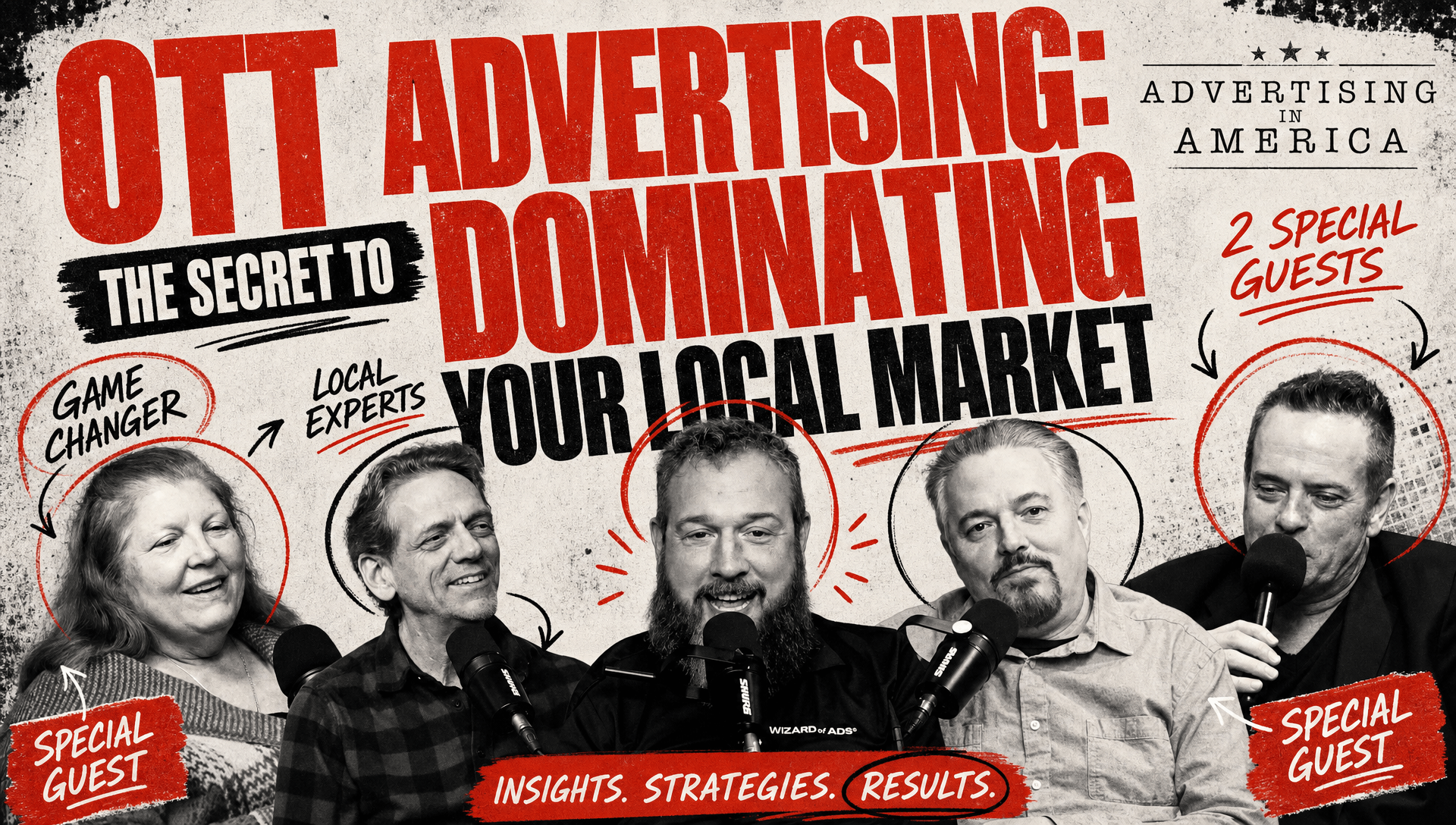
Everybody and their dog is selling OTT right now.
Radio stations. TV stations. Outdoor companies. Your dry cleaner probably has a deck.
But here's what they're not telling you: most of what's being sold under the OTT banner is overpriced, under-measured, and bought from someone who has absolutely no idea what they're doing and even less incentive to admit it.
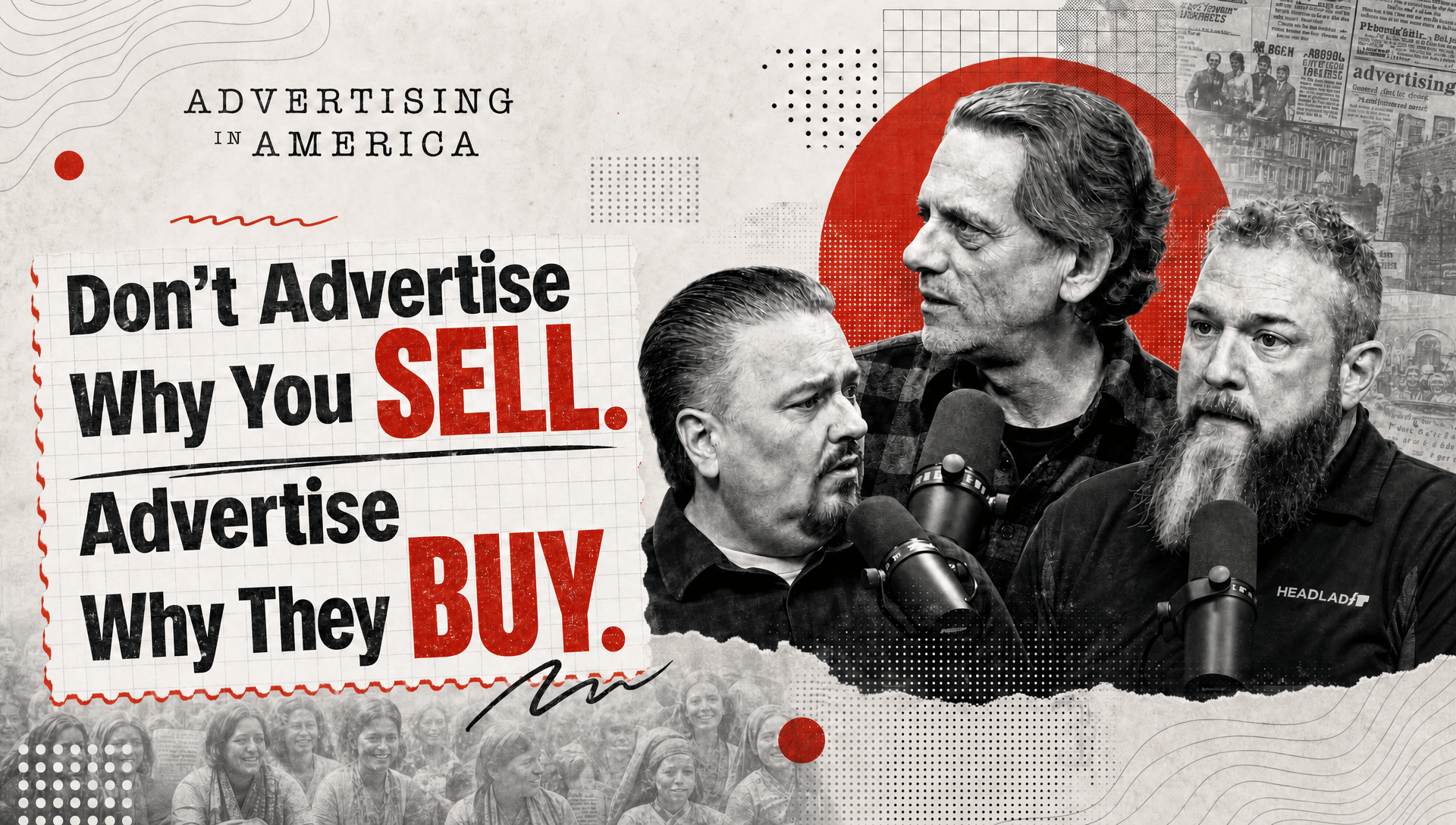
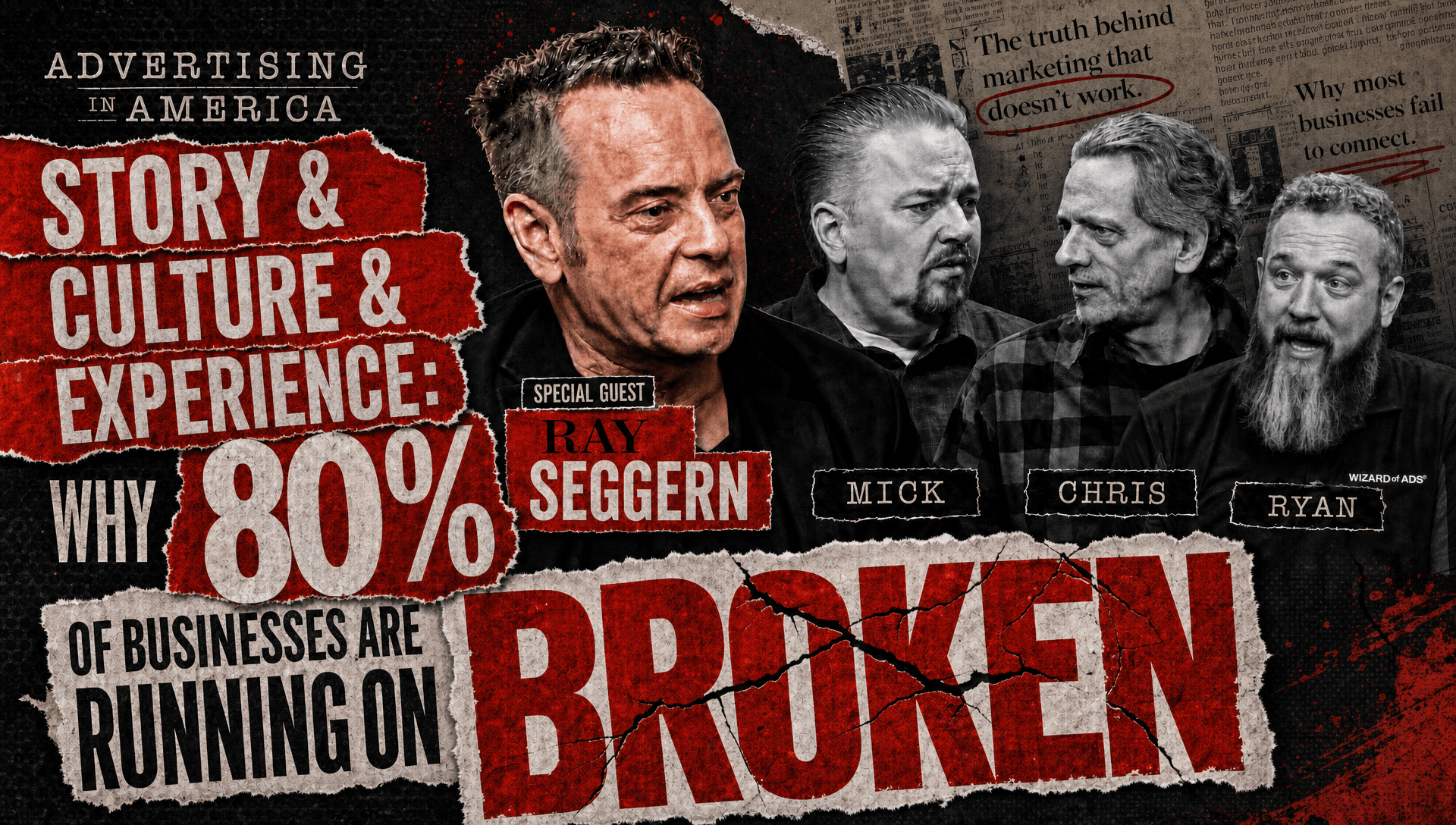
In this episode, Ryan Chute sits down with media buyer Beth Radtke and Wizard of Ads partner Ray Seggern to cut through the noise around Over the Top advertising; what it actually is, where it actually works, and how to avoid the traps that are quietly bleeding businesses dry.
The conversation pulls no punches. From Comscore's measurement sleight of hand, to the dangerous gap between impressions and actual people in the room, to the Atlanta case study where one buyer got 5,000 households and another got 25,000 for the exact same $5,000 — this episode is a master class in media buying clarity.
Because the medium isn't the problem. Buying blind is the problem.
Episode Highlights
- Media Agnostic or Media Commission? — The single most important question to ask before taking any media advice.
- What OTT Actually Is — And how connected TV, streaming, and broadcast now all occupy the same living room with different rules.
- The Frequency Minimum — Why OTT sellers push frequency caps and why that's exactly backwards from what works.
- Impressions Are Not People — The measurement gap between IP addresses, households, and actual human beings watching your ad.
- Who's Measuring Who? — Why independently verified data matters and what happens when the seller also owns the measurement tool.
- 78 Steps From the Source — Why buying OTT through the wrong vendor means paying a premium for the bottom of the barrel.
- The Atlanta Case Study — Same budget. Same geography. 5× the reach. The difference was who was doing the buying.
- Live TV Is Back — Why appointment viewing is growing inside streaming and why that changes everything for local advertisers.
🎧 If someone is trying to sell you OTT right now, listen to this episode before you sign anything.
👉 Are you buying media or just buying someone else's commission?
📱 Subscribe wherever you get your podcasts
💥 Brought to you by Wizard of Ads for Essential Services
📞 Book your complimentary 45-minute strategy session with Ryan Chute
Today, we have two special guests with us to talk about OTT.
OTT, even though it ends up a little bit more expensive on a per-person basis, for a business that's not prepared to handle a whole DMA, it's a solution.
What's fascinating now about something, if you're not looking at reliable, objective, disinterested, meaning there's no skin in the game, that the owner of the measuring tool is also the owner of the thing being measured, then it's unreliable.
Be very, just deeply cautious of who you're buying your OTT and streaming from. If you're 78 parts removed from the center, you're going to be paying a small fortune for something that you could have bought for considerably less.
When it comes to OTT, how do we know that the ads that you buy on OTT are actually being played?
Ryan Chute: Welcome to Advertising in America, where today we have two special guests with us to talk about OTT. Yeah, you know me. Okay. Are you down with OTT?
Ray Seggern: I'm not entirely down with OTT, but I hope to be more down with OTT as the show goes on.
Ryan Chute: Let's get into it. We have a wonderful guest, Beth Radke, here, who's going to talk to us about OTT and the pros and cons, the good, the bad, the ugly, and senior correspondent from Austin, Texas, Ray Seggern, who's spent many years.
Ray Seggern: From the great nation of Texas.
Ryan Chute: That's right, the great nation of Texas, who is going to talk to us about some of the challenges that he sees, some of the benefits that he's seen and what the landscape has looked like and how it fits into this landscape. Let's jump into it with you, Beth.
Chris Torbay: What is OTT?
Ryan Chute: What is OTT?
Chris Torbay: Explain it to me like I'm about this old.
Beth Radtke: OTT stands for Over The Top. It refers to anything that's delivered, content that's delivered to you over the internet, as opposed to the traditional way that we knew with the bunny ears and a TV, or cable. There's a difference between OTT and connected TV. Connected TV, of course, is just the delivery of that advertising or content through the TV that's connected to the internet. So that's the differentiation between the two. And of course, it's had a huge growth over a period of time now.
.png)
I think if you look back to 2011, which sounds like a long time ago to those of us who are a little older, but in 2011, about 83% of households were connected to cable TV. So they were primarily getting all of their content through the TV was cable-driven. Today, that number is somewhere in the 30% range. So if you look at cable subscribers going from 83 to 33 from 2011 to the current, that's a pretty dramatic shift.
Chris Torbay: So, just so that I understand it fully, what's the difference in terms of what advertising is in that content compared to cable?
So if you're watching cable and it's 2011, when we go to a commercial break, those ads come from where? How do they come from the station, and so, therefore, they go to everybody in the range of that TV station. Those ads are being run at the station, or I guess they're being run at the network, but local ads are being run at the station, and they're going to everybody in my town who's watching that through cable. Now that we are watching some of those same channels, some of that same content, but we're watching it through our computers or through our connected TVs, which is basically through the internet as well, now, where is that advertising coming from, and so then how does that lead to how we think about it?
Beth Radtke: So that distinction, the cable system, that's one platform of advertising, so those people who are watching through cable or broadcast, regular broadcast, are seeing one set of ads. People who are watching on streaming are seeing a different set of ads, and that set of ads is going to vary. I could be getting a different ad than my next-door neighbor, even if we're watching the same exact thing at the same time, which is really hard for people to understand, and it's the big difference. It's a different break than what we're used to with traditional TV, also, where there would traditionally be a series of spots that would run in blocks of five or so, and that's different on streaming. Usually, on streaming, you only see one or two. Sometimes the content is being matched, so they already have five spots laid in for a typical show, so the streaming live version of that will
Chris Torbay: Puts the commercial breaks in the same spot that they put five, if it's a drama, it's going to be the five commercial breaks.
Beth Radtke: Yeah. And because more and more streaming TV is now live, that's like the biggest growth sector of streaming TV right now, and you'll see more of a transition to that. People are watching more live sports and live news, it's really the fastest growing segment, as opposed to on demand, which is, the way we all got introduced to it, like through Netflix and some of those common places. But most households now have an average of four streaming apps that they use.
Chris Torbay: What's the opportunity for the advertiser now, knowing that people are getting their opportunity for streaming? What's the opportunity for them in terms of targeting, I assume?
Beth Radtke: There are a lot of different businesses that this would work well for, and I think when you look at who it makes sense for, it would be anybody who has a specific area they're trying to target, so a geography. We talk a lot about when you have geography that doesn't align exactly with the DMA. So say you're in a big city like Chicago, but you don't service all of Chicago. Then it makes sense to just place your advertising in the zip codes where you really want to be and talk to just those people, and then that allows you to scale up in a more natural way, rather than stretching yourself thin.
Chris Torbay: So, if you put your ads on broadcast on the major networks, you're talking to everybody. You go everywhere. If you go on OTT, I can just buy Evanston, or I can just buy a neighborhood or a couple of neighborhoods or whatever and only pay for those people.
Beth Radtke: And then you can scale up from there. We love broadcast because from an efficiency standpoint, that's the most efficient; you pay the least amount per person per year when you advertise on broadcast.
It's still one of the best vehicles. Even though viewership is changing, it's still one of the best vehicles for reaching many people frequently over a period of time, which is one of our objectives for building great brands. But I think that OTT, even though it ends up a little bit more expensive on a per-person basis, for a business that's not prepared to handle a whole DMA, it's a solution.
Ray Seggern: Hey, Beth, so I know there's a lot of new opportunities with OTT, but one of the things that we've done with my clients through the years has been cable TV, and cable, obviously, you can't target down to the zip code level. It's just whatever their predetermined zones are, they give you the grid map. And so I've got clients that have, like in Seattle, for example, we don't want to service all of Seattle. We essentially have three of the zones on the grid, of the cable grid, with I think it's Comcast there. So, two of them are perfect hand-in-glove fits, the third not so much. And so I’ve been slow to adopt OTT and connected TV, and I'm curious, as somebody who's studied it a lot more, at what point does it make sense to pull off of cable and either switch entirely to OTT or to mix it up a little bit?
Beth Radtke: I think what I'm seeing and hearing a lot of is not abandoning our successful approach wholesale, but I think some sort of measure of blending, maybe to better address the geographic concerns of the advertiser. So even if it's partially OTT, and then using your cable budget as the basis. And for us, that would be another thing we would do is take a base buy and then augment it or layer it so you have that kind of cross-cumulative approach where we're getting frequency in multiple different ways.
Ryan Chute: This goes back to the tenets of ROI and Wizard of Ads, where we want to dominate a particular medium before we start to look at dominating a second one, where we get to diminishing returns before we start seeing value in a second one, particularly one that's going to be more inefficient than the first one. So we always prioritize the highest efficiency to the lowest efficiency for cost, right? We want to keep the cost as low as possible for clients.
The second thing is, what is it that's creating inefficiency in it? One, it's a smaller market. Now, if you're only serving one-tenth of Chicago, then the inefficiency would be trying to serve all of Chicago, right? The drive times for too few trucks, all of those things would be just as detrimental to the business as spending more on the market that you are able to get to. The key is, let's get repetition in here over and over with that powerhouse message, and we'll win the game. Slow, but surely, we’re always going to be better off and we’re all speaking to the choir here, but to say it to the world at hand, it's far more valuable to reach 10% of the market and convince them 100% of the way than it is to reach 100% of the market and only reach them 10% of the way.
Ray Seggern: So frequency, the way that Wizard of Ads does marketing, that we're all on the, yeah preaching to the choir, we're all on the same page, we never sacrifice frequency. And this again, it's not just OTT. This is also with streaming radio. Nobody has ever really answered for me this idea that we want to reach them three times a week, 52 weeks out of the year, and I'm always getting pulled this way to “Just look at my gross impressions," and this and that.
How do you, what are you doing in your research, Beth, to get us to, because I know that you wouldn't be doing this if you weren't making some headway in frequency. So how are we dealing with the main thing, staying the main thing, which is, of course, frequency?
Ryan Chute: Repetition. When we speak of frequency, we're not talking about where we're tuning into, but we're talking about how often they see it a week. How often do you hear that message?
.png)
Ray Seggern: We want to do this ideally, it's at least three times on seven nights' sleep, which is the way that we like to do it.
Beth Radtke: Yeah, and we talk, I’ve talked to so many people about this over the last couple of years. It's interesting, whenever you talk about frequency, they go right away to frequency cap because that's really a standard in that OTT world. It keeps you from seeing that awkward pharmaceutical ad 50 times during one movie. So some advertisers want a cap, so that's a conversation they're comfortable with, and I'm always saying, "No, we have a frequency minimum. So don't serve me the ad if you don't think you can get me three times this week."
And the answer is the currency that all the digital platforms use really is impressions. And we're not. That's not us. That's like a bunch of reach without frequency. So having that conversation is a really important part of what we do because we have to find a way to tool the campaign so we make sure that people are getting that, and the answer is you can't do that immediately from the beginning. We have to optimize for that. So we discover over a period of time how to make sure that we're getting that certain frequency a week, and then we also want to cap at a reasonable limit, too, because we don't want to irritate people that much.
Chris Torbay: I think we've all had that situation where we're streaming something. We missed an episode, and so we go and find it on the app, and you find out that the only sponsor of that program is the same thing, and you just see that same detergent ad literally in every break all the way through the show. And you think, "I can't believe the advertiser wanted this to happen." I'm sure they love to have frequency, but in their desire for frequency, this is not what they wanted. This is definitely not what they wanted. How can you let this happen?
Ryan Chute: That's right, and we have to recognize these things as strategists when we're putting this together. If we know that we're getting an overabundance of repetition, even within a show, let alone a week.
Chris Torbay: Yeah, exactly. I don't want it to happen tomorrow when I'm streaming the next episode. Oh, my God, it’s another five airings of the same commercial.
Ryan Chute: Then what we have to be cognizant of is if that's happening, we have to be ready to swap that ad, which then goes towards the cost of production of those ads. So now we're looking at, not just the cost of getting the thing produced, but the actual purchasing of those products. So, we're not advocates of any particular channel. We're media-agnostic people. We do not care about which media channels we use. We care that the right strategy and the right messaging is used for the channel that's being deployed.
And that's a fundamental break because we're talking about repetition where everyone's capping it. We're saying, "No, we need to have at least three hits a week in a healthy environment." So there are ways that we can cheat with this.
And a few of them come up, like on streaming, you have very little control of that one after the other kind of scenario on OTT, that's mildly mitigated through, for example, the news. Not all OTT is created equal. I think that's one of the things that you and I have spoken about, Beth, is the smart TVs? So you can get your local news on your smart TV directly, almost like it used to be broadcast, right? Like it used to be, the antennas. Now it's just right there, and you can pick the news and watch the six o'clock news live, which is what you're going to do. That's a great option for clients. And then you can cycle those out. So, it's not just that we're only servicing a certain market. It might be, say, I want greater reach, and this is a relatively low-cost, low-efficiency, but still lower-cost access point to just reach people on the news.
Beth and I talk about Nashville and getting a $12,000 spend on TV ads for just running news in Nashville for the week for a month is the cost. So $3,000 or $4,000 a week. Was that worth it? Yes, because we're getting in front of the same consistent group of people. Now, if we run it on two different OTT platforms, one is the smart TV, but then Beth gets it on another OTT set of premium channels, be it specific shows or news, but different broadcasts. Now, all of a sudden, we've got two markets and we, we're not getting maybe a 10%, 20% overlap.
We’re guessing, no one knows. But now we're talking to two distinct markets, but they're consistently seeing the thing. So it, it is about being hyper strategic about it and figuring out, yes, if this is what we're dealing with, and yes, if people are cutting cords, and a way to get additional viewers consistently is to use this channel medium, then great. We go forth and figure that out.
One of the big challenges in California right now is with a client that's not in the LA market, and we have to solve for that problem. So it's what's the problem we're solving, and then how do we solve it in a way that's not going to mess with the game?
Ray Seggern: So, we're at the game has gotten way fiercer than it used to be. It's more ferocious. And as a guy who came up through radio, I knew radio enough to buy my own radio when I went out as a Wizard partner in 2006. And it was easy enough to morph that into a strategy to buy television, right?
So in a town like Sacramento, you've got ABC, CBS, NBC, and here comes Fox. You got the cable company, you got all the radio stations. There is a closed ecosystem of about 17 people I can go to, and I can buy any radio or any TV I want.
What I still don’t understand is how it works, and why we need the Beth Radtkes of the world who are going to devote the time to really stay on top of this. And this would be my cautionary tale for owner-operated businesses that think they're going to go it alone. Buyer beware, because I'm reasonable, I'm sophisticated enough to know that I'm getting out of my depth here at this point, right? Because I look at, okay, so you've got three, I'm not sure what Fox is doing, but obviously got Paramount Plus, and you got Peacock, and you got ABC, through Hulu, and Disney+, so those are the three networks.
.png)
Ryan Chute: You’ve got Prime.
Chris Torbay: You’ve got Netflix
Ray Seggern: We’re going to keep going. You've got Prime, but you've also, before you even get to Prime, you've got access to a lot of those same programs via YouTube TV, via Sling, and all of the cable alternatives, right? So now it's oh, and by the way, iHeart and Cumulus Radio groups, they both want to sell you OTT TV now, too. So it's like all of a sudden my neat, nice, Pleasantville kind of world where I had 12 people to go to, now it feels like it's 37, or is it 137? I honestly don't know if it's 37 or 137.
Ryan Chute: It's both, and I'm going to have to defer to Beth here, but there's, you're talking about two separate things.
It's valuable for the listeners to divide it. One is that everybody and their dog is selling OTT, and not all OTT or streaming is equal, and you may be buying it way downstream of the actual seller, and you may not be. So knowing that and then knowing how you can affect repetition, all deeply crucial to the actual strategy working or not. The second is that yes, there are just an infinite amount of actual real media channels because as the media landscape is shifting and people are either diversifying or trying to bundle, you end up having to deal with so many different players to view the landscape.
And measurement becomes damn near impossible because there is no cross-cumulative measurement of if they watch Prime, they also watch Paramount at its exact levels. In the good old days of radio, and today, even today, we can say without a shadow of a doubt exactly how many human beings in Sacramento will watch it.
So, Sacramento is an interesting city compared to Orange County. Where Sacramento is a city, and we can run strategy in a city way different from how we'd run in Orange County, which basically is getting all of the media coming in from LA. So the layers of where media lands is very complicated. Another complicated one, Jersey, New York markets are the same.
Ray Seggern: Any of those top 20 markets, really, if you think about it, and especially for, we have so many clients that are home service companies, right? So, especially where traffic becomes a thing, too. There is definitely value in geographic targeting. If you can't fish in the bigger pond, you have to create a scalable universe to be able to air your message in.
Beth Radtke: Like, we have somebody in Chicago, they have 10 trucks.
They can't service all of Chicago. They'd be using all their time on windshield time. So, the most efficient use of his media budget, even though he could afford, we could buy some radio for him, but he would be using all of his time, having people all over that city.
Ryan Chute: The flip side is that they'd be saying, "No, we don't service there," which burns you for when you want to service there.
Chris Torbay: When you grow beyond 20 trucks and with a second warehouse, you can suddenly service the South Side. And now people go, “Oh, yeah, I tried them once.”
Ryan Chute: And that’s the kiss of death as much as anything else. So the strategy is specific to the client's exact need. Even in the same city, we could have five different strategies going on with five different clients, all with different needs, at different sizes, and growth, and capacity to service a city.
In LA, if you don't have five distribution points, you don't do LA. You wait until such time as you can handle the city because drive times are disproportionately bad in that city. For sure. Boston's not uncommon to that, as well as New York in the boroughs.
Chris Torbay: There are a number of cities that have a choke point in terms of commuting, and if Boston, if you want to do the south suburbs, there is one bridge, and so to get in or out of there, you have to choose to be on one side or the other, and we have the same thing in Mobile (Alabama). If you want to go east of the city, there is one.
Ryan Chute: It's like you're going into a different universe to do that. It’s like you have to be prepared operationally to do that, and sometimes that's where even our messaging strategy will shift, as it's allowable, when we can actually play the game that's meant to be played, that was always meant to be played, but not until we're at that spot. So all of this is so deeply interconnected and deeply valuable
Ryan Chute: Why do we focus on OTT in this? But because, one, we like to have a single topic per conversation, but it's a fascinating conversation because so many people are being hit with OTT because there's so many sellers of OTT.
Beth Radtke: Everybody's selling OTT now. Pretty much anybody I would talk to about buying media fm, so that's radio, TV, outdoor and then, pretty much anything else in between, everybody's selling OTT and some other digital services. It's at least worth a conversation to look at and just help figure out and make sure that you're getting the best sourcing for whatever you're buying or interested in buying and, just looking at that because when you have people who that's not their main area of expertise, it gets harder to know if you're really getting the right thing.
Ryan Chute: I recall two within the last four months of having them send me over a client who had been presented without our media buyer being on hand, and was presented OTT options. It wasn't 10 seconds that you could see the massively glaring misconceptions that were being portrayed from broad rotators, to timings, to total amount of access, or ad points that were being put out into the marketplace, where they were going to be done. The amount of absolute nonsense that lives out there that we can now reinforce with Comscore, right? Comscore is the biggest scam on the internet in the universe right now. The Comscore is the company that will make up any number in the world that the media channel wants to convince you of the dumb bullshit that they're up to.
Mick Torbay: And we're going to get sued.
Ray Seggern: The opinions expressed by Ryan Chute, may or may not…
Beth Radtke: The views expressed here….
Ryan Chute: These are opinions only. But this opinion is derived off of the absolutely deviously misleading information and terminology being used to convince people that they're getting something that they're not.
Ray Seggern: Here’s the thing. What you've got is you've got companies that are developing their, “We will measure ourselves, and we will share..." And then they start to do this thing where they spread the glitter and the fairy dust on it, and before you know it, you've bought into looking at what…
Chris Torbay: But that's always happened. Radio stations have done that, TV stations have done that. It's a new area, and they’re doing it too.
Ray Seggern: For sure. But Nielsen has always been measuring TV. Arbitron always did a good job with radio, and then Nielsen bought Arbitron. That's a whole other conversation. But still, generally speaking, reliable metrics that we could count on through the decades of the history of broadcasting, there was obviously an evolution in measurement. Radio went away from a diary system, but there's still a lot of diary markets in America. And you have to look at their data differently. But what's fascinating now about something, I'm not going to single out come, but ComScore's not the only flagrant offender in this deal.
Ryna Chute: It's not. No.
Ray Seggern: And the thing that I will say is if you're not looking at reliable, objective, disinterested, meaning there's no skin in the game, that the owner of the measuring tool is not the, also the owner of the thing being measured, then it's unreliable. It's fundamentally, systemically unreliable.
Mick Torbay: In the past, when you were buying a radio campaign or buying a TV campaign, you didn't just have to take the TV station's word for it that this many people saw your ad. There was an independent organization that was actually measuring it, and they could do it to a mathematical certainty, within one or two percentage points, 19 out of 20 times. They actually know how many people are watching this channel, and how many of those same people are watching later that week, so that they could calculate how often they see it. So when it comes to OTT, how do we know that? How can you prove, or how can we independently verify? Explain to our audience, who's independently verifying that the ads that you buy on OTT are actually being played to an audience?
Beth Radtke: There are standards that are held throughout the digital industry that help measure, and there are standards that they hold up.
Mick Torbay: Because, for example, I know when it comes to pay-per-click on Google, the way you know how many people have seen your ads is that Google tells you. How does it work on OTT?
Beth Radtke: It's the same. The platform is measuring it for you. But it is an audited, and they have to. There’s a standardizing industry that measures OTT.
Ryan Chute: And they're measuring the IP. They're not measuring people. They're not measuring a person in the presence like Nielsen, or any people meter subset.
Beth Radtke: Yeah. And that it’s measured individually.
Ryan Chute: And that it's not fluffy.
Beth Radtke: It's by household.
Ryan Chute: That the dog's not being kept company by the TV rather than Mrs. Jones watching your ad. And the definition of people, for example, is within question when you actually say, “Should I even have to ask what the definition of people is?"
Ray Seggern: What are we doing here? Come on.
Ryan Chute: But apparently, that's a definition that you have to ask when you're being served up this information. Which is very true to what you said earlier about impression. An impression is not people, and impression is total potential reach, and they're not telling you, "Oh, here's how long they watched it for," and they have all this information, whether or not there was somebody in the room, whether or not there was somebody paying attention, whether or not all of these things that actually matter in the measurement are true.
We have to find ways of cheating the system based on what we know about human behaviour and the system.
Like the propensity to fast-forward through a thing or skip, or to watch the ads. It's funny. I was sitting in my in-laws' place, and they had the curling on, and they were watching the stuff, and the ads just played. They didn't fast-forward through the ads and stuff. They were just like, "Whatever." Just like, "Let them all play."
Beth Radtke: And that's what we're seeing is the level of engagement and even response to advertisers is different during live TV. People consume it differently than if you're watching your 30th episode of Game of Thrones or whatever it is.
Ryan Chute: The binging.
Beth Radtke: So it's just a different type of viewing. It's more, it takes us almost back to traditional TV viewing where it's appointment TV, like the news comes on at 6:00.
Ryan Chute: In a world where you wouldn't think that was still a thing, it's still a thing.
Ray Seggern: It is. And it makes it interesting, and Beth, by the way, I just want to say, because we're all here going, "But Beth, what about this?"
Mick Torbay: It's because we don't know stuff.
Ray Seggern: And I'm very much picking up from you that this is still very fluid and it's still developing? And I think, I look back on one of the fundamental things that I've, that has been, like, hardest to wrap my head around is if I buy a spot on the 6:00 news on KXAN in Austin, I can go plant myself in front of the TV, get my rabbit ears out, and see if the spot ran.
Chris Torbay: Bring the family around. “Hey, Daddy’s spots are about to run. Come on, everyone."
Ray Seggern: And now it's like I bought 1,000 gross impressions, or did I?
Chris Torbay: And you might not be any of them.
Ray Seggern: Did they play?
And so I know that, and through the years, on some level, radio groups like we used to work at, or TV groups, they deliver an affidavit that's a proof of performance that says, "We ran this spot here," and it's got a little stamp on it, and somebody is saying legally, "No, we guarantee that this is what we did." But you could have a trust but verify when you could go watch the spot. Now you can't do that anymore.
Beth Radtke: And when you buy a campaign, like I could be served the ad, my next door neighbor, even if they're watching the same streaming show at the same time, may not get that same ad. So, for any number of reasons, in that way, I think it's confusing for people because if you knew it only as one way, you're trying to make those two worlds make sense.
Ryan Chute: Let's talk about some of those OTT and streaming buying best practices. One of them being, is to be very deeply cautious of who you're buying your OTT and streaming from, because not all sellers are created equal. If you're 78 parts removed from the center, you're going to be paying a small fortune for something that you could have bought for considerably less. You're going to get showing up in one of the three kind of common areas of OTT:
- the local OTT,
- the premium channel OTT, and
- the garbage channel OTT.
And we know this is true from television statements, as certainly in cable programs, where if you're on the animal channel at 3:00 in the morning, is that as premium a spot as the news at 5:00? No. There's a reason why you're paying premiums for certain things. The other is having a provider who is providing you with some semblance of the ability to drive repetition in the appropriate manner through the strategy or through the actual systemization.
What other best practices should we be paying attention to when we're looking at buying OTT?
Beth Radtke: What you were talking about, making sure that whoever you're dealing with has access to those publishers, at least, some sort of decent connection with them. Some of the larger providers will have that. It shows that they get better inventory. Otherwise, you end up with a campaign that's running in just a bunch of junk places. And even the fast channels like the free ad-supported channels, which a lot of people are familiar with, you don't want all of your campaign showing there. That tends to be a lot of younger people; it's like reruns of whatever. Those just aren't as good at capturing people the way we want to. And some of the things that we do about how to reach people with frequency, so those are the main questions that we focus on are how to make sure that you're getting in the right programming, where you're engaging people, where they're going to be paying attention to our clients and, that they're being seen and remembered, and that has to do with content. That's why you see more of the live content growing currently than any other type of OTT.
Ryan Chute: So there's a part of it that I'm hearing that is emotional environment and surroundings, or putting yourself in a place that's surrounded by other high-value kind of emotional impact trust factor, and everything else.
Live news compared to the 78th rerun of MASH. A different emotional environment. Not to say MASH is bad, MASH is amazing, but at the end of the day you're showing up at a time and a place that's not going to have the same level of impact not necessarily the same type of people watching that are going to be most likely to buy your thing, particularly in home services or higher average tickets, longer purchase cycled items where people have the means to buy your thing.
.png)
Beth Radtke: I think context is important. Seeing advertisers in the environment seems to make sense for them. I expect to see certain national brands on the big, like on Netflix. I expect that. I like the idea of a local advertiser in local content. That makes sense. It's just in the right place with something that's related to their business. The right environment, definitely, I think, makes sense. Finding the places where we think that people are going to be actively consuming. News, for example, is something that more than one person tends to watch. If a household's watching, they're watching. That's News, but otherwise, a lot of TV, OTT has become like a solo sport. People are watching on different screens in different parts of the house.
Ryan Chute: Different rooms, and each TV now has your local news, like if you're showing up on the local news on your smart TV device, that person is less likely to be watching the news on another type of service as well. They've got their favorite when it comes to the News. Be it both the channel and the time of day that they're watching it. But that's a bit of a cheat. If we think about it, that's a way that we can get in front of the same person consistently, which is the most important part here.
Chris Torbay: I go to say, I feel generally encouraged by this whole thing. There are all the caveats that we've all been talking about, whether the numbers are right or how we get the numbers that we actually want not the numbers they're giving us. But in the context of an episode we’ve done before, on whether or not the TV-30 is dead, we talk about this all the time. "Oh, nobody listens to the radio anymore." And we always counter it with Nielsen, which will tell you who is still listening to the radio. So yes, just because you have Spotify doesn't mean that there's nobody listening to the radio. Just because you watch streaming doesn't mean nobody's watching broadcast.
But at the same time, yes, broadcast television is declining and broadcast radio is declining, and so people wonder whether they should still be doing radio ads and TV ads. If this OTT thing is the new way, and if we get those numbers right, we get the data that we need, and we can prove it. What it also shows is creating radio campaigns, if sometimes those ads are going to be on regular radio and sometimes, they're going to be streamed into your podcast and doing TV campaigns, again, some of them are going to be on broadcast and some of them will be on OTT, is still a great way to build the brand for your business in two media that we know are great for building brands.
Ryan Chute: Yes. And can be repurposed too, right?
Chris Torbay: While some of its origins have atrophied, it looks like this is growing in that place. And now we, yes, we've all switched to Netflix, but unless you're paying the premium price, it's got TV ads. Just like TV did.
Ryan Chute: In an early episode of Advertising in America, Mick had alluded to the fact that TV is still TV. That the place where one watches TV may have changed, but TV hasn't gone anywhere. Radio is still radio. A podcast is just another version of long-form radio. It hasn't gone anywhere. Strategically, is there a place for all of these things, depending on what it is that we're trying to achieve? The answer's absolutely yes.
But there are also places where you're just wasting your money. If we're going to take care of your money from a consulting and then in a strategic standpoint and say, "Hey, if we're treating your money like it's grandma's, I'm going to put it in the most efficient stuff first, and then I'm going to drive it down to the least efficient stuff based on what you have for budget as soon as I've optimized at each level."
And that's as simple as that sounds, there are 37 of these different options now, where there used to be 12. And you could talk to six people, or five people or three people. You're talking to 20 now. The job is astoundingly difficult, and then to get it all mixed together.
Ray Seggern: I think also in simpler times, Beth, one of the things where we just keep it simple is let's treat these people as commodities traders. This radio, very few radio stations I wouldn't advertise on, and obviously, it depends on the product or the category that we're in. But for the most part, you can reach good customers just about anywhere. But there was a finite number of radio options. There was a handful of TV options. You figured out how to triangulate cable as being kinda like broadcast but a little less, and now it just feels like the thing that's frustrating for me is I can get access to the six o'clock News six or 16 different ways. Is there an advantage, maybe, to just go into the source and just buy your OTT from you, keep saying get as close as you can to the source? So in Austin, Texas, would I not just go to KVUE, KXAN or KBVO and just get my OTT from them?
Beth Radtke: Yeah, absolutely. I think the other thing, though, that we were talking about earlier is, remember that your salesperson is incentivized to, and so you just have to weigh what all those things are. And that's what we try to do, just look at things. We call ourselves media agnostic. I don't have any dog in that hunt. I don't need to make a commission from a specific growth of a digital product. So it's just making sure that's balanced in the way that makes the most sense and that we think it's going to perform.
Ryan Chute: And having that negotiator on your side, I can think of two recent experiences with Beth in these really weird markets where we're not servicing a full spectrum market in any particular way, and had to use one platform or another to make these buys.
Ray Seggern: So shrink in the universe, so that you don't have the whole metro area of a larger city?
Ryan Chute: So we're creating trade area efficiency over, over reach efficiency. And ultimately, one example comes to mind quite quickly, Atlanta, Georgia, and where the last OTT guy had set up a like, "Let's just get in the house anyway we can," he managed to spend $5,000 a month on 5,000 households with about a one-and-a-half frequency a week. Which is really at the worst edge of bare bones that you could possibly get.
Where Beth comes in that exact same footprint and gets 25,000 homes at the exact same $5,000 at a 3.0 frequency. So when you start to look at when you have someone who knows what they're doing, you can pay them the money, you're going to get five times the result, right?
Yes, you had the same budget. But one, you spent $5,000, and it did nothing and two, you spent $5,000, and it did the thing. The whole point here is if you don't have repetition with a salient, strong, powerful, emotional driven message, and you don't have enough households, you've missed it three times.
We have to shift all of those problems. Buying it and just buying it for the sake of buying it doesn't solve the problem. It can, in fact, just be a burden on your business; you're in a small market, you're already inefficient, and you're already only talking to 25,000 homes. You're making it worse by talking to 5,000 of them so infrequently that they don't even remember you from the next week, one week to the next,
Mick Torbay: See, I'm a little concerned because we keep using a word that we use a certain way, and it's an inside baseball thing, efficiency. We've all said efficiency and/or inefficiency. Beth, can you define an inefficient buy so that we all understand what it is that we're talking about, media buy efficiency? What is an inefficient buy?

Beth Radtke: For our purposes, what we're trying to do is get the lowest cost per person per year. That is one of the ways that we look at it. That’s a way that a business owner can understand it.
Mick Torbay: How does a business owner know that when he goes to a radio station or a TV station, or an OTT salesperson, how does the business owner know that this is an efficient buy versus an inefficient buy?
Beth Radtke: We'll tell him or her.
Mick Torbay: So this is not something that's easily calculated.
Beth Radtke: It’s hard to understand the salesperson, and that's the other thing is I think media sellers haven't been all that good at breaking it down for clients. I feel like we do a pretty decent job of trying to just keep it on one sheet and explain it in a way that people can understand. But our objective is to buy the most cost-effective way, so the least cost per person per year first, and make that your base layer till we get to 50% of the market.
We're trying to reach as many people as we can with that frequency of three or better a week, and then layer on top of that. I'll buy more expensive people later on, but for my base layer, I want to buy it the most cost-effectively that allows us to reach the most people.
When I'm buying something like this, it ends up being more expensive, less effective…
Chris Torbay: Per person. Per year, it's more expensive.
Beth Radtke: Yes. It's more expensive.
Chris Torbay: But also without the wastage. If you have to buy all of Chicago and you can only serve one-fifth of that pie, then the math would be the wrong way, which it would be cheaper per person, except you have to throw out four-fifths of those people.
Ryan Chute: Just look at the Atlanta example. $5,000, at 5,000 people, is effectively 52 bucks to talk to that person for the year. At $5,000, but it's only $2.40 for the other person. So I can talk to you for $2.40 times by, right? All of a sudden, and now I'm talking to 25,000 people, I'm not talking to 5,000 people. Those are the two efficiencies we see. One is almost double, over double, and it's 1/5 of the people.
Mick Torbay: Will the salesperson who's selling me this break it down as clearly as this?
Ray Seggern: Probably not.
Ryan Chute: Maybe just an independent person could. Almost certainly not. They’re going to break it into a gross
Mick Torbay: So, how would I protect myself from that?
Ryan Chute: Hire Beth.
Mick Torbay: She's not the only media buyer at the Wizard of Ads organization, but someone who’s independent of the media providers. Whose business card doesn't say a “media company” on it.
Ryan Chute: 100%. And somebody who has had the opportunity to dig into it and understand it. It's probably taken you quite some time to just sift through this as an experienced media negotiator on both the selling and buying side. What did it take for you to get where you are today? It can only possibly be 10 years of experience, because you're only 30 years old.
Beth Radtke: It's been really surprising because I'm talking with other media professionals and people who I think know what they're doing, and I feel like I am constantly asking 100 questions. I feel like I'm asking the same questions over and over, not really ever understanding what the answer is, because they're, again, living in their world where their currency is impressions.
Our currency is frequency.
I need to find a way to convert that in a way that makes sense with the way that things are changing, and I want to be able to do that and find the most effective way for the clients we work with to do that. But because of the changing industry, I think they're all trying to figure out their sales mojo and sure, some people are happy to buy on impressions. It doesn't matter to them.
Ray Seggern: I think there's another important thing that, and I don't want this to be, "Wizard of Ads is the best media buyers ever. Come buy,” and “If you don’t believe me, ask me again.” Trust me, we are.
Ryan Chute: Sounds like we're the salespeople that are trying to sell it there.
Ray Seggern: So here’s the check, this out, and that's exactly where I'm going. There's a much deeper truth here that I want to make sure we connect to the important thing that Beth just said, which is we really pride the way that we approach things, which is we're never making a commission on any advice we give you.
Ryan Chute: None.
Ray Seggern: We don't benefit ever that you spent this amount of money here, there, or elsewhere, and it profited me or Beth or Ryan or anybody more because a specific channel was recommended. Our only care is what is the highest and best use of the client's money because we're in it for the long haul, and every year, every 52 weeks, we measure the last 12 months of sales.
And if you're up, if you do better, we do better. That's how we make more money, by growing your company. You cannot say that about any direct seller of media that is making a commission off the thing they're advising you to buy.
Ryan Chute: And that's, I think, alludes to Mick's point about efficiency. They're motivated to sell you an inefficient buy because they make more money when they sell more
Ray Seggern: Now you're stoking my trust issues even more now. Beth was getting me closer to wanting to buy more.
Ryan Chute: But navigating that is a challenge. It is a real bear to get your head around, and there are so many people selling something, they don't know what they're selling. And some of them are just so far downstream that they've, everyone's getting their piece along the way. And we have to sift through that. Cutting past a lot of that, like just cutting a lot of the fat off, is a big piece of this. And, being curious, I think the biggest takeaway from today's conversation around OTT is, is this an efficient buy? Are we talking to a heap of people with the right repetition every single week with a message that matters?
If we're not, let's reassess what the message is first, and then figure out the best channel to deliver that on that keeps our budget in line and gets the results we're looking for at meeting or exceeding expectations. And then stack those as we start to get past diminishing returns.
I don't know that there's more to the story than that when it comes down to it, because there are so many little nuances we could just get down the rabbit holes again so easily as a sum up. But that really does, I think, encapsulate what we've explored here today.
Thank you so much for watching Advertising in America. We'll see you next time.
Thank you for joining us on Advertising in America. We hope you enjoyed the show and captured a nugget of marketing magic. Wanna hear more? Subscribe, leave a review and share this podcast with your friends.
Do you have questions or topics you want us to cover? Join us on our socials @advertisinginamerica.
Wanna spend your marketing budget better? Visit us at wizardofads.services to book your free strategy session with Ryan Chute today.
Until next time, keep your ads enchanting and your audience captivated.

Advertising in America
The podcast that turns marketing into magic! Hosted by the brilliant Ryan Chute and the ever-entertaining Michael Torbay & Chris Torbay, this show dives deep into the world of American advertising, revealing the secrets behind the most successful campaigns and exploring the latest trends.
Share this:





%20(1).webp)
.webp)
.webp)
.webp)

.webp)

Nothing to see here!
Nothing to see here!