Your brand has a story. The question is whether it's true.
Most businesses think they have a culture. They have a summer picnic. They have a mission statement on the wall. They have a boss who reads leadership books and then shows up late on Mondays. That's not culture. That's a fairy tale with fluorescent lighting.
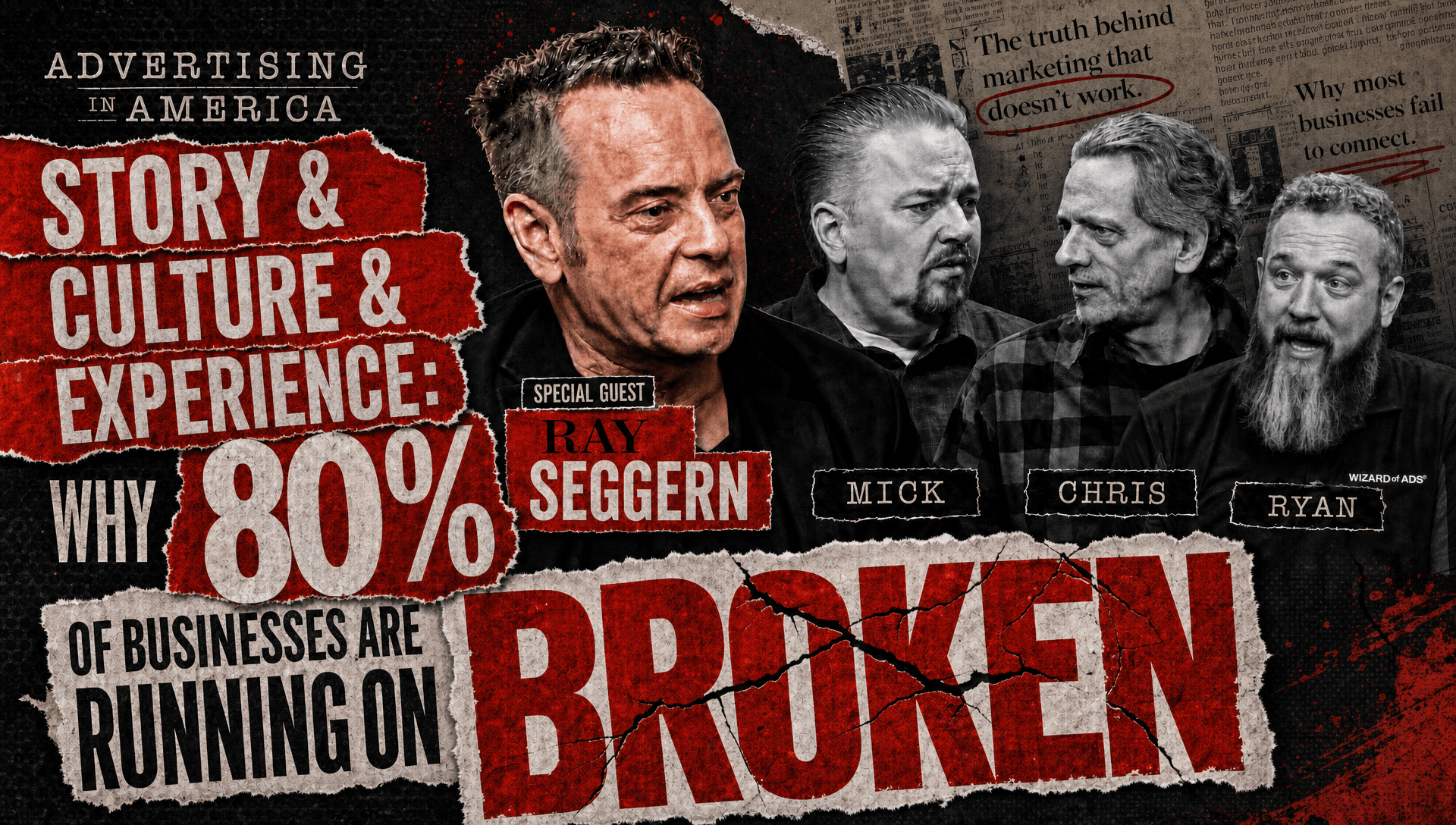
In this episode, Ryan Chute and the Torbay brothers sit down with Wizard of Ads partner Ray Seggern, author of the forthcoming book Story & Culture & Experience: A Field Guide for Finding Your Awesome, to break down the three forces that determine whether a business becomes iconic or invisible.
Story is what the market believes about you. Culture is who your people actually are. Experience is what your customers actually feel.
When all three align, you don't have customers, you have champions. When they don't, no ad budget in the world will save you.
This conversation goes deep on why advertising is secretly also a recruiting tool, how the boss's behavior predicts the team's behavior, and why the organizations that are hardest to fix are often the ones who most need fixing… starting at the top.
Ray doesn't sugarcoat it. Neither do Ryan, Mick, or Chris.
Episode Highlights
- The Three Circles: Why story, culture, and experience are inseparable and what happens when any one of them is missing.
- Culture on Accident: The businesses that are quietly brilliant but invisible and why that's a fixable problem with a powerful upside.
- What You Emanate, They Will Emulate: How leadership behavior sets the behavioral standard for everyone below it — for better or worse.
- Every Consumer Ad Is a Secret Recruiting Ad: How the story you tell the market is simultaneously shaping who wants to work for you.
- The 80% Problem: The uncomfortable reality about how many businesses conspire to bend the truth — and what that does to culture from the inside out.
- Assholeism: Ray's favorite chapter. The uncomfortable self-inventory that most bosses will never take.
- Does Your Business Have a Soul? The final question in Ray's book and the most important one in this conversation.
🎧If you've ever wondered why your culture keeps breaking down, why your best people keep leaving, or why your story doesn't match what actually happens inside your walls this is the episode.
📱 Subscribe wherever you get your podcasts
💬 If your story disappeared tomorrow, would your culture still tell it, or would no one notice the difference?
💥 Brought to you by Wizard of Ads for Essential Services
On today's episode of Advertising in America, we have a special guest today, Ray Seggern.
The thing I love about Wizard of Ads is we're empowered to select those kind of people. We're taught early on from our founding partner, Roy Williams, that you should sniff out what a client's all about, and it's not just about whether they're going to be astronauts when they grow up financially. It's also whether or not they're going to walk the walk, and be reputable and all those things.
Mick and I like to say this in a lot of the brands that we work on, where when we're doing advertising, the advertising is aimed at consumers, but it is secretly also saying something.
What would you, as a culture expert, how do you say to the boss, "Hey, maybe the problem's you?"
And it's not, maybe not even a nice one-day thing, because if you don't like the people you work with, now you're being forced to come to. I don't know what story I'm on.
And that boss that you're about to quit from is drunk.
Ryan Chute: On today's episode of Advertising in America, we have a special guest today, Ray Seggern, one of the Wizard of Ads partners, who's going to talk to us about story, culture, and experience. This is the thing that got me to join the Wizard of Ads, and I'm excited to talk about this today, so welcome, Ray.
Ray Seggern: Thanks. It's really good to be here. And Ryan, thank you for all the support, man. That's some pretty tall praise. You've made quite an impact, moved a lot of mountains in the Wizard of Ads world, in the almost decade now. Eight years? Nine years? So, to acknowledge this little bit of mind craft to be what got you involved, or wanting to get involved, it’s pretty tall praise. Thank you.
Ryan Chute: It is. It's exciting times, and the reason why it did, and before I say that, Mick, why don't you come in? Welcome in. Come on in.
Ray Seggern: Mick does like a little Madonna wardrobe change, I'm noting. It's like between songs- yes... he runs backstage
Mick Torbay: Once every two weeks, I change my shirt ...
Ray Seggern: Gets the pointed brassiere on and then comes back out. Every two weeks ... and then comes back out and
Ryan Chute: It is amazing how he always still has the same socks on. Every time.
Mick Torbay: If you knew me, that wouldn't surprise you at all.
Ryan Chute: So yeah, he's got 78 pairs of red socks.
So the reason why story, and culture, and experience was so impactful for me when I first heard it from Roy, who referenced you in the first Wizard of Ads Magical Worlds class at the Wizard Academy in Austin, Texas, was that it spoke to me because I'm a sales guy, I'm an operations guy. I'm a person who builds systems and processes and strategizes from a business standpoint. I wasn't a writer; I wasn't a media buyer. And I was looking at it, going, if there was something that I was missing, it was probably more of the story at that time. What I came to find out was that what I could contribute to the Wizard of Ads more than anything else was the culture and experience side, and that I've grown to believe in David Packard's quote from Hewlett-Packard, “that marketing is far too important to be left to the marketing department.” And this is the epitome of that, with story and culture and experience. There's a book coming out next month. Next month, we're excited to read this in depth. But take us through the Coles Notes, the high-level version of what this is all about.
Ray Seggern: It's Story and Culture and Experience dropping it next month, A Field Guide for Finding Your Awesome, and it is about business owners who know something's amiss, right? What are the KPI? What are the measureables that might be amiss?
Maybe you can't hire people and keep them. Maybe you know your marketing kinda sucks. Maybe you should be making more money. And I believe that just about any- and not just businesses, but a nonprofit, a sports team, a family unit could take this lens and apply it to what's going on, and you could figure out what's right, what's wrong, and what's missing. And therefore, use that to affect change that would allow you to get better. It all started when I was hired by Roy Williams, founder of the Wizard of Ads group back in 2004. I was one of his in-house writers. And a lot of people think Roy must have mentored you. You were mentored at the knee of the master there." It's like, "No, here's the three books, and it helps you figure it out. And, if not, Tom Walters is next door, Corrine Taylor's up the hall.” So I devoured the books, and in particular, I devoured the advertising performance equation, which says that the components that we usually think of, the salience of the ad, which Roy calls the impact quotient, the share of voice, how good is the buy, and then the market potential, would kinda be the three things.
But there's this, there's a fourth factor in there called the personal experience factor. And it is not the experience you deliver, but the experience that your organization delivers relative to the expectations. I’m absorbing all of that. It was several years later, and it was the first day of the year, the second day of the year, I'm on the way to the gym, and I hear a story on NPR, on Morning Edition, called, or the theme of the story is, does expensive wine taste better? And that brings up for me that. So that ended up being the jumping-off point for my TEDx talk that I gave back in 2012 in San Antonio.
But somewhere along the way in developing that, I was like, “Wait, there's a, there's something missing here," because a lot of my clients, home service companies at the time, but also jewellers, car dealers, and everybody were having a really difficult time attracting and retaining quality employees, and a lot was made of that. The brain drain, the mind flight, the whole gig economy was coming on at the time. And what I realized was, and this is where I kinda had my Archimedes moment. I jumped out of the bathtub and went running down the street. Eureka! There was a missing factor there. The personal experience factor applies to customers, sure, but you can also point it inward. The personal experience factor of your team is the predictor of culture.
So that's how it all got started, and then I came up with the overlapping circles in the Venn diagram to see what happens when story and culture are aligned, what happens when story and experience are aligned. So that's how I started exploring it. And then, a very lengthy decade on, it's ready to go into a book now.
Ryan Chute: But tell us about the three buckets. Tell us about these three independently, and then how they overlap.
Ray Seggern: Okay. So, story is a combination of everything that is being said about you by you and by the marketplace. So it would include your advertising and your marketing, but it would also include reviews. It would start with what people could read on your website. But in an era of social media, and where review sites are so prevalent, what's changed, maybe since those original Wizard of Ads books, is that the story is no longer a linear one-way offering from you to the market. It's now very much three-dimensional. All communication is a feedback loop anyway, and that's probably more indicative of what's really gone. Now, along the way, it has become so much more exponentially powerful to the degree to which you can't control your own narrative. So that's story.
The experience, depending upon what it is that you do. It is the level of service that you provide. If you're in the ice cream business, it's the quality of the ice cream. If you're in a restaurant, it's the quality of the food. If you're a car dealer, it's not only the experience that you deliver on the lot, but it's also the quality of the car, it's tangled up in there as well.
Culture, I think, is where the magic happens, and it's also the slipperiest part of the slope because it's harder to define. It's like we know where we've observed or been inside an organization that has really good culture, and we know what it's like when we've been in one of those toxic environments, regardless of what the mission statement on the wall says, we know what the real story is there, right? Exactly right. And that's harder to pin down. And I'm going to be honest, in the time that I've been developing this, I sometimes cringe when people talk about culture anymore. It's almost like it's getting to be overused. So, I don't claim to have all the answers for how to make you whole or solve the world's problems around culture. My only contribution, hopefully, is to explore the relationship between that and the story and the experience you deliver.
And along the way in writing the book, obviously, I've absorbed a lot of materials and observed those really positive and really negative instances of culture. What I've observed, hopefully, it's the where we observe the best, let's do more of this. And then we observe the worst, let's do less of that. The headline, I think culture's an inside job. For a long time, people made it all about “You gotta get a ping-pong table, and it's work-life balance," all this. It's not necessarily that. It's about consistency, and we've all heard that saying that people don't quit jobs, they quit bosses. So, fixing our bosses, fixing our leaders, and fixing our managers.
Chris Torbay: There's a lot of places that think that culture is that we have a summer picnic, or we bring the kids in at Christmastime, and you know, we bring in Santa. And it's like that's a nice one-day thing, but if that's not how you operate the other 364 days.
Ray Seggern: And maybe not even a nice one-day thing, because if you don't like the people you work with, now you're being forced to come to, oh my goodness.
Chris Torbay: And that boss that you're about to quit from is drunk.
Ray Seggern: Yeah, for sure. One of the things that I like to say, recently about culture is there's a relationship between what leadership emanates, the team will emulate. So if you're showing up hungover to work three or four times a week and you're the boss, you shouldn't expect different from your staff. If you're cutting out early.
Chris Torbay: To have their nose to the grindstone and care about every penny and all that kind of stuff.
Ray Seggern: Exactly.
Chris Torbay: So are there good examples? The one that jumps out for me, and that marketing people, we all love to cite Apple. But there's a brand where if you look at their outward story their marketing, it's all seamless and pretty and classy and sophisticated looking and things like that, and then your experience in an Apple Store is seamless in the way that the receipt comes out of a table behind you and you didn't even see it, or the people can help you with, the unboxing experience and all the stuff like that. And my understanding from the few people that I know who've worked in those organizations is that they are, they feel very well taken care of, very well supported, very well educated, and all three of those circles are aligned in those things. Are there others in your mind that stand out as a good example of where it's firing on all three cylinders?
Ray Seggern: Yeah, for sure. There's so many. And I think, as I hear you talk about Apple, obviously
Chris Torbay: That's an easy one.
Ray Seggern: It's an iconic example, and I think we've all seen the lines around the block at the Apple Store. We've seen people tattooing the Apple logo and all that stuff. And fundamentally, I think, they had a great marketing campaign. I'm a Mac, I'm a PC. But, fundamentally, the thing that starts with Apple is its experience.
You could be Dell guy, you could be the Microsoft guy. You can be all that. Acer guy, whatever. And if I ask you to trade your Acer computer for a Dell computer, you might have a little bit of preference, but fundamentally, it's the same functionality. People will fight or die. You will have to pry my Mac out of cold, dead hands.
But to your question about other examples, it's not always that it has to be the thing that's good about Apple is that it's, it all seems to fit.
The story seems to fit with the experience you get, and to the outside looking in, it seems to fit with the culture you've got there. But there's also the United States Marine Corps. There's the culture of Vince Lombardi's grizzled, hardened Green Bay Packers back in the day. It doesn't have to be that everything is all sunshine and rainbows. It's just that, I think more than anything, that it's consistent. So I think that is the commonality is really unity, clarity, and alignment across all three of the channels.
Ryan Chute: The research that I've done, which is fairly extensive because of the pathway in, has taken me down a tremendous amount of rabbit holes, and one of the things that stood out to me today in this conversation for the first time was the power of one of the most powerful brands on Earth, Apple, arguably in the top 1% has got such a prolific culture that it has leaked outside of the company and into the marketplace as a cult following, or other iterations of whatever you want to frame that out as. But the brand is an extension. For me, brand is culture and culture is the brand.
Ray Seggern: So when I explain story and culture and experience, and then, so there's really eight, it's an eight-step progression. You look at story, then you look at culture, then you look at experience, then you look at the pairs, like what happens when you have story, and culture together? What happens when you have culture and experience? What happens when you have experience and story? And then there is a scenario where none of them are there. But really, the magic happens when all three of them are occurring because what happens is you could call it a flywheel if you want, but it doesn't necessarily go in one direction because they're constantly feeding back and forth in every direction. But what you ultimately have to your point is that rare phenomenon, and you know it when you see it, where the fans of the brands do the marketing. They carry the message. They become the vocal. Again, I don't want to upchuck, brand ambassador is a phrase that got distorted a lot through the years, but they really are true brand ambassadors.
Ryan Chute: Yes, sure they are. They are champions of the brand and are defending it at that point in time, which is arguably the extreme case of us being able to put a lens on what does that mean at a home service business? What does that mean at a jewelry store? What does that mean at a furniture store, or car dealership, or a law firm. And to me, like the answer is, like you said, emulating.
Ray Seggern: If you emanate, they will emulate.
Ryan Chute: For what you emanate, they will emulate. And you think about what leaders are doing, not all leaders were considered kind leaders. Jobs was not considered a kind leader, Lombardi and some of these other folks that were strong, stoic and hard-lined. But they had a set of rules. They had standards. They had a North Star. They had things that they were willing to compromise, to lose, to sacrifice. And that's where true value lies. And one of our partners Manley Miller one of the just absolutely brilliant minds in the Wizard of Ads partnership, came up and said to me one day when we were having dinner together with Roy and Penny, and said, "Ryan, your beliefs are worthless."
I'm like, “That's an interesting way to start the conversation." And I go, “Tell me what you mean." And he goes, “Think about beliefs. Beliefs are like for every proverb, there's an equal and opposite proverb." "For every truth, there can be an equal and opposite profound truth."
Ray Seggern: We should bear in mind that Manley it is a Metairie, Louisiana, with that good kickass New Orleans accent, preacher.
Ryan Chute: Preacher.
Ray Seggern: In addition to being a Wizard of Ads partner.
Ryan Chute: Yes, he is. He is all of that and so much more. He’s an onion. He's got layers.
Ray Seggern: The proverbs, the equal but opposite, so-
Ryan Chute: Those are your beliefs, right? If you believe in justice, you equally as much believe in mercy. And it really just depends on which side of the table you're sitting on as to which one you believe. And if the accused murderer wanted mercy, that's pretty normal. But if the accused murderer wanted justice, that's a sacrifice. What happens when the victim's family murders the murderer? Now what do they want? They want justice, and now they want mercy. So you end up having this dichotomy of it suits me best, so I'm willing to change because there's no consequence. I'm going to go on the side that serves me best. Values live in the world of I'm going to take the sacrifice, right?
Ray Seggern: Okay, so you've got a lot of experience in and around sales. You, as much as anybody in the Wizard of Ads tribe. You can sell some shit, and you've grown up steeped in that culture. So, of all of the different sales organizations you've been in and around, how many would you say are rigorously honest, objectively rigorously honest? We're not going to tell any little white lies on one end of the spectrum, and on the other, far end of the spectrum would be what I've observed a lot, which is we're fine conspiring to sometimes borderline lie to the client to get the sales.
Ryan Chute: Over 80% conspiring to be evil. A very small percentage of those have a code of honor and a sense of duty. No one who never lies, because sometimes the imperfect truth is the best way to get a sale without hurting anybody.
Ray Seggern: So we'll call it a continuum, a spectrum, whatever you want, right? So one of the things that I have observed in looking at hundreds of companies is where we're falling more to what you're calling 80% of organizations in the world are skewing a little more towards, we can bend the truth a little bit to get money on the books, right?
Ryan Chute: Self-serving.
Ray Seggern: Here's the problem with that. So that's part of the experience, right? If the experience is that's what we're doing, how does that affect culture? And why would we expect anything other than what I'm about to say? If we will conspire to lie to them, we're perfectly fine lying to each other.
Chris Torbay: To our bosses and to our customers.
Ryan Chute: And the truth is that I've seen huge successes on both sides. The very small few that are willing to take the consequences and the sacrifice are some of the best operators in the world. And I've been around the world. I've seen the world. It’s extraordinary. But so many people get bogged down in survival mode and think they have to do these things to put food on the table and meet payroll and all the things.
Ray Seggern: I started suggesting to my clients, my Wizard of Ads clients, what it would look like, what would have to happen, what if you just implemented a no little white lie policy? We don't lie to each other, and we don't lie to the customers. And if I catch you doing it the first time, you get a warning. The second time, you get fired. I have not been able to convince one client to do this. And I've got fabulous clients.
Mick Torbay: Wow, you can't talk them into a don't lie to your customers policy. That is amazing.
Ray Seggern: No. Hold on a sec. Hold on. I'm going to get in trouble on this now. Well, a zero tolerance policy towards no little white lies.
Mick Torbay: And I simplify everything and draw attention to it.
Ray Seggern: My reason for making the point is that it's a very hard hill to defend and agree to fight and die in the world we live in now.
Ryan Chute: But it's also so all-encompassing that we start getting into the gray areas of how much of a lie is this? And measuring what a lie is.
Mick Torbay: Does my new haircut look good?
Chris Torbay: This is the problem where you... Yeah, because you have to define what a white lie is. Because the white lies, by one definition, are the ones that you do to save someone's feelings. And say, "Okay, that's not a lie, it's just I'm not going to say it looks weird, man."
Ray Seggern: And in talking to people at events, and talking to my clients, a very common refrain is “we're an honest organization," and I believe in the core to go out that far on the branch and say, "We're going to fight and die on this," is hard to do.
Ryan Chute: Here's what I've discovered from the research that I've done, and it breaks down into three buckets which has become my mission statement, which are, is then backfilled in by the components of actual mission statements, which is objectives on one end commander's intent, which is the mission statement, and then the rules of engagement. Just to speak about the actual commander's intent, when I researched all companies that I could get my hands on, hundreds and thousands of them, just if I saw a value statement, a bunch of core values, a bunch of mission statements, I'm reading them, I'm dumping them into a bucket and saying, "What do these all mean?" And I broke them out into different themes, and they all lived in these little buckets. Eventually, those buckets got paired down into this, which means this, and it gets down to three buckets.
There's three things that matter in every business to operate in virtue. And it's to help people win, to be the helper, to have that servant mindset of people, including yourself, your inner circle, and your outer circles. All of them.
The second is trustworthiness, to do things worthy of trust. The optics, the aesthetics, the intentionality with yourself. Am I betraying myself to say these things, do these things? Am I betraying my customers, the people I care about, my coworkers, my employees? Am I betraying the greater communities, the outer circles?
And the third one being gratitude and living in humility and grace, and abundance and curiosity and growth, and ambitiousness, and all of the things that live in gratitude. That allows us to expand, in nature. And when you take literally anything that you get from any company anywhere, it will live in one of those three buckets, and sometimes a couple of those buckets for different reasons.
And that gave me a lot of peace. It gave me a lot of peace because it allowed me to allow something to happen in the organizations that I run, and that's to empower them to go forth and prosper. I trust your decisions. And that has given those organizations more power in having enough autonomy to do the job that they need to do without feeling as though they're boxed into catching themselves in every little moment.
Ray Seggern: What's interesting, so those are very noble concepts. And I think the best operators, and I think the thing I love about Wizard of Ads is we're empowered to select those kinds of people. We're taught early on from our founding partner, Roy Williams, that you should sniff out what a client's all about. And it's not just about whether they're going to be astronauts when they grow up financially, it's also whether or not they're going to walk the walk and be reputable and all this other stuff.
What's fascinating to me in my study of experience and culture as they relate to a fabulous story is a couple of things. The degree to which it evolves a certain amount of success requires a lot of new people coming in to sustain the growth. So maintaining the culture with a lot of new people coming in can be hard to do, which is why you would find one of my clients who went from this amazing growth spurt from 2007 to 2010, $5 million, $7.2 million, $16.1 million, $22.3 million, okay? Bip, bip bip, okay? In that third year, was when they hired somebody who then hired his wife to work at the company, and then had an affair with somebody else in the company. Is it a surprise that's also the year that channel whatever was hiding around the corner when one of our comfort advisors lied about heat, cracked heat exchangers? It's not. It's because it's hard to sustain that. So you talk about, I often say that a story is either a mirror or it's a fairy tale. And in the beginning, it was that the story will hold up the mirror to culture or experience, but in a lot of ways, experience and culture in particular are now holding up the mirror to the story as well, or not in some cases. And, so the degree to which it's this very dynamic flow and the components feed off each other.
Chris Torbay: You would think story can also contribute to the establishment and perpetuation of culture as well. Mick and I like to say this in a lot of the brands that we work on, where when we're doing advertising, the advertising is aimed at consumers, but it is secretly also saying something. So we say every consumer ad is also secretly a recruiting ad. And, especially if it's one where you put the client, we've got a couple of clients that we share and, if you're putting a client on the air and you're establishing him as a person that you know and trust and all these sorts of things that secretly people who are maybe not happy where they are go, “that guy seems like..." to your point about quitting bosses. They think, "That is an organization, if that's the way he thinks, if that's the way they operate there, that seems like a place that's a better fit for me."
Then when that person arrives, you would think it reduces the burden of incorporating them into that culture because the story kind of established, to go back to Apple, I think if I were to go get a job at the Apple Store. I'm already 50% to understanding how they are going to teach me the culture of how you are a staff member, because the story is “I already know what Apple's about.”
It's I betcha this is probably true here. I bet. So I wonder how to your point of overlapping.
Ray Seggern: So let's talk about what would happen if Apple is so iconic, it's hard to apply this. But what if Apple didn't have a story? What if Apple, and what's odd is it's more common and more prevalent than you would think, that there are companies with basically decent culture, and they're okay at what they do. So let's call them C+ B- B that we would give them on culture and/or experience. Basically good at what they do, right? Decent people work there. Boss maybe goes to church on Sunday. He's a good guy. Maybe he's a little bit of a pushover, doesn't fire people or whatever. But never marketed, never told the story. So, what you've got is culture by accident? And so none of that is scalable without story, for a few reasons. One, is you can't get the horsepower to attract people to want to come be part of this culture.
Chris Torbay: It's an impromptu culture. There's no structure to teach.
Ray Seggern: By the way, in our world, that's the perfect Wizard of Ads client. It's a guy who's really good at what they do, and has good moral fibre, and attracts people to want to work there and stay there. And if all we go to do is come in and insert a story, need story…man, this is the kinda clients that.
If you look at some of the biggest Wizard of Ads success stories, I believe that's what's going on, where you've got a guy, or gal, that are primed for an organization that's primed for growth because of those two things. We just have to bring the help, help distill the story. And the way you do that is not by making up some bullshit. It's by holding the mirror what is up to there. And then doing what we're good at.
Mick Torbay: I told a story on this program a couple of weeks ago about a company that was a former client of mine. And the owner of the company was telling us that in that community, you just couldn't get anybody, it was an air conditioning company, a heating and air conditioning company. And he basically said, "In this community, you can't get anybody to stay at a heating and air conditioning company for more than 18 months." After 18 months, they leave.
Chris Torbay: Nobody's loyal around here.
Mick Torbay: Nobody, nobody's loyal around here. There's no loyalty whatsoever, and I was looking at going in this city, as if to say there's something wrong with the city. Because boy, “I've got a lot of clients in this space, and they don't lose people for every 18 months, they're not turning over their entire staff every 18 months.” And just to further complicate it, it was a military town, so it made no sense whatsoever. Because this is a place where your base of potential hires is all literally the most loyal humans on the planet. And I was just looking at that, going, "Huh, the only common denominator here that I can see is you." So, what would you, as a culture expert, do in a situation like that? Like, how do you, oh, how do you say to the boss, "Hey, maybe the problem's you?"
Ray Seggern: Oh. Yeah. And maybe I'm wrong.
Mick Torbay: Maybe it's not the boss, but who knows?
Ray Seggern: So when the book comes out, the emotional intelligence, I think everybody should be in therapy and do some sort of exercises like that to get more self-aware. And man, self-awareness at the personal level, it cannot be hoisted upon you. All right? It's only when, and my highest hope for Story and Culture and Experience would be that people will read the book and go, "Oh, okay." And, because I think sometimes there's a macho thing about therapy and self-improvement, an ego thing that limits a lot of people. An ego thing. There's a lot of self-limiting beliefs. If you just think about, Mick, the thing you were just talking about, everybody here is dishonest, right? Think about how often we've heard some different stripe of that as consultants coming in, "Oh, it's just different here in San Antonio." "It's just different here."
Mick Torbay: Oh, good heavens.
Ray Seggern: No, it's not. It's really not. It's really not that different there. And I also think that it's much easier for people with big egos. And I didn't mean you, Ryan. You just sit, you observe people.
Mick Torbay: A large beards, and large egos, assholes.
Ray Seggern: My favorite chapter in the book actually is Assholeism, which, you know, we have an asshole problem. Excellent. We need Asshole Anonymous to go to.
Chris Torbay: Is there a picture of me in that, or is it just a group?
Ray Seggern: We just need a group. We need a recovery group for assholes.
Ryan Chute: Yeah, 12 steps.
Mick Torbay: Is it just the first step is what?
Ray Seggern: It is acknowledging our powerlessness over our own assholedom.
Chris Torbay: Oh, there we go. Yes. That's a good one.
Mick Torbay: But it seems to me there's a slightly challenging aspect to your goal of trying to fix these problems, because that's actually what you do. You wrote the book to prove that you're an expert in this, which you are.
Ray Seggern: I'm a curious student. I don't want to claim I got all the answers. I just make observations and put them out there.
Mick Torbay: No, that's not what I meant. What I meant is that if your business had a culture problem, you would be a good person to call to come in and maybe help with that.
Ray Seggern: I think any Wizard of Ads partner would be a good person to call in because we're not going to candy coat or bullshit anything fair enough.
Mick Torbay: But I would never dream of doing that myself because it's just not something I've studied the way you have. What I'm getting at, though, is that one thing you mentioned right near the beginning, you were talking about how part of the problem is fixing bosses, if the boss is not leading well and people are therefore not following well and that the problem very often starts at the top. The challenge with bringing in someone who might help or improve this is that ultimately, that decision has to be made by the boss. And how do you convince a boss to maybe come in and bring someone in who might fix the boss? They might be better. So think about that.
Ray Seggern: Just interpersonal connections with family members, with spouses and loved ones through the years, how often does it work when you set out to fix somebody?
Ryan Chute: Fair enough. It never works. The person has to be ready to fix themselves. And that usually happens with some sort of catastrophic moment in their lives, be it that their business is struggling, their marriage is struggling, or their staff is leaving them in droves.
Mick Torbay: Like every 18 months, for example.
Chris Torbay: Still hasn't got the message, has he?
Ryan Chute: If you look at any of the training of any of the major players, Tony Robbins and Lisa Nichols and then these folks who are really dialled into motivation and interpersonal work. That self-work, it all starts with mindset. It's always mindset first. And the mindset starts with the self, and then it works to the inner circle, and then it works to the outer circle. And this is what I call the leadership trifecta. If you don't have the wherewithal to work on yourself first and recognize that if you're an overachiever, there's a very high chance that you've got some daddy issues.
Ray Seggern: May I? There is a lot of, I probably the single most common problem, I believe, I would hypothesize, is that there's just a lot of trauma in the world. And this is not, Story and Culture and Experience is not about let's all get in a circle and complain about our feelings, okay? But it does flow from emotional intelligence for sure, and there's just an awful lot of situations where employees bring their trauma into the workplace, of what they didn't get when they were kids, and it is just triggered by that boss.
Ryan Chute: Sure, it is. And the boss too. And I'm included in this daddy issues mix. It's like I had things that made me the person I am. And I'm an overachiever, and those issues are one of the biggest fears I had in doing the group work, and the personal work in the last year for me was, what if I come to terms with this, and no longer have that fire in my belly. That thing that made me what I am. And what I've come to discover, almost through fear, because it was terrifying, really to go through it, was that it makes you stronger, and it makes you more vulnerable. It makes you more courageous. It makes you clearer on boundaries and all the things that your employees are looking for in that great culture. All the things that your wife is looking for in a great relationship, and your kids looking for in a good father-son relationship. And frankly, how you show up in your community, the man you want to be or the woman you want to be. You don't want to be the asshole. You want to be a strong person and show up with intent. And I think everybody who's operating at an extraordinary level is putting in that work or at least being willing to be vulnerable.
Ray Seggern: By definition, extraordinary means that all the ordinary is over here. And so to do great things sometimes pushes us outside our comfort zones, a little or a lot. And great is itself a spectrum and relative. I think when people start to, the metaphor might be outkick the coverage of their experience. For me personally, I came into the Wizard of Ads group because this looked like a late-night heavy metal DJ; there's not a lot of exit strategy to get to here's how we make some money on this deal, right? That's right. Okay? There's just not.
Ryan Chute: You die young and beautiful. So that's the way out.
Ray Seggern: But what I liked about what Roy offered in the beginning for me is, “Wow, I could have 12 clients, and they could pay me a little bit, and I'm basically just working from home. I can do the media buys, I can write the ads. I learned how to do all that, and I'm making a living now, and I don't have a boss,” right?
Then, very accidentally, I got an opportunity, and we had 17 new clients in one week. I don't have any experience; nobody ever taught me how to be an effective leader. And really observing my dad run his dump truck company and all the radio stations. Radio, by the way, through the '80s and '90s was not necessarily the hallmark of enlightenment, let's just say the hallmark of enlightened leadership. It was a lot of fun.
But let's just say it could be really inconsistent, and a lot of fevered egos, a lot of ruthless management, actually is what I saw in there in some cases. So, as the entrepreneur, the founder, the leader, the managers, whatever, as we ascend, we get to a point where we've out-kicked our coverage here. We don't know how to do this. And I look back on a lot of those relationships that I had from 2012 through 2017 or so, those first five years of just meteoric growth inside my Wizard of Ads business, where, man, I just did some things so poorly. A lot of what became Story and Culture and Experience was, boy, nobody taught me how to do any of this, and I sure learned the wrong way to do it.
Chris Torbay: Let me write it down.
Ray Seggern: So let's write it down.
Ryan Chute: Isn’t it like you're trying to become the person you needed? That was me. I needed that when I had what I know now back then, that would've been a gift, such a gift.
Ray Seggern: And me in those years, this is before, I really had an epiphany along the way, which is the ability to own our own shit and say I'm sorry is huge. And a lot of bosses and a lot of leaders just suck at it. They just have a whole blind spot about it, because they think it makes them weak if they show that kind of vulnerability.
Ryan Chute: And one of the people they feel that they're weak to is themselves. Me included, struggle with that vulnerability, it takes courage. And ultimately, those are things that you have to work on as a man trying to define his masculine through his femininity.
Ray Seggern: So we use the word vulnerability. It makes me think of Brené Brown, obviously, right? Love Brené. She, so she built a whole cottage industry around that. And one of the chapters in Story and Culture and Experience is Boss' First Emojis, and I'm literally repurposing Baby's First Emojis, which there are eight emojis in the book. So just think of mad, sad, and glad are the first three, all right? Five more emojis would be in that, think of it like Crayolas, right? You've got the box of eight. But, and you've got the three that they just wrap up and give you, the kids at the restaurant? Red, green, blue. That's mad, sad, and glad, okay? If you read Story and Culture and Experience, I'll walk you through the eight emojis. But what you really want to do is evolve to the point where you get Atlas of the Heart by Brené Brown, and you want the full spectrum and get good on emotions, because then if we can identify them first, then we can exhibit them, and show up better.
Ryan Chute: I think that's really the exercise of leadership, of your brand, of your culture, is one reconcile yourself. How do you want to show up? And how are you expecting your people to show up? And set a standard and build a vision that's big enough to incorporate their visions as well, and to inspire them into this.
One of the exercises I went through is simplifying motivation, both externally and internally, both positive and negative, and how it all reconciles to identity. And why that matters so much in how we sell, how we market, how we lead, how we pay our people, not just in the externalities, but in the internal reward systems that are as powerful or more powerful at motivating a person to do a thing than us. Including autonomy, helping people win in a trustworthy and grateful manner. Why does that matter so much? Because empowerment is one of the cornerstones of feeling you're the self-made person, that got yourself there through the efforts of showing up in this space that allowed you to do that. That's culture. Those are the stories we tell. Those are the stories we tell. The culture is the brand because it is the experiences we deliver to the buyer, by end result.
But it's also the employee experiences. The employee experiences and the customer experiences are the experiences we're talking about in our advertising. Roy and I had a really interesting conversation, we chatted about last night over a nice glass of wine. It, it was fascinating to suspend reality a little bit and just say, "Hey, what if your brand had a soul?"
And what if the words that we use, and the actions we take are the expressions of that soul? Well, that's story, and culture and the experiences of those actions, behaviors, and words. And that resonated with me. What are your thoughts on that?
Ray Seggern: So the last chapter in Story and Culture and Experience is, "Does your business have a soul?"
And for me, as we were talking about last night. Okay, for me, on my personal journey whether it was getting a handle on a drug problem in a season of life or being brought up in a church, which then my parents got divorced so we weren't going to church, and then we'd be back in, the commonality through the years and I think really in the last 10 to 15 years, it set me up where I could make this observation about business. Because remember when I went to work for Roy H. Williams in 2004, I wasn't an expert on anything except that I could beat you at alternative rock night, ‘name that tune.’ And I know how to put a concert on and stuff like that, right? So along the way, just again observing, I think if anything, I don't want to be like, "I got all the answers," but observing that the people that seem to have the most calm, confidence, peace of mind, were the people that had some sort of tether to something bigger than themselves. Now, in a standard Judeo-Christian ethic, it could be Jesus, right? It can be anything you want, really. It can be a connection to humanity, right? And that's why I think the word mission is so interesting because we kick mission statements up and down because they're so boring and drenching, in category speak and blah, blah, blah and whatever and interchangeable. But mission, it's the concept of mission that would apply to a military mission or a statement of purpose. To me, that is where we start to define. Doesn't, a soul doesn't have to be, but think about it. So if the way that we've been presented the idea of a soul through the years, it would ultimately is when you die, all right? And they put you in the ground, and your heart stops beating, does anything survive? So, where I like to apply that in the book, spoiler alert, is this, that if I do the right things now in my business, the accompaniment when I'm not around anymore will be that I made a difference. And people who will buy into that now, is going to cultivate a situation where we have unity, clarity, and alignment around what our purpose is. And if those are healthy values, if it's more than just making money, then that becomes the spark, I believe, that you can build culture around. But that is the final observation in the book. It is about soulfulness. Because I do believe that.
Ryan Chute: It's fascinating, and I spent less time admiring myself in the spiritual side of it as it was almost the energetic side of it, the positive and negative, weaving yourself into the universe, and what you're putting out is what you're getting in. Maybe it's karmic, maybe it's whatever. But it starts from within, and that energy comes from the leadership and that choice of "I'm going to stand for these things within myself, and with my people, and then I'm going to simplify those guidelines, those rules, those walled gardens so that they know where the playground is." And they play their very best game in the playground. But, I also make it super easy for selling, for salespeople to sell, to make it easier for buyers to buy. And I don't mean in selling in the overt, direct sense. That, too. But the whole idea of selling an idea, selling a change, selling the right way to do things, the wrong way to do things, selling, making things simpler. We spend so much time complicating things. What can we do to make this just not complicated?
Ray Seggern: So, along those lines, I believe culture is a function of leadership. Experience is a function largely of management, and you have to appreciate the distinction, right? Leadership really is selling a vision. Managing is, "This is our system. Follow the system," right? And there's a yin and yang there. You have to have both, and they have to complement one another. And especially as organizations, as the bandwidth expands, as there is evolution, with any evolution comes a certain degree of uncertainty. The ability to manage change, the ability to adapt, is a function of both leadership and management.
Ryan Chute: See, this is where I'm going to get contentious and challenge that. Only in so much as experiences to me are about feelings, and leadership. Management is a function of leadership to me. And this comes from my training and raised, raising and experiences. But it comes down to great leadership happens in simplified systems. Great leadership happens when you say, "Hey, here's how the playbook is. Go play the playbook. You've got buffers here. You're not on a railroad track. You're in a bumper car space; you have room to move. Go be free. You're empowered. I trust you.”
And the employee has these experiences that makes them feel elevated, empowered, purposeful and on an adventure that's challenging them in some way. And those things feed their identity and build them up as people to go out and prosper for the company- representing the company in the brand ambassador way that we allude to. The customer stands on it from the outside and goes, "I like what I'm seeing here. I like how this feels, and I'm going to buy it because I feel right." And that circles me back to the transactional shopper versus the relational buyer. If I'm going to be relational when I feel something. In a transactional world, the only thing that I have as a seller that's different is how did I make the customer feel to make them want to buy from me, regardless of my price?
Ray Seggern: So, I don't dispute anything you said there, and I want to make sure that you heard me when I said that these are yin and yang. And they're perfectly. For this all to work, they have to be perfect. Management and leadership have to be perfectly interlocking pieces, okay?
One of the examples I've liked to share recently is Blue Bell Ice Cream, out of Texas. The little creamery in Brenham, Texas, which employs, it's a Texas tradition, right? Was it four or five years ago?
Mick Torbay: They've got a great airport there. I've actually landed right there.
Ray Seggern: At the little creamery in Brenham, Texas, with the great airport, okay? There was an outbreak of Listeria in…
Mick Torbay: It wasn’t because I landed there.
Ray Seggern: This beloved treasure. This Texas treasure, Blue Bell Ice Cream, all of a sudden was tainted, and people kept going to the hospital. So the Blue Bell production was shut down entirely. Now, if we unpack that a little bit, okay, the story is all about the feel-good and everything, but there are systems you have to follow in the delivery of the Blue Bell ice cream for the customer to get the experience they want.
Now, I would not surmise to guess whether there was a culture problem inside of Blue Bell or not, but I do know one of two things happened. Either some systems that should've been followed were no longer being followed, or there was an evolution of some sort of new problem that would allow Listeria to develop that was not anticipated. So, whether it's leadership or management, sometimes it's hard to guess from the outside looking in. But what I do know is that none of this stuff is stagnant. It's always constantly evolving. You can invest billions and decades to become the most beloved ice cream Texas has ever put out into the world. What's more popular than Blue Bell, except for maybe Ben & Jerry's? I don't know. There are a couple of other famous ice creams. Oh, Häagen-Dazs. Okay, it's been all right. So overnight you've gone from the story that was bulletproof, all of a sudden experience is holding a mirror up and story's holding a mirror up to the experience. And now the Listeria problem is part of Blue Bell's story problem. So the degree to which they all seep and overlap, and it's constantly changing. It comes from out of the blue.
Ryan Chute: A fascinating example and an exercise I'm eager to noodle around for the next while and try to reconcile in my own brain. This has been a fascinating conversation. Oh, thanks, man. I can't wait for the book to come out.
Mick Torbay: Where do we get it? How do we get your book?
Chris Torbay: Where does one get one of these fine books?
Ray Seggern: It's not out yet.
Mick Torbay: So you can't. I'm afraid you can't have this book.
Ray Seggern: It'll be on Amazon starting next month.
Mick Torbay: And who wrote this book again?
Ray Seggern: Me.
Mick Torbay: And you, and how do I spell your name?
Ray Seggern: Ah. Come on. Here, put... Can we put it somewhere? It's on the screen here, Mick. Can't you see it? Oh. Oh, is it right there?
Ray Seggern: No, can't you see the editor put it up at the bottom of the screen here?
Yeah, but so thank you. Mick's lobbing me a softball here by- That's right ... making it difficult. That's right. Thank you, Mick. Th- So the name of the book is Story & Culture & Experience. You'll know that it's the book in your airport bookstore when you walk by because it looks like the old t-shirt- T-shirts that have the ampersands on them.
Mick Torbay: Excellent.
Ray Seggern: Story & Culture & Experience.
Mick Torbay: And then, and the naked dude on the front.
Ray Seggern: A Field Guide for Finding Your Awesome. And I hope you'll check it out when it comes out next month.
Ryan Chute: Awesome.Thank you so much. This has been a special episode of Advertising in America. I look forward to seeing you next time.
Thank you for joining us on Advertising in America. We hope you enjoyed the show and captured a nugget of marketing magic. Wanna hear more? Subscribe, leave a review and share this podcast with your friends.
Do you have questions or topics you want us to cover? Join us on our socials @advertisinginamerica.
Wanna spend your marketing budget better? Visit us at wizardofads.services to book your free strategy session with Ryan Chute today.
Until next time, keep your ads enchanting and your audience captivated.

Advertising in America
The podcast that turns marketing into magic! Hosted by the brilliant Ryan Chute and the ever-entertaining Michael Torbay & Chris Torbay, this show dives deep into the world of American advertising, revealing the secrets behind the most successful campaigns and exploring the latest trends.
Share this:







%20(1).webp)
.webp)
.webp)


.webp)

.webp)


Nothing to see here!
Nothing to see here!
.webp)