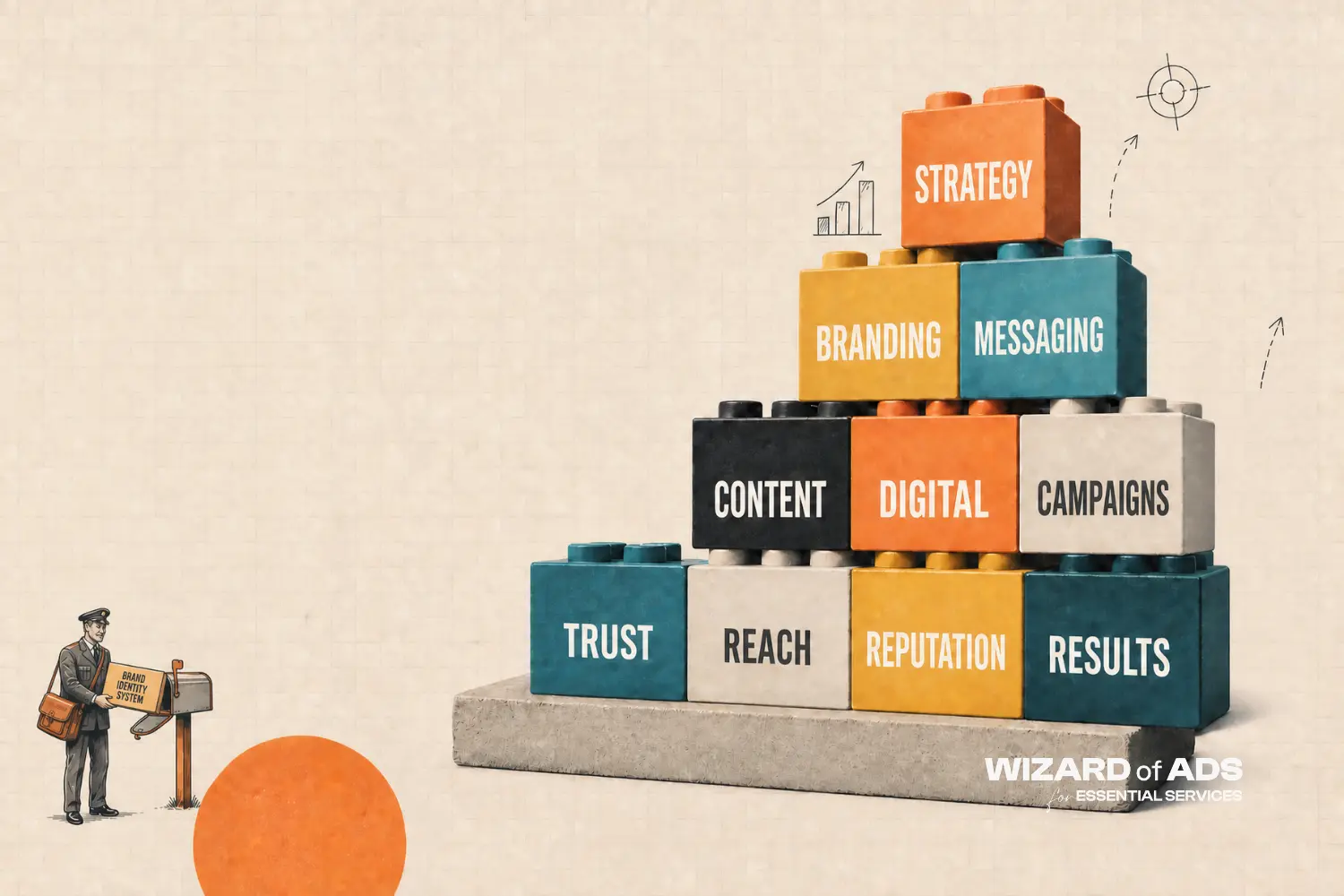
A distinctive brand identity system requires consistent visual, verbal, and experiential elements applied across every touchpoint. Wizard of Ads for Essential Services builds these systems by defining core positioning first, then codifying logo, tone, and messaging rules that guarantee instant recognition and customer trust.
Brand systems demand five sequential steps.
- Visual framework,
- Verbal guidelines,
- Consistency rules,
- Application standards, and
- Governance, applied uniformly across every touchpoint.
A distinctive brand identity system requires strategic alignment across every visual and verbal touchpoint—logo, color, typography, and messaging—unified under one narrative. By building these systems on neuroscience-backed memory triggers rather than me-too advertising, growing companies scale flexibly while staying instantly recognizable, distinctive, and unforgettable to prospects at their exact moment of need.
Key Takeaways
- A Brand System provides visual and conceptual frameworks that ensure consistent communication across all organizational touchpoints.
- Strong brand identity includes five key elements: name, logo, color scheme, typography, and cohesive design elements.
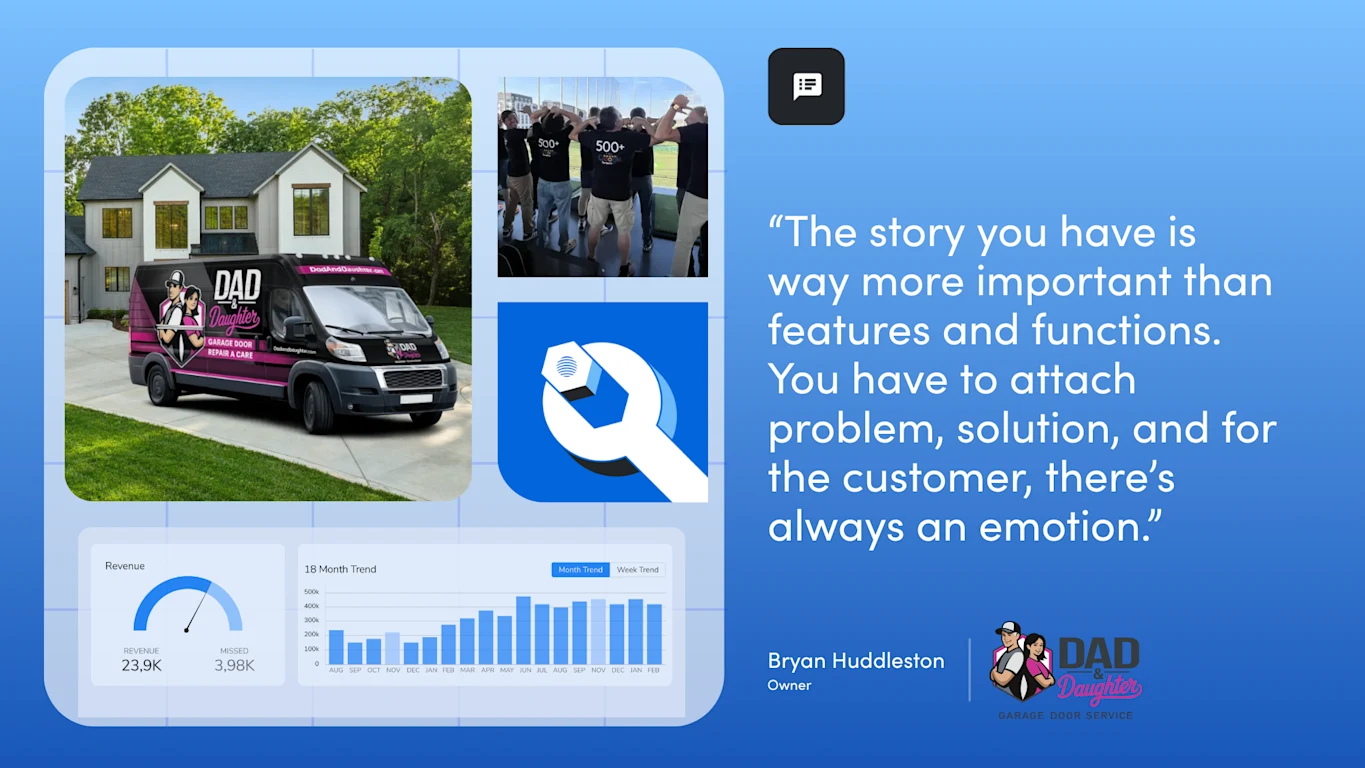
- Distinctive brands communicate a unified story, mission, and personality that resonates deeper with consumers than product features alone.
Why Do Most Brand Identities Fail To Stick?
Roughly 10,000 advertising messages compete for attention in front of the average American every single day. Weak or generic identities disappear into that noise before a prospect ever registers them. Growing companies rarely lose because their product is inferior; they lose because nothing about the brand lodges in memory.
Advertising itself is not neutral. Done well, it shapes what prospects think and what they want, turning attention into demand. A poorly built brand identity squanders that lever entirely, leaving spend on the table instead of building recall.
Is a strong brand identity really necessary for a growing company?
Necessity, not luxury, describes where strong identity now sits for companies scaling past their first few years. Founders who treat brand-identity-design as optional discover that competitors with clearer positioning out-earn them and acquire customers more cheaply.
What happens when identity stays inconsistent?
Inconsistency costs money in measurable ways. Companies with consistent, well-articulated identities outperform competitors by 20 to 30 percent in revenue growth. Their customer acquisition costs run 40 percent lower than businesses stuck with unclear branding. Three failure patterns show up repeatedly among growing companies:
- Sameness with competitors — messaging blends into the category instead of standing apart from it
- Inconsistent execution — visuals and voice shift across channels, forcing prospects to re-learn the brand each time
- No process for how-to-create-brand-identity work — decisions get made ad hoc rather than through a repeatable framework
None of these failures stem from bad luck. They stem from treating identity as a logo project instead of a strategic system built to survive 10,000 daily distractions and still get remembered at the moment of need.
What Is Brand Identity?
Visual and symbolic elements define brand identity. The marks, colors, and cues a company uses to represent itself in the market. Marketing leaders who treat identity as "just a logo" leave money on the table. A name alone rarely earns trust before a purchase decision gets made.
Concrete assets build that identity, not vague impressions. Name, logo, color palette, typography, and design elements work together as a system. Each piece reinforces the others rather than standing alone. Founders scaling a growing company need every asset pulling toward the same recognition, or the brand fractures across channels.
Identity carries more than a look, though. Informative advertising — a facts-and-figures method of proving to an audience why a product or service matters. Depends on identity to land those facts with credibility. Without a consistent identity behind the message, even accurate claims struggle to stick in a crowded market.
What should a brand identity include?
A working identity includes:
- A name that's easy to say, spell, and remember
- A logo built for recognition, not decoration
- A color scheme applied consistently across every touchpoint
- Typography chosen for legibility and personality
- Supporting design elements, icons, imagery, patterns that reinforce the whole
Why does brand identity matter before choosing colors or fonts?
Leaders must decide first what the brand most wants to build: money, a name, or a difference. That decision shapes every element that follows. Skipping it turns brand-identity-design into guesswork, and guesswork rarely produces distinctiveness that scales.
Understanding how to create brand identity starts here, with purpose defined before pixels get chosen. In-house brand managers who reverse that order end up decorating a strategy that was never built in the first place.
What Separates A Brand Identity From A Brand System?
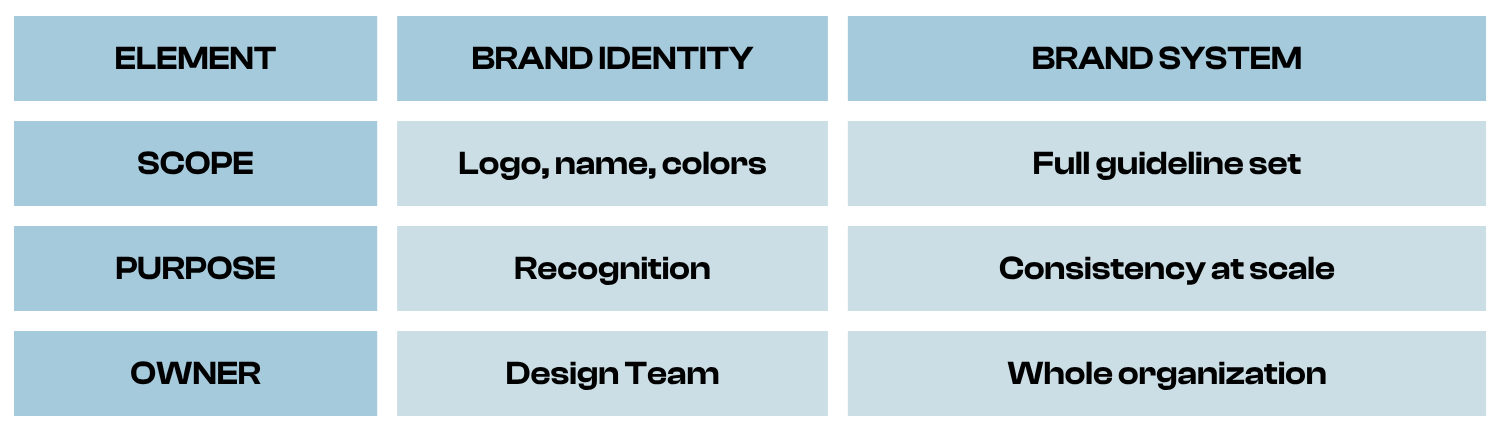
Brand identity functions as the visible signature of a company — the name, mark, and story a customer recognizes. A brand system, by contrast, provides the conceptual and visual framework that lets an entire team communicate that identity the same way, every time. One is the face; the other is the operating manual behind it.
Confusion between the two costs growing companies consistency. A logo without a system becomes a suggestion, not a standard. Every designer, vendor, and new hire interprets it differently. That drift shows up in mismatched colors, inconsistent messaging, and a brand that feels different depending on who built the last touchpoint.
Is a brand system just a style guide?
No. A style guide covers fonts and colors. A brand system goes further, defining both the visual and verbal elements of a company. Voice, tone, imagery, and language rules. As a comprehensive set of guidelines that keeps every touchpoint consistent, from a website to a service van.
Does a small team need a full brand system?
Team size does not limit the need for structure. Wizard of Ads for Essential Services operates with a lean team, yet governs identity work across a wide roster of client essential home service brands. A focused, disciplined group proves that scale comes from process, not headcount. The system, not the staff count, carries the consistency forward as a company expands into new markets.
Why Does Distinctiveness Beat Merely Being Different?
Distinctiveness earns a permanent place in memory; novelty for its own sake earns a shrug and disappears within days. The ads that survive for decades follow a specific, engineered formula built by skilled advertising strategists, not random creative flourishes. Random weirdness fades fast. A deliberate, story-driven brand identity compounds in value with every impression.
Populations prove this pattern reliably. Ask a room full of strangers to name their favorite commercial. The same handful of ads surface again and again. That overlap signals something important: genuine distinctiveness is rare, and rarity is exactly what drives outsized recall. Difference alone, a brighter color, a louder jingle, rarely produces that shared memory. Distinctiveness does.
What makes a brand identity memorable instead of just different?
Memorable brands communicate a cohesive story, mission, and personality rather than a features list. Companies chasing "different" often bolt on quirky visuals without a strategic backbone. The effect fades once the novelty wears off. Effective brand-identity-design ties every visual and verbal choice back to a single narrative thread. Recognition builds instead of resetting with each new campaign.
How long does it take to build a lasting brand identity?
Legendary brand identities never happen overnight. They require careful planning, sequential decisions, and a willingness to reject the first "different-enough" idea that surfaces. Founders and brand managers who understand how to create brand identity systems that scale treat the process as infrastructure, not a one-time design sprint.
The distinction between different and distinctive shows up clearly in practice:
- Different: a one-off visual gimmick with no strategic throughline
- Distinctive: a consistent story, mission, and personality repeated across every touchpoint
- Different: recall that fades once the novelty wears off
- Distinctive: recall that compounds with every additional impression
Growing companies that mistake difference for strategy end up rebuilding their identity every few years, losing the compounding memory advantage distinctiveness delivers.
What Five Steps Build A Scalable Brand System?
Five sequential moves separate a memorable market leader from a forgettable competitor: research, strategic choice, identity design, team alignment, and touchpoint consistency. Growing companies lose customer loyalty and market share the moment their messaging turns generic or scattered across channels. A strong, consistent brand-identity framework prevents that erosion and gives a crowded market a reason to remember one name over the rest.
Step one starts with analysis, not artwork. Marketing leads examine how existing advertising already shapes audience thoughts and desires before a single guideline gets written. Skipping this diagnostic stage produces a brand system built on guesswork instead of evidence.
Step two forces a decision: informative or persuasive advertising. These two approaches move consumer behavior in different directions, so the choice shapes every later asset. In-house brand managers who make this call deliberately, rather than by default, keep their creative output aligned with actual business goals.
What comes after the strategic choice is made?
Step three translates strategy into visual and verbal form through brand-identity-design. Step four brings in structure: a compact, ten-person team model keeps research, writing, and launch phases tied to one coherent strategy instead of fragmented across departments. Smaller, tightly coordinated teams close gaps that typically appear when identity work passes through too many hands.
Step five locks in consistency across every customer touchpoint. Founders following a disciplined how-to-create-brand-identity process treat this final step as ongoing maintenance, not a one-time launch event.
- Analyze current advertising's effect on audience perception
- Choose informative or persuasive messaging deliberately
- Design the visual and verbal identity system
- Align a small, focused team across every phase
- Maintain consistency across all customer-facing touchpoints
Skipping any single step below leaves gaps competitors exploit within a crowded market. Companies that complete all five build the kind of recognizable, trusted identity that converts first-time buyers into loyal customers.
Building a distinctive brand identity system demands strategic clarity, disciplined consistency, and authentic storytelling rooted in your market position. The work requires aligning every customer touchpoint—from messaging to visual language to employee experience—around a coherent brand promise. When executed with intention, this foundation transforms how prospects perceive your business at the moment of need, anchoring memory and trust in ways that generic competitors cannot match. The result is a brand that endures.
FAQ
What are the five steps to building a brand identity system?
The five sequential steps are visual framework, verbal guidelines, consistency rules, application standards, and governance applied uniformly across every touchpoint to create a distinctive, memorable identity.
What are the key elements of a strong brand identity?
Strong brand identity includes five key elements: name, logo, color scheme, typography, and cohesive design elements, all unified under one narrative that resonates beyond product features alone.
Does brand consistency actually impact revenue growth?
Yes, companies with consistent, well-articulated identities outperform competitors by 20 to 30 percent in revenue growth and run customer acquisition costs 40 percent lower than businesses with unclear branding.
Share this:





%20(1).webp)
.webp)
.webp)

.webp)

.webp)


Nothing to see here!
Nothing to see here!