
Cute and clever gets you watched. A campaign gets you remembered.
And in a business where they don't need you until the day they really need you—remembered is the only one that pays the light bill.
Most businesses think they have an advertising problem. They don't. They have a memory problem. They ran a funny ad. People laughed. Nothing stuck. Six months later, nobody can name the company—or worse, they're confusing it with the competitor down the street.
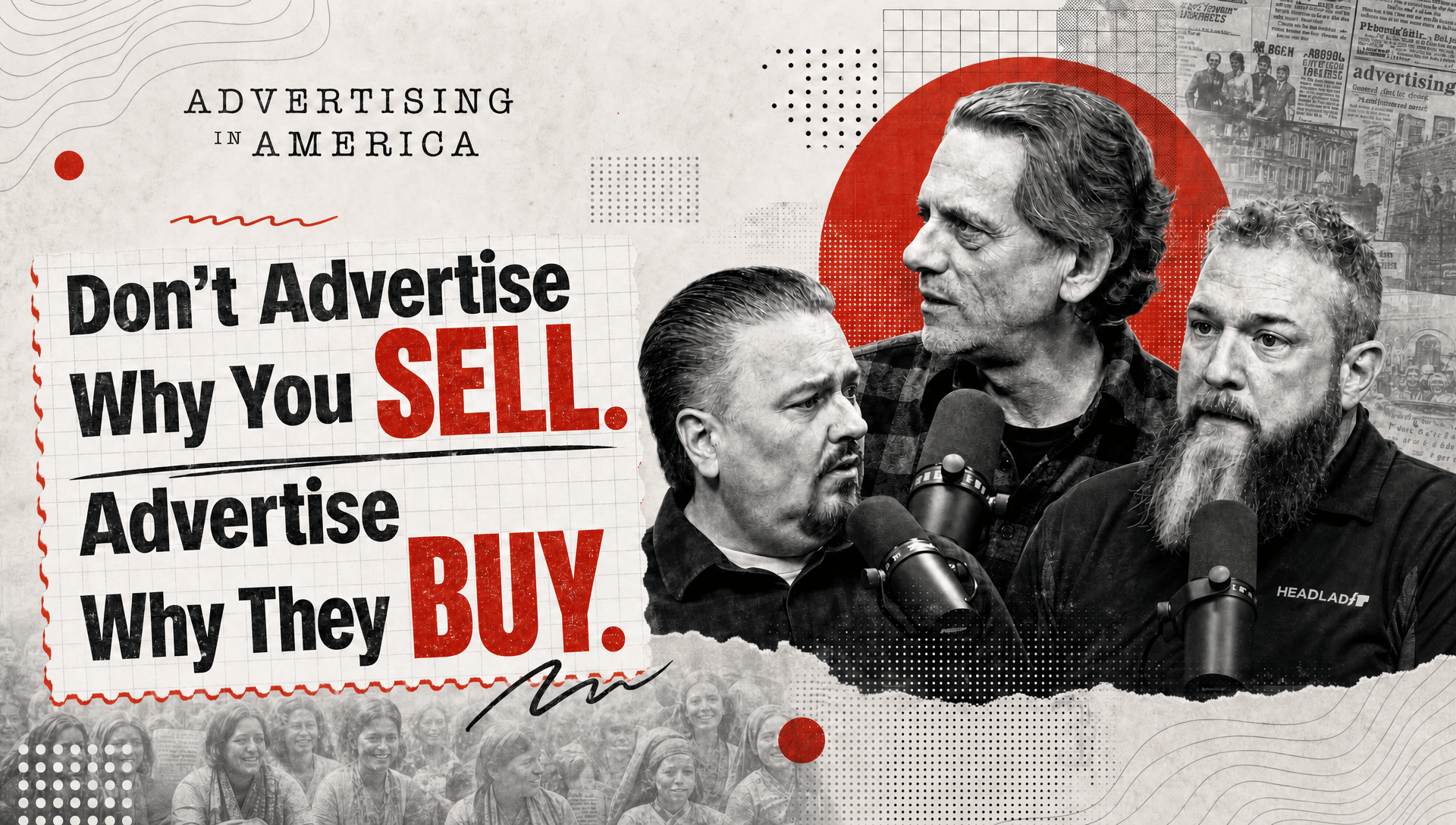
In this episode, Ryan Chute, Chris Torbay, and Mick Torbay go to war with each other—and themselves—over one of the most misunderstood tensions in advertising: the difference between cute and clever and a real campaign. One's a great joke. The other's a relationship. And most brands are spending real money on punchlines that evaporate the moment the laugh track ends.
Chris makes the case for humor done right—and exposes why the real crime isn't cute and clever, it's cute and clever as a trend-chasing reflex. Mick defends the long game while admitting that in a landscape of boilerplate mediocrity, even a halfway decent joke is ahead of the pack. And Ryan ties it all together with the question no business owner wants to sit with: are you building a character, or just wearing a costume?
Episode Highlights:
- The Character vs. the Costume: Why a campaign builds equity and a one-off ad just gets a laugh at the 19th hole.
- The Competitive Landscape Test: Before you pick a tone, read the room. If your whole market is doing quirky dances, profound is your disruption.
- The Super Bowl Trap: Why the most-watched ad event in the world teaches brands the worst possible habits.
- Brand Tonality Isn't Optional: Guinness doesn't do cute. Mercedes doesn't do quirky. Know what your brand is before you choose your voice.
- Category Entry Points: The science of why the brand that gets remembered at 11pm on a Tuesday—when the AC dies—wins everything.
- Attention Is Cheap, Memory Is Expensive: Anyone can get three seconds of notice. The win is being the name that surfaces eight months later.
- The H.L. Bowman Standard: What campaignable cute and clever actually looks like when it's done with precision and commitment.
- The Optimal Number of Complaints: Why zero complaints means your ads are invisible, and why the target number is never zero.
🎧 Hit play if you're running ads that get attention but never seem to stick. This episode will show you exactly why—and what to do instead.
👉 Are your ads building a character people remember—or just wearing a costume they forget?
On this episode of Advertising in America, we're talking about campaigns versus cute and clever.
I'm a big proponent of cute and clever. I write a lot of material for my clients that embodies that tone. I'm hilarious, and humor sells. Humor disarms people and gets them to think about you and remember you and never realize they're actually internalizing someone's ad campaign.
Me, I'm taking the long game, and I'm not satisfied to allow my clients to succeed simply because their competitors are doing it worse. I'm not going to give that competitor the opportunity to beat my client by doing what they should have been doing all along.
Didn't we already rant about why making your marketing look the same as your competitor's marketing is a bad idea? Why is it a good idea on Insta?
Cute and clever is better than nothing, and most advertising is nothing. Cute and clever is also relatively cheap to acquire because you don't have to be a master strategist to come up with it. You don't have to find somebody as expensive as us to do cute and clever.
Ryan Chute: I already know how this ends. These two are gonna agree. They always agree. They walk in through their different doors, shaking hands in the middle, and then they act surprised about it every single episode. But here's my predicament with this one. I like cute and clever. Cute and clever is fun. It's the talking frog, the wise-cracking lizard, the ad that catches your attention. Nobody ever pulls their truck over and tells a buddy that a friendly staff with great parking and hours that's been open for 38 years with people who really care about your needs. So somewhere in the next few minutes, one of these fellas is gonna look at me in the eye and tell me my favorite thing is a trap, and I can feel it coming. Chris, you're up.
Chris Torbay: If the question is, should I develop a long-running campaign or instead try a one-off cute and clever ad? Then no question the answer is do the campaign. Campaigns work. Campaigns weave their way into the subconscious, and years from now, maybe when people need something in your area, they will have come to identify with you through that campaign.
One charming ad, as quirky and memorable as it may be, does not accomplish that. Now, if the question is, does cute and clever as a tonality work in building a memorable brand, then sure, it absolutely does. But so do other approaches, trendy right now or not. I'm a big proponent of cute and clever. I write a lot of material for my clients that embodies that tone. I'm hilarious. And humor sells. Humor disarms people and gets them to think about you and remember you and never realize they're actually internalizing someone's ad campaign. People love to hear that little GEICO gecko prattle on in British and never realize they're actually paying super close attention to an insurance ad.
And lots of brands suit the personality of cute and clever. Macs are quirkier than PCs. Mountain Dew is quirkier than Coca-Cola. Volkswagen Beetles are quirkier than Cadillacs. If it's a tonality that matches your brand personality and the sensibilities of your target audience, then have at it. Do both.
Create a campaign and make it cute and clever. What surprises me is the number of brands that have turned to cute and clever because that's what's trendy these days. It started out that Taco Bell was snarky and funny on social media, commenting on events in real time. Then suddenly KFC started being quirky and snarky, then Wendy's. Now every fast food social media feed has some Gen Z social media wisecrack vibe. Why? Because every company hires a 20-something Gen Z wannabe influencer to run their social media feed, and they all sound the same, but the brands they represent aren't.
I have a number of clients where we took the campaign the other direction: serious, thoughtful, earnest. The campaigns are just as disruptive in a quality service selection wasteland of generic advertising because of how deep and committed they are. People think, "Wow, these guys really think hard about stuff I've never even thought about." So cute and clever is a disconnect for brands like that. What's funny to me is when the same brands hire a 20-something Gen Z wannabe influencer to run their social media feed, and suddenly they're doing trendy dances, and wacky challenges, and goofy dad jokes just like every other advertiser.
Somebody decided the way to win socials is to post every day, more than once if you can, and make it light and goofy and quirky because that's what everyone else does. Wait, didn't we already rant about why making your marketing look the same as your competitor's marketing is a bad idea? Why is it a good idea on Insta?
Advertising has always followed trends. When Budweiser released the frog spot in the '90s, people started using animals in their advertising all over the place. When MTV was popular, beer commercials all looked like music videos. These days, on-screen graphics and TV ads all look like the captions on TikTok videos. Go ahead, be trendy. Be cute and clever, but do it because it's the right thing for your brand and says the right thing about you to your audience.
Ryan Chute: See, this is the thing nobody warns you about. Chris is for cute and clever, and he still made it sound like homework. Do both, but do it right. That's my doctor telling me I can have the cheeseburger as long as I have it in a kale bun. And Chris, you went after that 23-year-old social media intern pretty hard. Somewhere out there, a kid just lost their light, and an angel lost their wings. Mick, you're the one who's gonna tell me that cute and clever is a trap, aren't ya? Go ahead.
Mick Torbay: I've gone on record as saying the campaign has all but disappeared on American radio and TV advertising, but does that mean there's no other way to do it?
Yes. I'm always right. Unless I'm wrong. We have to remember that the ideal is exactly that. It's an ideal. You can't judge every piece of work by what it could be. You have to judge it against what else there is. That's how your audience is judging it. What's the norm? What's the status quo? Lucky for us, the status quo is rubbish. It's not a good campaign. It's not even cute and clever. For the most part, it's a sad rehash of, "Here's who we are and here's what we sell," which is, of course, answering two questions that nobody is asking. Who are you and what do you sell? So if you're struggling with how to stand out in mass media marketing today, you could do a lot worse than cute and clever.
Hell, in a lot of cases, cute and clever could make you a leader. Me? I'm taking the long game, and I'm not satisfied to allow my clients to succeed simply because their competitors are doing it worse. I'm not going to give that competitor the opportunity to beat my client by doing what they should've been doing all along.
But that's me. I'm competitive, and I do this for a living. My standards are high, but so are my fees. What you, the business owner, have to do is first take a good, hard look at the competitive landscape. What's everyone else saying? Is it boilerplate stuff? Quality, service, selection, price, convenient location, free parking, a professional staff who really cares about your needs.
Okay, then you're in a safe place. Half your work is done by simply not just doing that some more. And if you can replace the table stake shit with something that's interesting or memorable, you can pass all of these guys, no matter how big they are and no matter how long they've been doing it.
Because all of those things are easily dismissed the minute you give them a reason to remember you. Never forget, radio listeners and TV viewers are watching because they want to be entertained. So entertain them, for crying out loud. Give them what they want and slip your stuff in while they're laughing. It's a legitimate way to cheat your way to the top, and your competitors are probably handing you the opportunity because they can't be bothered putting in the most basic effort. Cute and clever is better than nothing, and most advertising is nothing. Cute and clever is also relatively cheap to acquire because you don't have to be a master strategist to come up with it.
You don't have to find somebody as expensive as us to do cute and clever. Just remember, when someone decides to raise the bar, you'll have to raise your game, too, because whoever makes the first move into the big leagues will be hard to beat.
Ryan Chute: So Mick's whole pitch is, "Cute and clever is great. Please go do the cheap version your competitors are too lazy to do. And oh, the second somebody gets serious, you're toast, because I'm always right." That's the most Mick thing I have ever heard. This is a pep talk and a threat holding hands. We'll be right back.
Ryan Chute: We're back. So the twins agree. Shocker. But listen to what they agree on. Cute and clever isn't the enemy. Cute and clever with nothing holding it together is the enemy. One's a character, the other's a costume you wear once. Let's pull it apart.
So jumping into it, we're talking about cute and clever does work, but you have to decide how you're gonna place these things out. And you'd mentioned, Mick, about the competitive landscape. How do you tackle this when you're starting to look at what should I actually create for advertising that's going to make a difference?
Mick Torbay: You need to know is there someone in your marketplace who is a leader? Are you number one, are you number two, are you number three? Is there somebody else who's much bigger, much stronger than you, and if so, why? What are they doing? Is it just that they've been around longer and nobody's bothered to take them down, or are they actually very good at their marketing?
Because your response to that has to be proportional. If you've got a guy who has a very strong, memorable, meaningful campaign, you can't beat him with cute and clever; you have to beat him with what he's doing, only more. But the truth is, I think statistically, that's the outlier market.
Where I live, which is a market the size of Chicago, there is nothing. So anything cute and clever would easily beat that guy. But you need to know, are you going up against Heinz Ketchup? Are you in the ketchup category? Because you've got someone strong you need to beat, and they've got a campaign, and they've been working on it for a long time. That’s what I was getting at.
Ryan Chute: Yeah, absolutely, and we see that in a large market. It's a huge market. There's really nobody that's owning that space.
Mick Torbay: Lot of money to be made, and no one has decided to take that role.
Chris Torbay: Yeah, but I think a lot of people start with the style of how they write rather than starting with the brand, right?
I think a lot of the tonality in advertising comes from the fact that a lot of the copywriters are 28-year-olds, and they're writing in the tonality that they would speak to other 28-year-olds, rather than digging into the brand and saying, "What is the tonality of this brand?" And for some brands, cute and clever and snarky and fun and parody and all that kind of stuff will make a ton of sense.
If you're selling Skittles, it totally works. The interesting comparison for me is the beer brands. If you're selling what the Brits refer to as a session lager and the Budweisers and the Millers and the Molson Canadians and the Heinekens of the world and things like that, by all means, be fun. That's what beer is. It's a party atmosphere. But if you're selling Guinness, you don't also play in cute and clever because Guinness will be different from those beers by going the other way, and it'll be Guinness, and it'll be proud, and it'll be about waiting, and it'll be watching the bubbles rise. And it will go as far as you went into quirky; it'll go the other way as well, and it is equally powerful, and it comes from the brand. If you're a 28-year-old copywriter and you get put on the Guinness brand, you need to learn what Guinness is and start writing to that emotion. Then to say, I was really successful last week when I was writing for Kit Kat, and so now I wanna take that quirkiness and make it work for this next assignment that I've been given.
Ryan Chute: I think that really reflects at what Roy H. Williams is about. He's a person who deeply studies fine art, classic literature, and poetry. He's a renaissance man who's able to create a unique angle of entry. And he certainly encourages the writers in our group to do the exact same thing.
But in a way that doesn't run out of metaphor, right? Doesn't run out of the stories that we can tell to continue deepening the relationship with the characters. And I think that's the truth about any good sitcom or series that's been going on for decades, is that they might be doing the same old shtick, but they're doing it from a new angle of approach.
Chris Torbay: And you need to define yourself as a brand, then, that's different from the other one. If the leader in your category, in your market, is doing two quirky guys who banter with each other and bust each other's balls, then don't do a campaign where you've got two people who are being quirky with each other and busting each other's balls. Do go a different direction. If you have two quirky people bantering and they have two quirky people bantering, then essentially those two brands are gonna get mushed up in people's minds, and they're not gonna remember which one was which. And frankly, they may reflexively go to the one that's been around longer, right?
If you're the upstart, come in with a different perspective. Maybe you're the one who just thinks so deeply about hat you have a sort of profound contemplative approach to it. And that is gonna be equally disruptive. Because in a market where the beer commercials are trying to be quirky, and the candy commercials are trying to be quirky, and Mountain Dew's trying to be quirky, and half of the automakers are trying to be fun and "Hey, pile the kids in the car, let's go have a good time," you're gonna be the one that comes in and says, "I'm gonna think about this at a profound level." And you say, "What the heck is this about?"
That's gonna disrupt just as much. And it's gonna carve out a different space for you. So it's not- while it is trendy, and while humor often conceals you trying to say strategic things in a way that makes being advertised to more palatable, it's not the only way to do it.
Mick Torbay: You know who I blame? I blame the Super Bowl for all of this. Be- if you think about it…
Chris Torbay: Who can do the funniest ad ...
Mick Torbay: because we build our whole freaking calendar around the Super Bowl, I'm talking about big brands. Where you cannot do a campaign on the Super Bowl. So we'll talk about the ads through the years that have made such a big deal; we still quote them. I'm still talking about this stupid ad where Seal turned into a freaking seal. And I still can't tell you the name of the client. But the point is, what a great ad, what a cute and clever ad, what a shocking ad.
We're all talking about it the next day at the water cooler. But you can't do a campaign on the Super Bowl, and are you gonna waste the freaking $4 million it costs to run a 60-second ad on the Super Bowl to be number 27 in your campaign, right? Instead, they're gonna probably dedicate a whole budget and a whole team to, "Yeah, but on the Super Bowl, we're gonna do this crazy one-off ad."
Chris Torbay: The challenge becomes what's the most outrageous gag we can pull.
Mick Torbay: So they talk about our thing tomorrow instead of talking about the Seal ad. Except that, that is a one-off thing and has nowhere to go, almost by definition. And therefore, it's actually, it doesn't serve your brand. If you're planning on continuing to do business for the next 12 months, you can't ride on your laurels of your Super Bowl ad for the other 11 months, can you? No, exactly.
Ryan Chute: And I guess that's the fun part of it, though, right? And we're also, again, we're reflecting on things that are internally triggered identity purchases. These are things like, "I'm fun. I like to hang out with pretty girls and drink beer. Let's do that," right? "I like to wear plaid shirts and have a beard. Let's do that," right? Like, all the things that you see in beer ads. Or Lululemon ads, or whatev- like insert interesting thing here that aligns with your identity very easily. These lessons that we are learning are teaching us bad habits for the future.
Chris Torbay: And that's what gets me is I sometimes feel like all the copywriters are developing their chops by watching late-night TV.
So they're listening to the Jimmy Fallon monologue, and they're listening to all the late night monologues, and they're all watching SNL, and they're all watching funny TikTok videos and Instagram videos and things like that. And so that's the vibe of all the writers, as opposed to take it from the brand.
What is it about the brand? Your tonality should come from what your brand is, and then you can make it a campaignable idea. And interesting, it just occurred to me: Budweiser in the Super Bowl will always do a Clydesdales ad. And so for years, they have built the campaign of the Clydesdales ad. And they will try to do a more and more profound one each year in the Super Bowl. But also, they have stuck with that idea over time.
Ryan Chute: Orlando Wood, very famous market researcher out of System1 Ad Testing Data, he's saying, look the advertiser's brain has turned sour in his 2019 post of the same name research document. And it's talking about how the characters, the sense of place, the story that unfolds is gone. It's replaced with this... It's almost shove a square-peg-in-a-round-hole kind of thing, and it doesn't make any sense. It's like it's this mismatch to the brand. And it's empty and vacuous.
It's the Barbie doll of copy because we're not celebrating or embracing what is true to the brand, which has huge ramifications. If you look at companies like Call Dad, they are the brand. Their culture is the brand is the culture. Their mechanism of making decisions is what would Dad do, and that's the start of the conversation. That is purely and 100% oriented to the brand in their structure so that they show up right. That's often very manufactured. Like, when you have three random letters, and all of a sudden you just have to make stupid shit sound funny enough for you to get a laugh at the water cooler. Or people who are gonna do goofy dances in front of their trucks and hope it sticks. Look, if you're relatively good-looking fellas, and you can pull off a Chip and Dale thing long enough to not emasculate all of the husbands out there that are gonna feel like you're gonna go in there and take advantage of their wives.
Mick Torbay: The way it would happen if you and I were to do that.
Ryan Chute: It would ... This is the problem, right? It's just, it's one of the things.
Chris Torbay: And this is an extension of the thing, and I think we've talked about this is that sense where a lot of times clients will say to us, "Hey, our competitors are to doing this. We should do what they're doing. In their ads they're talking about this, so in our ads we should be talking about this."
It's any time that's what your competitor is doing, my first instinct is what could we do that's different than that they can have that, and we will take some other territory, and we'll make more hay out of that.
Ryan Chute: It's a lot easier to take the hill that's not being defended by the competition.
Chris Torbay: And this is what gets me, especially on socials, is people say, “These other guys are doing, like, quirky videos. Should we get a person, or should we do quirky videos?" I don't know. Are you the brand that does quirky videos? They seem to think they are a brand that does quirky videos. Before you go do that, if you're Mercedes, kike I say, if you're Mini, or if you're, I don't know a, a various sort of maybe younger focused car brands and stuff maybe you're fun. Maybe you're happy-go-lucky. Maybe you're a young couple, out having joyrides. If you're Mercedes- you're serious ... is that the same thing to do? Or should you be talking to that person and saying, "Where's, where is that person's head? What, how do they think about the world?"
What are the, are they gonna respond to something else because of who they are?
Ryan Chute: Probably white trench coats and tigers on chains. Walking in slow motion all over the place, right? It's yeah, there is a different vibe, and we have to recognize that. But this isn't an exercise of story writing so much as it is an exercise of being remembered and specifically your name.- and this is,
Mick Torbay: This is a strategic question.
Ryan Chute: being remembered ...
Mick Torbay: I have to wonder, are we sometimes, as advertising people, giving ourselves permission to do it the easy way? Do we so easily dismiss the consumer and say, "They don't have the, they don't have the attention span to stick with a campaign, so we just have to bombard them with cute and clever over and over again, one-off ads the way we do at the Super Bowl.” Which might go over very well at a meeting, but I think we make a mistake when we under- underestimate the attention span of the consumer, because I think they've got it. If we would just freaking deliver something that they, that's worth paying attention to.
Ryan Chute: I think this is, if I'm gonna be so brave and bold as to to say that there's a lot of self-esteem baked into this, and ego, where one, they might not be completely convinced that their people can deliver on the promises that are being made in these feeling-oriented campaigns.
Chris Torbay: Yes, because you have to stick with it.
Ryan Chute: Beause you not only have to stick with it, but you gotta do what you say you're gonna do and then do a little bit more.
Chris Torbay: And you have to do it equally well to win the game. I think some people think cute and clever is easy, because it's easy to make a kind of a bunch of small jokes. And it's interesting. I wrote a a campaign years ago when I was working in London, and my British creative director I'd written a script, and it was quite thoughtful. And I'll never forget what he came up, he came up to me, and he looked at the script and he said, "It's a bit worthy, Chris."
Meaning, you're a bit full of yourself. You're a bit proud of your own intellect here. And, but I think the takeaway from that is not that is not a way of doing advertising, but boy, you better do it well. And so if you think it's easy to just knock out a wisecrack, and hey, people will go for that. Yeah, just go put a couple jokes in there. Yeah, because if you're gonna, if you're gonna commit yourself to a, a dramatic or a philosophical perspective, you need to be-
Mick Torbay: Very good at that.
Chris Torbay: ... interesting and make me go “Never thought of that." Because if it's just you trying to sound a little bit full of yourself, then I'm gonna go, "Oh, look at this guy who thinks he's," "he's the be-all and end-all of beer. It's just freaking beer, man. Stop being so full of yourself." And the ones who do it well, you need to be good at it that way and yeah maybe we take the easy way out and go, "You know what? I can just pull the rug and do a joke and finish."
Ryan Chute: And look, I think that people hide behind the quantity of crap, slapstick comedy to be, do something of actual worth without being worthy. It's not about pretension or esotericness or that's not a word but esotericism.
Chris Torbay: Esotericism
Ryan Chute: Is the word ... eso- sosily. I think there's a, I think the T is silent.
Chris Torbay: It's,
Ryan Chute: as is the X. Yeah, it's like a pterodactyl.
It's not a philosophical righteousness. It is a, "I've chosen to have a North Star that I stick to, that I fight for, that I'm in the foxhole with the client with." And, that's frankly hard, because it's way easier to have interchangeable beliefs that you just turn on and off based on the situation.
Mick Torbay: And in the topic of that long-term promise, you can try shit out with Cute and Clever that you can't try out with the campaign. Once you're campaigning an idea, you better be committed to this for years, whereas you can try a thing out on a Cute and Clever ad, and if you change your mind, it doesn't work out, it's like, "Oh, just stop doing that." And six months later, everybody will forget. It's, yes, six months later, everybody's forgotten your fucking ads. That's bad. Exactly.
Ryan Chute: That’s kind of the whole problem.
Mick Torbay: That's what we're trying to avoid.
Chris Torbay: Or it can't be campaignable. This is, Budweiser did the What's Up spot, and it's okay. They, and then they did a sequel, they did one more because of how well it did, but you can't campaign that sucker- No ... out for five years.
Mick Torbay: You can't stand for What's Up.
Ryan Chute: But, and as much as we don't go in and write, social media campaigns that's, beyond a scope that we're looking to do. We have had it a number of times where we have outlined the campaign idea to have campaign-ability.
If you're the company that is just doing what everyone else is doing, tugging on the current trend and doing the goofy thing, you're not getting remembered. You're getting a laugh, right? You get a little chuckle, and the, and your buddies will give you a little bit of the gears because they're like, "Oh, doing dances and dude, you look like a dipshit," and you're, like, all laughing around the golf at, on the 19th hole. Great. That did nothing for you, right? Could you grow a little bit from that? Yes. Does it have legs? No. Does this have the ability to actually anchor you in and do the thing that matters in your trade area?
Arguably not. Right now, you look at building out something that you can repeat and continues to evolve, change, and have flavor that can be added to it in different ways. Absolutely. There's a number of things that are being done right now with clients of ours that have consistency to them so that they do anchor the brand and elevate the equity, which is golly, if you're not chasing after, like, building more worth in the hearts and minds of your customers, you're gonna spend an awful lot of time farting around doing goofy dances, when what you need to be doing is running your frigging business.
Fun fact number two: Jenny Romanek. This is, again, Ehrenberg Institute: the category entry points; these are the cues a buyer's brain uses to locate a brand at the moment of need. The when, the why, the situation. It's 100 degrees, and the AC died, right? Brand grows by linking themselves to those cues; I call them anchor points and triggers. You've got the trigger that happens; an event occurs. How did you anchor your business in a negative situation to a positive result that has them compelled enough to go, "Them"? We've already decided. It was decided weeks, months, years ago. That's frigging hard in home services. Super easy in Lululemon and in cars.
Chris Torbay: One day, when I'm old enough and rich enough, I will finally buy myself a Ferrari.
Ryan Chute: Exactly. And then drive it off a cliff before the first payment's made. Exactly. I have just enough credit to die in this thing.
So this has been studied. This is proven data. This isn't a guess of “oh golly, we hope a campaign's gonna do it this time." It always friggin' works. Where it's going to fail is if you don't do something that's good. And it's gotta make them laugh, cry, or angry. And not angry at you, but angry at the villain that you're fighting. And the villains are proverbial villains. They're not real villains. They're not Marvel movies. They're hot weather and sweat and frustration for waiting for bad people to do the thing that's right for you, and all the stuff that we can play with.
So educating yourself is really about sneaking in the vegetables into the spaghetti sauce. Or in your case, Mick, it would be sneaking the meat into the vegetable sauce so that he doesn't know that he's eating meat, because he's a vegetarian.
So as we've been talking about this, the thing that kind of sticks in my mind is this, this notion of getting attention and getting attention is super easy. Holding attention is really hard. Now, if you have a long purchase cycle and a higher average ticket and a grudge purchase and an externally triggered, some event has to happen, geez, getting attention is pretty empty because it's how many times do you have to get attention over and over again. That's never going to get the know, like, and trust factor in there. You might be likable, but you're also equally forgettable.
So how are we balancing this out? Martin Lindstrom talks about it in his book Brandwashing, 2011, about how brands plant subconscious cues. These jingles, these sound signatures, these, these brandable chunks, as we call them at Wizard of Ads, where you can anchor things in over and over again that they go click world connection. As Robert Cialdini would say in his book, it's about that immediate I see this, hear this, and I'm going to-
Chris Torbay: Respond that way
Ryan Chute: trigger that into existence. And that's an important piece of this whole idea of why we're doing this, is because we want to be able to say the same stuff.
Chris Torbay: Yeah. And that can be a cute and clever thing if that's your brand and if you can replicate it. If you've always got to use Call Dad, there's always a dad joke, right? Or there's always the GEICO gecko always says funny, sarcastic things. We continue to get his personality in every spot.
Ryan Chute: I think of H.L. Bowman. Why don't you give the H.L. Bowman example?
Chris Torbay: Yeah. We've got the, we've created a character, the H.L.Bowman Bow Man, and he's a superhero, but he's so over the top that we're making fun of him, and he is overly proud and overly triumphant in everything that he says.
Once you've created that character, if you can continue to write him in that way, like a great sitcom character, there's always the crazy guy next door, right? Then yes, that is cute and clever. But it is a replicable cute and clever and it plays, and campaignable directly into the brand because that's their logo, and that's the, that's their identity. So if it is in your character, and if it is something that you can continue to develop, then you can campaign cute and clever. What doesn't work is cute and clever just once for a brand that is generally not that personality.
Ryan Chute: Yes. We see that down in south Texas, where we have characters that have been evolving at the pace of the dinosaur age. And it's like it's taking forever for it to happen, but we're also playing ads for a month, and then they disappear and never get seen again.So we're baking this kind of evolutionary process. The people are deeply invested in the two characters.
Chris Torbay: You're drawing people into that story to see where it goes.
Ryan Chute: Yeah. And they, love or hate, does not matter. The truth is remembered is what matters.
Mick Torbay: Just don't confuse me with the competitor.
Ryan Chute: That's right and that's where the flavor comes in of the anchors. Yes, the H.L. Bowman bowmen, campy 1950s superhero, over-the-top, over-exaggerated in every way to get anchored. But then we have the ability to sing the H.L. Bowman bowmen, and we have the, the, the constant character development of the different quirky thing that he's shooting an arrow into this time.
Mick Torbay: Which is always never quite the thing that he's supposed to be shooting at.
Ryan Chute: It’s never the right thing. It's right, "Oh, that's my fridge."
Mick Torbay: Yeah. Sorry about the window. Sorry. Sorry. Yes.
Ryan Chute: But there's a lot of comedy in that, and that is, you guys are meticulous with those things. But there's a precision to cute and clever that a lot of people lose sight of, and I think it's important to recognize, hey, this isn't careless humor.
If you had me writing your stuff, it would be tragic, right? I would go off the rails. I would get you banned. I'd get you canceled. There'd be all kinds of issues that would arise from the goofy crap that I would do that seemed whimsical and funny to me in the moment, but doesn't actually strategically play out the way it needs to do the things that we're doing and remembering behind every campaign there are anchor points and consistency and pulling and deepening that relationship, not testing the waters and seeing how funny we can be, and some people will or will not like it and cancel us because of it. Now, that's not to say that we won't have people that'll be mad at the ads.
Mick Torbay: It's always gonna happen. And we encourage it ...
Ryan Chute: As Mick Torbay says.
Mick Torbay: There's a certain number of complaints we're looking for, and that number is not zero.
Ryan Chute: That number is not zero. The optimal number is never going to be zero. Is never gonna be zero. Because if, look, if we don't get some reaction, we know that we haven't gotten any reaction, and people are much more primed to stick their hand up on something negative than they are on something positive.
Mick Torbay: I understand people who complain better than I understand ... Some people call to say how great the ads are, and I never get that. I can never figure that out. I've never- thank you ... I've never under- it's lovely when it happens. Yes, sure. Appreciate it. But I do not understand it. Wow.
Ryan Chute: Yeah, how many times can your mom call, though, and-
Mick Torbay: She's awesome. That's right.
Ryan Chute: And this has been a fantastic episode. I appreciate the conversation here.
Ryan Chute: So look, if you're running an essential home service business in America, heating, cooling, plumbing, electrical, here are the things I'd want you to walk out the door with. One, keep the funny. Just make it a character, not a costume. Cute and clever isn't the problem. Cute and clever with nothing holding it together is. Give the joke a recurring home, and you've built a campaign. Tell a different clever joke every quarter, and you've built a highlight reel nobody can name.
Two, pick one big thing and stay married to it. Your campaign is your North Star. One idea told as an episode for years. The water heater is just the vehicle. The character's the thing they actually fall in love with.
And three, attention is super cheap. Memory is the real money. Anyone can get noticed for three seconds. The win is being the name that floats up eight months later when it breaks at 11 at night. That's not a clever ad. That's a cue you planted on purpose over and over.
If you don't hear anything else, hear this. Cute and clever gets you watched. A campaign gets you remembered. And in a business where they don't need you till the day they really need you, remembered is the only one that pays the light bill. So go be that character. Then show up again next week. Until next time, this is Advertising in America.
Thanks for tuning in.
Thank you for joining us on Advertising in America. We hope you enjoyed the show and captured a nugget of marketing magic. Want to hear more? Subscribe, leave a review, and share this podcast with your friends. Do you have questions or topics you want us to cover? Join us on our socials at Advertising in America.
Want to spend your marketing budget better? Visit us at wizardofads.services to book your free strategy session with Wizard Ryan Chute today. Until next time, keep your ads enchanting and your audience captivated.

Advertising in America
The podcast that turns marketing into magic! Hosted by the brilliant Ryan Chute and the ever-entertaining Michael Torbay & Chris Torbay, this show dives deep into the world of American advertising, revealing the secrets behind the most successful campaigns and exploring the latest trends.
Share this:




%20(1).webp)
.webp)
.webp)

.webp)

.webp)

Nothing to see here!
Nothing to see here!