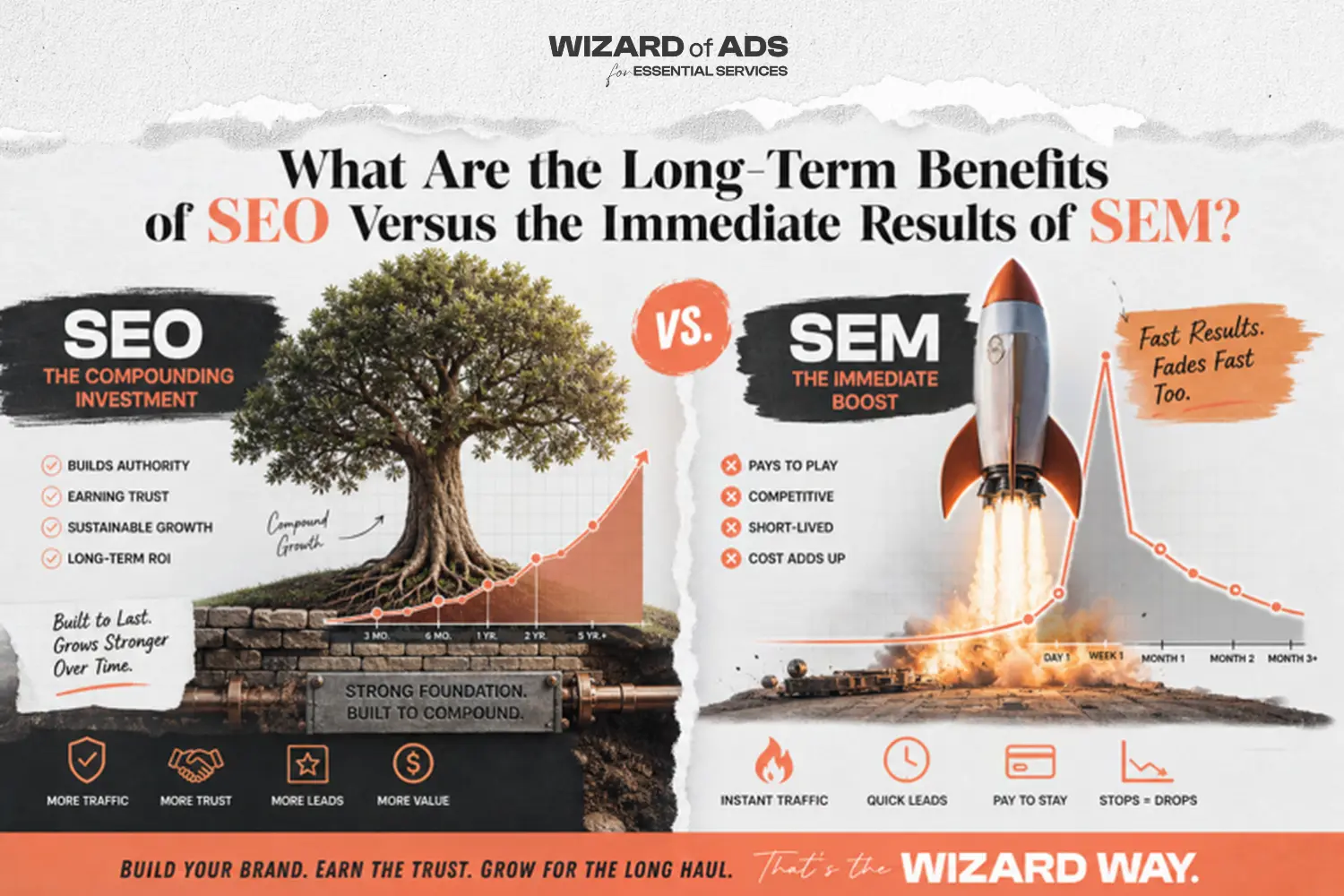
What Are the Long-Term Benefits of SEO Versus the Immediate Results of SEM?
SEO builds organic rankings over time at a lower long-term cost. SEM buys immediate visibility through paid search. SEO suits contractors building durable market share; SEM fills short-term lead gaps but grows expensive fast. Organic search beats unreliable, costly PPC for lasting brand equity and cheaper leads.
Takeaways & Easy Wins
- SEO focuses on organic ranking through long-term optimization requiring sustained strategy and patience.
- SEM combines organic and paid search, delivering faster results through paid placement.
- SEO is one element within SEM, but not all SEM campaigns use SEO tactics.
- Construction companies using both gain immediate paid visibility plus long-term organic growth.
Why Are Contractors Confused About SEO and SEM?
Confusion stems from constant advertising noise and near-identical terminology. Contractors face a marketplace where search engine optimization and search engine marketing get treated as synonyms, yet the strategies diverge sharply.
General contractors already compete against a wall of noise before a prospect ever searches for their services. The average American encounters roughly 10,000 advertising messages daily, and a generic contractor ad gets buried in that flood before it earns a second glance.
Industry sources routinely use SEO and SEM interchangeably, blurring a distinction that matters for budget planning, and leaving owners guessing which strategy pays off when.
Is SEO the Same Thing as SEM?
No. SEO is organic ranking, the steady work of climbing search results without paying for placement. SEM is broader; it can include organic tactics but is most commonly paid search that buys visibility instead of earning it.
- Ranking method: SEO is organic; SEM combines organic and paid.
- Timeframe: SEO is long-term; SEM is short-term.
- Cost structure: SEO requires ongoing content and technical investment; SEM runs on pay-per-click spend.
- Common confusion: SEO is often assumed identical to SEM, and vice versa.
Mixing up the two often means underfunding organic ranking while overspending on paid clicks that vanish once the budget stops.
What Is SEO and How Does It Work for Contractors?
Search engine optimization (SEO) optimizes a construction company's website to rank higher in organic results, without paying for placement. For contractors, this matters because homeowners with a burst pipe or a failed furnace search Google, not a printed directory, the moment trouble hits. A contractor invisible on that page loses the job before the phone rings.
SEO works through several layers reinforcing each other:
- On-page SEO: content quality, headings, and keyword placement that attract traffic
- Technical structure: pages that load fast and display correctly across devices
- Content depth: answering the specific questions homeowners search
- Authority signals: trust markers search engines weigh over time
Unlike paid placements, SEO leans entirely on organic strategy. No bid, no click charge, no budget cap throttling reach; a page climbs because the content and relevance earn the position.
How long does SEO take to show results for a contracting business?
SEO builds gradually. Rankings shift as search engines credit on-page improvements and accumulated authority, so results compound over months rather than days. Contractors who commit early keep that visibility long after competitors quit.
Does SEO cost money like paid ads do?
Organic visibility carries no per-click charge. Owners invest in the optimization work itself, content, structure, technical fixes, rather than paying per click. That structural difference separates SEO from SEM at its foundation.
What Is SEM and How Fast Can It Generate Leads?
Search engine marketing (SEM) covers both organic rankings and paid ads used to appear in search results. Speed is the trade-off: paid placement can put a contractor at the top of results within hours, but that visibility disappears the moment the budget stops.
Most marketers use SEM specifically to mean paid search advertising, even though the category technically includes organic tactics too. A "SEM package" often just means pay-per-click.
Is paid search worth it for contractors?
Paid clicks generate leads fast, but costs climb as competitors bid up the same keywords. Wizard of Ads for Essential Services bypasses unreliable, expensive PPC in favor of direct and organic search, backed by national media buying power that secures stronger rates than most local firms can negotiate alone.
Why did digital search replace print advertising?
Print directories vanished almost overnight once search engines like Google became the default way households found services. That shift pushed budgets toward digital channels, but not all digital channels perform equally over time.
- Speed to results: paid search is immediate; organic is gradual, building over months.
- Cost trend: paid search costs rise with competition; organic costs stabilize.
- Visibility after spend stops: paid ends immediately; organic persists.
- Trust signal: paid search carries lower trust; organic carries higher trust.
SEM answers today's emergency. It rarely builds the lasting brand recognition that keeps phones ringing once ad spend stops.
Long-Term SEO Benefits Versus Immediate SEM Results
The trade-off is simple: patience builds equity, speed rents attention. SEM delivers a short-term ranking boost by blending organic tactics with paid placement, putting a company at the top of results within days. That speed carries a cost: the moment ad spend stops, the ranking and the lead flow disappear. Contractors who lean only on paid clicks rebuild visibility from zero every budget cycle.
SEO plays a longer game. Rather than renting a slot, it compounds brand recall through neuroscience-driven messaging paired with sustained mass-media reach, training a prospect's memory long before a pipe bursts, so the contractor's name surfaces first, not a competitor's paid ad.
Which strategy actually keeps a contractor top of mind?
Emotional resonance does the heavy lifting, not click volume. A contractor who invests in brand recall stays present in a homeowner's mind between projects. When an emergency hits, the search doesn't start from scratch; it starts with a name already remembered.
Does SEM ever build lasting brand value?
Rarely, because paid placement disappears the instant spending pauses, leaving no residual memory. SEO-driven distinctiveness separates a brand that lasts from one that fades once the campaign budget dries up.
- Speed to results: SEM delivers in days; SEO builds over months, compounding.
- Cost after spend stops: SEM visibility vanishes; SEO recall persists.
- Builds memory: SEM builds minimal memory; SEO builds it through neuroscience-driven messaging.
- Best for: SEM suits short-term gaps; SEO suits market ownership.
Contractors chasing quick jobs may still use SEM for pipeline gaps. Those building a company that outlasts competitors need the distinctiveness only sustained brand strategy delivers.
How Do SEO and SEM Costs Compare Over Time?
Cost curves for these two strategies move in opposite directions. Contractors chasing fast leads pay a premium for speed; contractors playing the long game pay less per lead as time passes.
Does SEM cost more than SEO in the long run?
Yes. Paid clicks keep charging full price every month, while organic rankings compound in value. SEM stops appearing the moment ad spend stops; SEO builds equity that keeps generating calls long after the initial investment.
- Cost trend: SEO costs decline per lead as rankings mature; SEM stays flat or rises with competition.
- Speed to results: SEO is slower but compounding; SEM is immediate but temporary.
- Value after spending stops: SEO value is retained; SEM value disappears.
An agency track record built on billions of dollars in media buying shows how national purchasing power drives down the cost of reaching an audience, savings that rarely show up in a self-managed PPC account.
What does long-term brand investment actually deliver?
Brand-building outperforms rented traffic. One HVAC company grew revenue several-fold by owning the airwaves through a strategic rebrand and memorable radio, not by chasing clicks. That growth came from durable brand recall, not a paid-search budget resetting to zero every billing cycle.
Can SEO and SEM Work Together in One Strategy?
Yes. Contractors gain the most ground when SEO and SEM run as one coordinated system rather than two separate budgets. SEO is a single component inside a broader SEM strategy; not every SEM campaign includes SEO work at all.
Wizard of Ads for Essential Services aligns auditory messaging and brand identity across radio, digital content, and call centers so a prospect hears one consistent story everywhere, giving construction and trade businesses a head start most SEM-only campaigns never achieve.
Does a contractor need a formal process to combine SEO and SEM?
Structure prevents wasted spend. A defined sequence, uncovering brand truth, researching the market, writing creative, buying media, and securing approval, keeps SEO and paid efforts pointed at the same target before launch.
Which strategy should come first, SEO or SEM?
It depends on goals and current market position, not a generic formula. A company with steady organic traffic but weak brand recognition benefits from SEM-driven mass media first; a newer business with no digital footprint often needs SEO groundwork before paid spend pays off.
- Current market position: established reputation versus new entrant
- Timeline pressure: leads this quarter versus next year
- Existing brand recognition: whether the name already carries trust
- Available budget: capacity to sustain both efforts
No universal ratio applies; the right mix follows strategy, not habit.
Why Do Most Construction Ads Get Ignored by Homeowners?
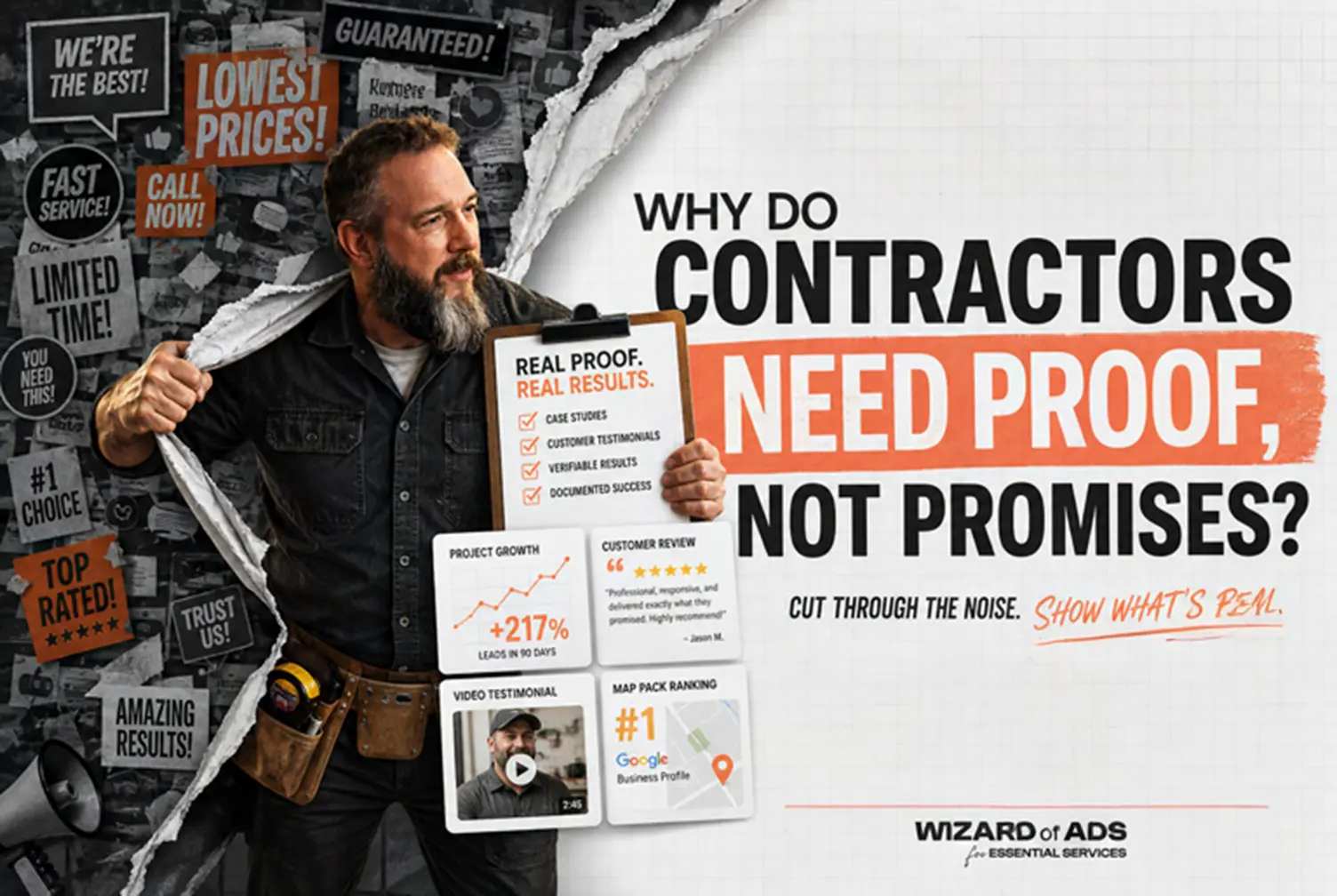
Clutter buries most construction advertising before a homeowner ever reads the message. Generic ads compete against TV, social feeds, billboards, and even mobile games for a fraction of a second of attention, and bland creative loses that fight every time. Advertising shapes what people think and want, but only when the execution earns attention rather than assuming it.
Industry award shows compound the problem, often rewarding creativity over effectiveness, celebrating spots that impress fellow marketers rather than campaigns that generate calls.
What makes a construction ad actually stick?
Informative advertising works by presenting facts that convince a homeowner a service is needed right now, and only pays off if the message survives the surrounding noise. A generic "quality work, fair prices" tagline delivers zero facts and zero recall value.
- Undifferentiated positioning: the same claims every competitor makes
- No specific proof points: vague promises instead of concrete facts
- Forgettable creative: safe, award-chasing production with no distinct voice
- Single-channel thinking: one format expected to cut through everywhere
Why does creativity without strategy fail contractors?
Creativity alone does not generate booked jobs. An ad can win design praise while producing zero increase in service calls, because peer admiration and homeowner action rarely align. Strategy has to dictate the creative, or the budget disappears into noise nobody remembers.
How Should Contractors Choose Their Marketing Mix Today?
Contractors choose their mix by matching channel strategy to how homeowners actually search today. Print directories no longer decide who gets the call; digital resources now cover the entire customer journey, and a contractor absent from that landscape loses the job before the phone rings.
Why does digital research matter more than print listings now?
Homeowners no longer flip through directory books. The internet hands them reviews, service pages, and past project photos long before a call gets made. A contractor's digital presence is the new front door.
- Homeowner behavior: long-term SEO serves homeowners researching maintenance and options; immediate SEM serves those searching for emergency help now.
- Resource replaced: both have taken over for print directory browsing.
- Vetting process: SEO relies on reviews, content, and reputation; SEM relies on quick-click ad response.
Does one channel replace the other?
Neither works alone. Emergency-repair searches demand immediate visibility, while maintenance and reputation-building searches reward sustained presence. A deliberate, research-backed mix, not guesswork, determines which jobs a contractor wins.
FAQ
Is SEO the same thing as SEM?
No. SEO means organic ranking effort earned over time. SEM is broader and most commonly refers to paid search campaigns that buy visibility instead of earning it.
Why do contractors mix up SEO and SEM?
Industry sources routinely use the terms interchangeably, blurring a real distinction. This leaves contractors unsure which strategy fits their budget and lead-generation timeline.
Should contractors choose SEO or SEM for leads?
SEO builds lasting organic rankings and cheaper leads over time. SEM delivers immediate paid visibility that fills short-term gaps but grows expensive fast. Wizard of Ads for Essential Services favors direct and organic search for lasting brand equity.
Conclusion
The choice between SEO and SEM isn't really a choice between rivals; it's a matter of timeline and budget priorities. SEO builds lasting organic visibility through strategic content and technical optimization, while SEM delivers immediate visibility through paid search. The most effective construction brands integrate both, using SEM for urgent lead capture while SEO compounds market authority over time. Construction companies that treat search as part of a larger brand identity, rather than a standalone tactic, build the kind of recognition that outlasts algorithm shifts and bidding wars. That recognition, not clicks alone, is what builds a brand contractors remember when the need finally arrives.
Share this:


%20(1).webp)
.webp)

.webp)

.webp)

.webp)







Nothing to see here!
Nothing to see here!
