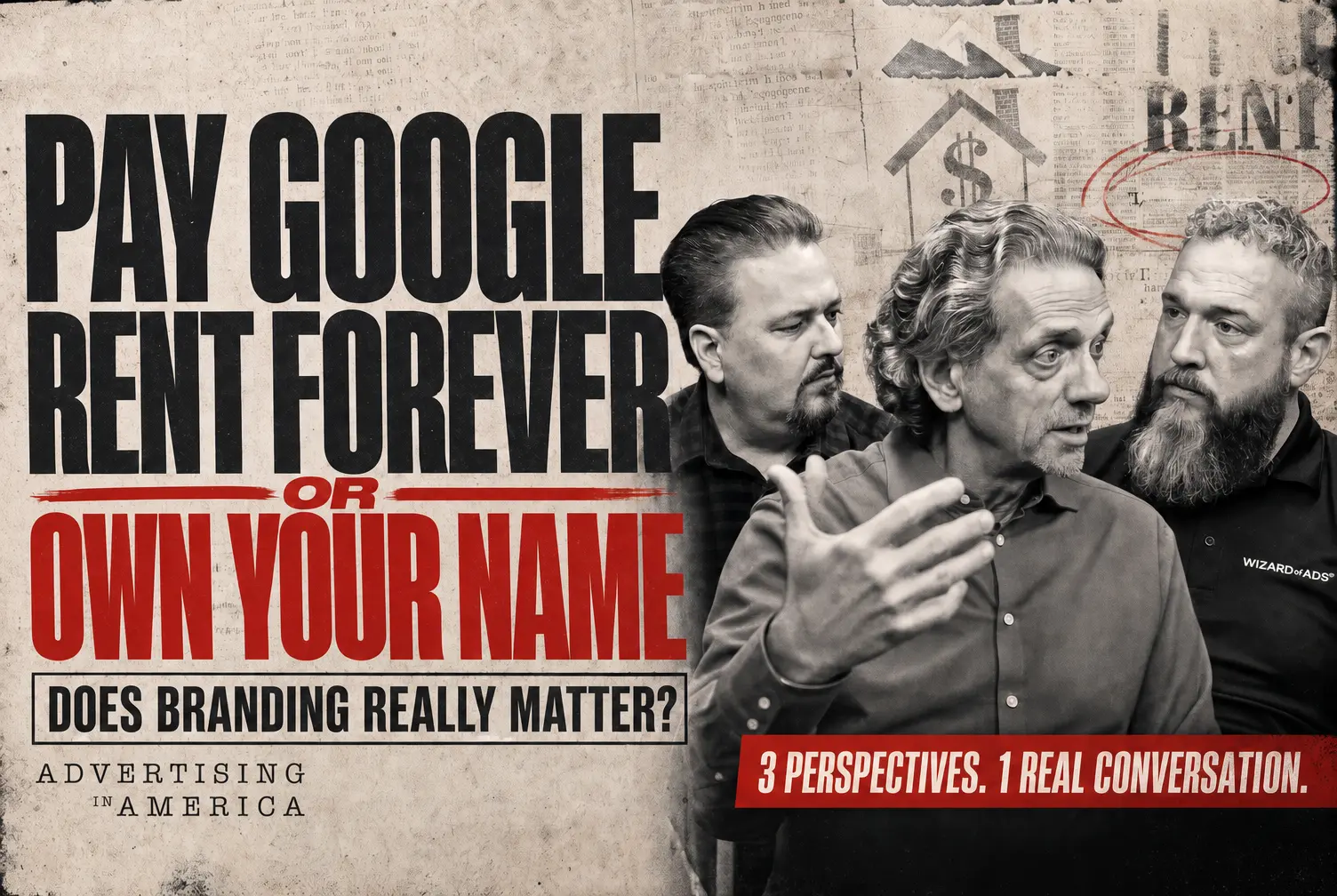
You can't beat the giant at his game. So quit trying.
You've heard it before: build your brand. But does it actually matter, or is it just what agencies say to keep the meter running?
This episode goes straight at the question. Chris Torbay says yes, obviously, unequivocally, and he'll tell you exactly why your brain doesn't give you a choice in the matter. Mick Torbay says... it's complicated. And his answer might be the most dangerous insight in home services right now.
Here's the thing: in most American markets, you can survive without a brand. Lots of companies are doing it. The question isn't whether you can survive. The question is who gets destroyed when the one well-branded competitor finally shows up.
Because right now, the prize for not building a brand is paying Google to distribute your customers to whoever's willing to outbid you today. And tomorrow. And every day after that, until your margin disappears.
The alternative? Own a name people reach for instead of a problem they're searching for. That's the whole ballgame
Episode Highlights:
- The Brand You Didn't Build: Why your customers are already forming an opinion, and why inaction hands them the pen.
- The Google Rent Trap: How unbranded lead markets work, who they benefit, and what it costs you every single day.
- Survival vs. Dominance: The honest difference between making it and owning your market.
- Apple vs. Everyone: What "I'm a Mac, I'm a PC" proved about brand irrationality, and why human beings can't be reasoned out of it.
- Neil Patel's Admission: Why one of the world's top digital marketers insists branded keywords outperform cold terms on every metric, even though it doesn't serve his business to say it.
- Branding Is Bonding: The oxytocin science behind trust, and why familiarity isn't soft; it's your most durable competitive advantage.
- The Roulette Table: Why most ad budgets are designed to lose, and what a different strategy actually looks like.
- The Service-Profit Chain: How the feelings your customers carry away from an interaction are manufactured inside your company first.
- The Personal Brand Trap: Why forcing your techs to fish for name mentions in Google reviews is now actively hurting your rankings, and what to do instead.
- Build the Brand's Brand: The critical difference between celebrating your team and burning your own brand down.
🎧 If you're running heating, cooling, plumbing, or electrical, and you're not sure whether the brand thing is worth the trouble, this episode will make the answer impossible to avoid.
👉 Is your market one well-branded company away from having a leader? The answer is probably yes. That leader could be you.
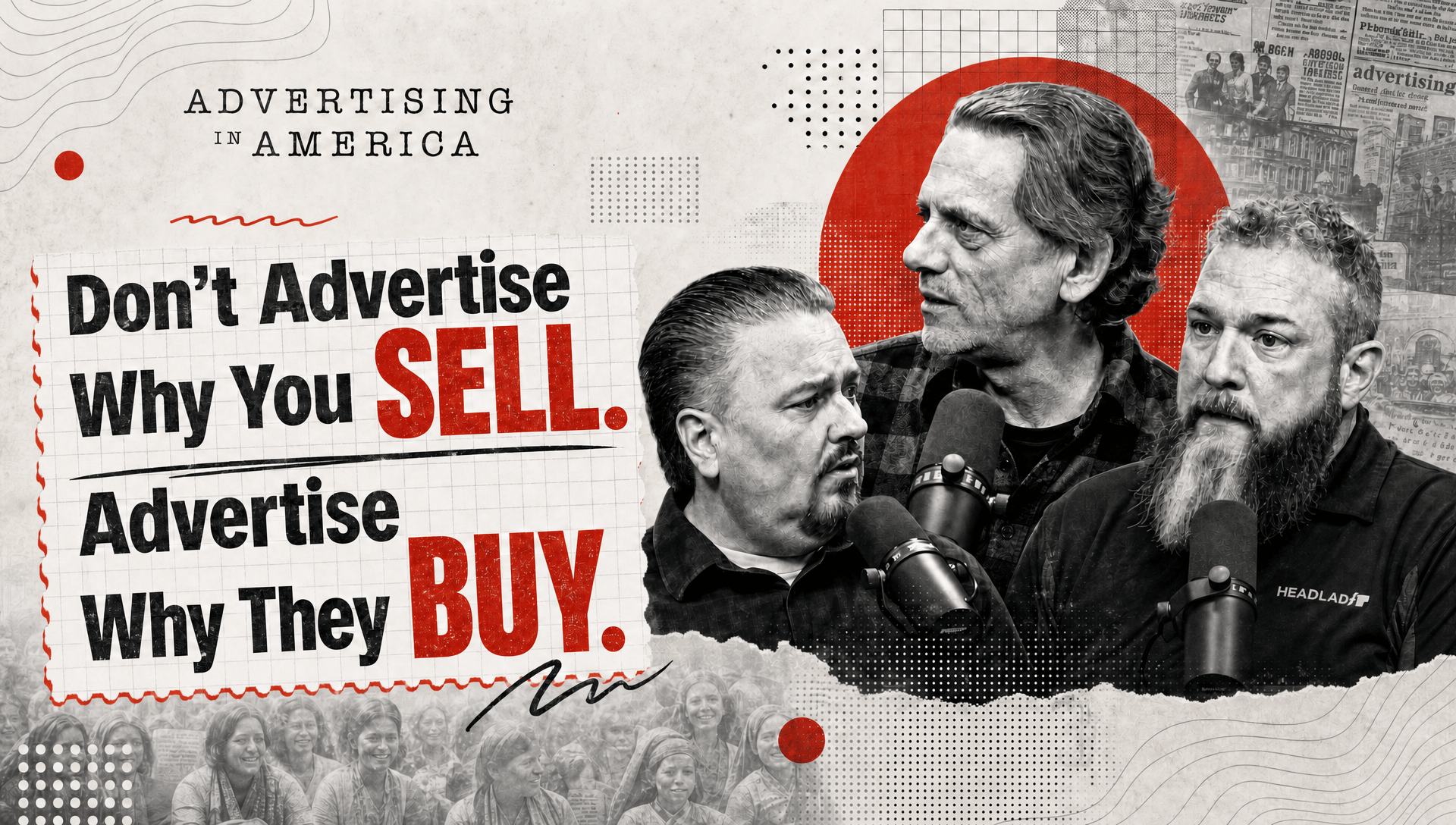
On this episode of Advertising in America — the big one. The question that quietly plays: does this branding thing actually matter?
Yes, you need a brand. But while brand building sounds like marketing babble or a cash grab from your agency, the truth is people don't buy because advertising told them to. People buy from brands they identify with. Hell, you are a brand. That's why when your wife bought you that one shirt, you thought, "I'm not gonna wear that." Well, it's not because it doesn't look good. It's because in your mind, it's off-brand. It's not me.
Can you succeed in a large American market without branding? Today, it appears you can. Everyone is playing the same game by Google's rules. The only winner is Google. Google is not going to tell you how to beat Google, but I will. Somebody will, and when they do, they'll be unstoppable.
RYAN CHUTE: Does this branding thing actually matter? Or is it just a thing precious agencies say to keep the meter running?
I'll be honest with you. For years, I thought branding meant logos, a little swoosh, a truck color. I figured if I picked a nice font, boom, I had a brand. Which, it turns out, is like saying you've got a personality because you bought a nice hat. We've done a few dozen of these together now, and I notice that these two agree on basically everything, so I fully expect them to land at the same spot again. The fun part is watching them scrap about it on the way there. Chris, you're up, and I already know the answer's gonna be yes. So prove it.
CHRIS TORBAY: Yes, you need a brand.
Yes, you need a brand. I think a lot of people ask this question because they come to an ad agency looking for new ads, and the ad agency changes the subject to brand-building, and the client thinks: "Oh, they're just trying to run up the billable hours." It sounds kind of like that speech from your mechanic when your serpentine belt fails, and they explain that you should also pay the guy to replace your perfectly good water pump while he has your whole engine apart. "It's more expensive now, ma'am, but trust me, in the long run you'll be better off."
But while brand-building sounds like marketing babble or a cash grab from your agency, the truth is people don't buy because advertising told them to. People buy from brands they identify with.
Brands aren't a marketing thing created by advertising agencies. They're a real thing that inevitably forms in people's minds as a result of the human condition. It's how our brains work. People will form a brand image for you in their minds whether you like it or not. If you don't do it, they will, and when they do, they might create a brand image you don't totally like. But hey, you had your chance.
The proof of this, of course, is that everything is a brand. Your favorite band is a brand, that's why when they do a pop album, you think, "Oh, they sold out." Nope, they just did something off-brand. Your neighbors are a brand. There's the nosy one, the helpful one, the oddball who's always fastidiously polishing his mailbox. All brands defined by you, or defined by them, through their actions. Hell, you are a brand. That's why when your wife bought you that one shirt, you thought, "I'm not gonna wear that." Well, it's not because it doesn't look good. It's because in your mind, it's off-brand. It's not me.
Most people who avoid brand-building say: "Oh, well, people make their own choices based on real attributes, not some airy-fairy brand." Well, as Roy Williams said: "The mind always justifies what the heart has already decided."
People claim to make attribute-based decisions, but the attributes always come second to the desire to associate with the best brand for them.
If people bought things based on measurable attributes like quality, people would buy zero American cars and trucks. The Germans and the Japanese make the best cars and trucks. The American automakers have some of the world's best brands. People make brand-based choices whenever they have a choice between brands.
The only time you don't need a brand is when people don't have a choice. The little tuck shops and hairdressers at the foot of big apartment buildings, brands don't matter. You go because it's there. Ice cream trucks — no one stands in the park when the ice cream truck comes by thinking, "Nah, I'll wait for my preferred brand of ice cream truck, thank you. They're very much better." On a hot afternoon, you will happily give your kids $5.00 and send them over to Mr. Pedophile's Frosty Salmonella cone because you know what? There he is. Brand doesn't matter.
When film photography was big, I bought all my gear from my favorite brand camera store on the strength of their brand. But at some temple in outer Mongolia, if I ran out of film or batteries, I'd buy it from any schmuck in a kiosk next to the latrines. Interestingly though, I'd only buy Kodak or Fujifilm, on the strength of their brands.
You need a brand.
RYAN CHUTE: Chris says everything is a brand, your band, your neighbors, even you, which finally explains Mick, who is, and I quote from everyone who has ever been within five feet of him: "the I have a plane guy." That's his brand. He built it, and he's frighteningly consistent. But here's where it gets good. Chris says yes, obviously, always. And Mick, I happen to know you've got a "well, actually" locked and loaded. You're fixing to tell me a company can skip the whole brand thing and still make money. Go ahead, Mr. Contrarian. Ruin the consensus for once. I dare you.
MICK TORBAY: I have to confess, if you'd asked me this question 10 years ago, I'd have given a very different answer. Ten years ago, it would've been just: "Yes, it makes all the difference. Without a strong brand, you simply cannot succeed in the modern marketplace."
Today, it's not as clear. Here's why.
Let's take home services as an example: heating, cooling, plumbing. I live in a market the size of Chicago. Lots of business being done in this space, lots of money being made. But when I look at the trucks on the road, the results that come up when you Google "plumbing services" or "AC repair," I'm not seeing the same top names showing up over and over again. Sure, there are a few larger companies, legacy companies that have been around for decades, but apart from their longevity, I can't tell you what any of them stand for. There are a few loud ones and some who advertise on radio and TV, but they're not saying anything particularly branded. The biggest in my city has the tagline: "Let the guys in the green truck save you big bucks." That's not a strategy. It's not even cute and clever. It rhymes, and that's about it. They're not the cheapest, so their tagline doesn't even track.
Can you succeed in a large American market without branding? Today, it appears you can.
Is this an opportunity to grow big without the trouble of building a meaningful brand? Well, now you're asking a different question. It's an opportunity, no question, but when these things shift, someone will seize on a way to beat everyone else. And that magic plan is not to simply abandon the idea of a plan.
Here's what I mean. If you want to simply grow your business by running more calls without having a brand that is memorable or meaningful, it can be done, but there's really only one way to do it. Pay Google more money for unbranded leads.
Unbranded leads are expensive, and Google will happily sell them to the highest bidder. If no one in your market has a meaningful brand, then all leads are unbranded leads. Google likes that because then there's more of them, and each one is more expensive. This is heaven for Google and hell for the companies providing those services, because the cost of those leads will rise until you make pretty much zero money. Everyone is playing the same game by Google's rules. The only winner is Google. Google is not going to tell you how to beat Google.
But I will: skip them. Get out of the "water heater repair" search terms and into "Dave's Plumbing" search terms. Costs a lot less for the lead, and it cannot be simply sold to your competitor. Companies abandoning the idea of building a brand is indeed an opportunity, but not for the company doing it. It's an opportunity for someone like you to derail the Google profit plan.
So to answer the question as asked: do you need a brand? No, apparently not. Lots of companies are not bothering to do so. But should you? Well, only if you want to beat somebody else. Only if you want to get more than your fair share. Only if you want to be profitable.
My market is just one well-branded company away from having a leader that could beat everybody else in a matter of three years, simply because no one has bothered to build a strong brand. But somebody will, and when they do, they'll be unstoppable.
RYAN CHUTE: Mick makes big finishes. Sure, you can skip the brand, and the prize for skipping it is paying Google rent until you go broke. That is the most heavy metal thing anybody has ever said on this show, and we had Gene Simmons here. You can absolutely do it; it'll just cost you everything.
His fix is to quit bidding on "water heater repair" and start owning "Dave's Plumbing." Hold that thought; it's the whole ballgame. We'll be right back.
RYAN CHUTE: We're back. So, shocker, they agree in their weird little ways. Chris says you need a brand because the human brain builds one whether you help it or not. And Mick says you need a brand because the alternative is renting your customers from Google for the rest of your life. One's about psychology, one's about your P&L. Same answer. Let's land that plane.
Mick, it's pretty crazy that we're sitting here as people who strongly support brand, saying "you don't actually need a brand." There's more than one way to skin a cat, and a lot of people are kind of freaked out that sentiment would come from people like us. But I wholeheartedly agree. There are plenty of situations where there's just a quiet market or a quiet industry. No market leader. People making money, and good for them. They're doing the thing without having to go to the effort. But what's the consequence?
MICK TORBAY: I like being right, and it annoys me when I'm not. Obviously, in my heart I think brands are important and they matter, but I can't argue with the data. When the data says there is no clear leader in a market that should absolutely have one. And knowing that we work in markets like Charlotte, Vegas, Phoenix, Dallas, Houston, in home services, it's like Coke and Pepsi. There's a big dominant one, one right next to them, a third guy who's pretty strong, and then everybody else has to fight over the scraps, because these guys are doing so well. But that's not what every market is like.
We would not be doing ourselves or our viewers any favors by pretending that the way it is. There are many, many markets where there is no Dewey Jenkins, there is no Ken Goodrich — there's nobody who's just saying, "I'm doing this thing."
Can it be done? Yeah, obviously it can. But we also know that when all the business is getting funneled through one port, through one access point, they'd be crazy if they did anything but jack up the cost to the maximum people can afford. Which is all of your profit.
RYAN CHUTE: It's not just your profit. Because you're meeting for the first time at the last moment of truth, that moment they're in need, you're also giving up the equity that brand gives you. That ability to charge a bit more because they trust you. You've established empathy. You've already shown your competence. You've already demonstrated that you're the more convenient choice, and that they're willing to pay you a bit more to save them a bit more of their time.
CHRIS TORBAY: I think we've talked around this a bit, but we're talking about two different things. Is it possible to make a living, to keep a few people employed, to have something to do next week and the week after, without having a brand? Yes. Is it possible to become a market leader? No. Is it possible to build an empire? No.
It's really about what you're trying to achieve. If you just want to be "one truck Chuck" or "three truck Chuck" or something like that and chug along comfortably, and it's going to cug away, there are lots of people who do that. Single-guy handyman, word of mouth, a little something. But if you are trying to build a big, successful company, working toward an empire, generational wealth, taking business away from others, there are always little scraps for people to fight over. But no one becomes the leader by being the same as everyone else or being as beige as everyone else. If you want to be the dominant player, you need to be somebody, stand for it, and be that brand.
MICK TORBAY: Google doesn't care about your market share. Google cares about its own market share, and they care about selling the most expensive thing they can. So they'll happily sell you those leads today and sell Ryan those leads tomorrow. Whoever's writing the checks, whoever has an empty board today and wants those leads, they'll give it to you. But that comes out of your margin, out of your profit, which as Ryan says, leaves you fewer options to solve problems, to surprise and delight, to do all the things we want to do to stand out. It puts you in a place of keeping your head above water rather than thriving.
RYAN CHUTE: One thing I can say with a fair amount of confidence: customers are really not interested in paying for your greed or your inefficiencies. They're happy to pay you a reasonable premium for your convenience and what you exude in trust.
It's the classic Apple versus Dell scenario. Dell and Apple both sell bazillions of computers, but Apple makes bazillions of dollars more because they have the brand equity. They're getting the premium on their dollar, because they've created an environment where the personal brand of the customer is so deeply entrenched into the product brand that people insist on paying disproportionately too much money for the crap we have sitting in front of us. That's a certain level of strength that is so hard to find. There's not ten Apples out there. There's one.
MICK TORBAY: Let's acknowledge the irrational nature of that. The idea that I would only buy a phone from one company doesn't make sense. Ditto for a watch or a computer. The idea that I actually feel like I identify with a huge multinational corporation is insane. There's nothing about that that actually makes any sense, and yet we all make decisions like that routinely and don't even identify the irrationality of it.
Think about the Apple campaign — "I'm a Mac, I'm a PC." Remember, it wasn't Apple versus Dell. It wasn't Apple versus IBM. It was Apple versus fucking everyone. It was us or everyone else with the fucking balls to say, it's not even like we're just saying we're different.
It's not like Ford saying we are different than GM, it's like Ford saying we're different than every other car company in the world. And to look people in the eye and say, "Yeah, I'm a Ford guy. I'm not an everyone else guy." Holy shit! What is that? That's madness. So we're talking about humanity, right? Humans are not rational. People do not try to reason your way out of this, because that is not how the world works.
RYAN CHUTE: People don't do the things they say they do. People will classically say, "Oh, I'm this." And they're not doing that. How many people have we talked to who say, "Yeah, I'm a big documentary person" — but they haven't watched a documentary in their life?
MICK TORBAY: Because "watching documentaries means I'm smart." So I must be smart.
RYAN CHUTE: Bingo. And fun fact — Neil Patel, arguably one of the most successful and famous digital marketers in the world, with a massive company and authority in this space, has fought for years for something that by rights doesn't serve him best. But he knows and continues to insist: branded keywords pull higher click-through rates, lower cost per click, and stronger conversion than cold non-branded terms. You are always going to win more when you have the stronger brand on cost per acquisition, cost per click, cost per lead, and every other metric you can possibly measure. It is going to show up over time in equity, by not having to give more of your money away to the Googles and aggregators of the world.
MICK TORBAY: Which is why Google is always telling people, "Spend a lot of money building your brand so you don't have to pay us so much." Wait, they don't do that. I got that wrong.
RYAN CHUTE: Oh my god.
MICK TORBAY: Right, I got that wrong.
RYAN CHUTE: It's much nicer to be a 30% non-equity shareholder of your company that gets paid more than you do in a year. That's unconscionable to me. It's like, no, I'm looking for the way out of this mousetrap, out of this maze. It's nice to see authorities that we have that would say those things about brands in a way, in a place where they wouldn't have any need to defend that to serve themselves. The other thing is this whole misnomer of what a brand actually is, while everybody is so obsessed with focusing in on the assets. It is none of those things. It's not the messaging we write for customers. It's not the logos, the truck wraps, the colors, the uniforms. It is a culmination of what those assets do to make a customer feel like we're the choice.
CHRIS TORBAY: And this is the thing that you said, that I loved a minute ago, to Mick's point, without a brand you'll get a few leads and you'll be able to sort of chug along. But one of the things customers say to me all the time is: "We need a better kind of customer. We really know this stuff, and when we recommend they get a certain type of water heater based on how their house is laid out, we're always having a fight because they just want to do something cheaper. And we know that they're going to get better... And I wish they would just listen to us. I wish they would just take our advice."
Without a brand, you're just that thing they clicked on, and now you're trying to explain a bunch of things. You're trying to teach them how their air conditioning system or plumbing system works. If you are a brand, and a brand they sought out because you've built up trust, you've created the impression of a company they know, like, and trust, one they're predisposed to buy from before they even have the issue. Then when I do that, and I do Google you, and you do come to my house and give me advice, I'm likely to take [that advice].
And so the answer to those clients is the same thing: if you invest in your brand, when you have customers, they will pay you more heed. They'll listen to your suggestions more because of what that investment in your brand has done in their heads.
RYAN CHUTE: It's what Roy Williams would say: branding is bonding. It's about forging that alliance. And bonding comes from oxytocin, which isn't just the love chemical. It's the trust chemical. It's established through empathy and competence; it's established through familiarity, through the echo of something they've heard before and can trust and rely on through consistency. On that commitment to consistency. That's really what becomes the gap when you look at how lead capture is money you spend, but money that disappears. There's no retention of them looking at a search result to that person's heart and mind. So how do we leverage this? We leverage it by not ignoring that we have to do lead capture, that's silly, of course we do. But it's about redistributing budgets to do things more effectively, to capture leads more affordably, and have more people coming in with a relational mindset before we get too deep in the weeds and having them think it's a roulette table.
The alternative is a roulette table. All the numbers on the table, and the clients we work with are putting chips here and there and everywhere on ten, twenty, thirty of these numbers, hoping for a payout. Then the wheel spins, the ball drops, and you've got a red or a black, and if you put them on the corners, you picked up four or five leads. Great. But all the other stuff just scrapes off the table.
I literally watched this with another Wizard of Ads partner. We each broke out 200 Canadian dollars — which is like 50 American dollars, basically a donation to Canada. It was amazing to watch how I doubled my money and walked away, and he lost all of his. Because he did exactly what our clients would traditionally do. I played a different strategy. That's not important because I won't tease him mercilessly for the rest of his life.
MICK TORBAY: Not on a public broadcasting forum.
RYAN CHUTE: I won't say his name. I am doing everything I can not to say his name.
MICK TORBAY: You will tell me something that rhymes with his name.
RYAN CHUTE: No. Ah maybe. Famous chef. And I watched that and thought: "Oh my God, this is Google." In every way. The money's gone. It's never to be thought of again. It was a laugh and a circumstance of my money is all gone now. It blew me away about how much of a metaphorical associate there was there. So, I belabour it to make the point, there is a way for you to spend your money wisely, and it's about mixing brand-building and sales activation into the mix of capturing those leads. That's why branding is important — not because we get paid to do it, but because we get paid for you to grow. There is no value in coming up with some cockamamie tactic that works right now and not later, because we're sticking with you for the next decade. It makes a difference.
The Service-Profit Chain, by Heskett, Sasser, and Schlesinger from the Harvard Business Review, is one of the most cited models in management. The plain English version: the feelings your customers walk away with are manufactured inside your company first — culture. You just can't wrap a truck with that. That was kind of the number one key element of these findings.
Make your employees feel right to deliver the experience you want your company to be perceived as, and you will build equity off that. Serve your employees to serve your buyers. Those experiences are your brand.
CHRIS TORBAY: And that touches on another thing, that talked about, it's not just the lost opportunity of not creating a brand and getting only a few leads from paid to have the clicks. There's also an inherent danger if you don't create that brand, because that brand will be created by others. That's human nature.
And so I think that you just touched on is, internally, if you don't have a strong brand for your company, then how do you create that feeling among your employees on how to present yourself and the things you do with your customers.
But even among consumers, if you're just a name on a truck and they don't know anything, they will jump to a conclusion. Maybe when they see none of your advertising, they'll think, "Oh, they must be cheap, quick, and dirty — I never see any ads, so they must be bargain basement." Now they're going to be price-competitive with you because they think that's your brand. And you're sitting there going, "No — we have the best trained people, we're actually the smartest technicians. Why isn't that our brand?" Well, it's because you didn't do it. And now you're going to have to invest in undoing a brand that formed on its own in order to take to your brand to a new place. That affects your relationship with customers, but it also affects how your staff present themselves.
RYAN CHUTE: 100%. When you don't have them leading the charge, then what do you really have? You have what you tolerate. And that's not a brand.
CHRIS TORBAY: Pretty soon every technician is behaving differently, giving different levels of service, having different levels of ethics — because they don't have a North Star of a brand either.
RYAN CHUTE: Right. So your branding is really serving the North Star. If we really boil it down to values and beliefs — it's the things that you sacrifice, the things you accept a consequence for when you don't live up to them. And that's a way bigger deal than people get. People aren't going to follow people who aren't going anywhere. The only way you can go somewhere is if you're a navigator with a North Star that doesn't move in the sky. That thing that doesn't move in the sky — that's your values. That means you can't just up and change them when it's inconvenient.
(Mick: Good news is — it's a suppository.)
MICK TORBAY: There's an interesting thing going on right now with Google reviews. I'm not an expert in this, but my guess is it has to do with how strongly reviews are ranked. There is an absolute push now toward specifically mentioning individual people within a Google review. "Had a great experience with Jesse. He installed my water heater so well."
Everyone's looking for those, and I know technicians who are basically being told by their employers: "Better bring home some five-star reviews — and not just a star rating. I want specific things. It's gotta be longer and it's gotta mention you specifically. 'I had a great experience with Jesse.'"
It's almost like now the technician has to build their own brand. They're turning into real estate agents — where it's not about RE/MAX or the real estate company; it's about the agent. And that's happening in the Google Review world. Does that undermine the whole idea of the company having a brand, when the tech in the home is worried about his personal brand because his boss is checking whether he brought in enough good reviews? They don't have room to support the company brand.
RYAN CHUTE: Interestingly enough, this has been going on for a number of years. And to Google's chagrin — which is a T-shirt-worthy word, by the way — with the onset of AI overview and passing through the believability filter that comes from large language models, Google is now saying: if you force Google reviews, force namings, force those things, they've got it so pinned up and down that they know it's bullshit, and they de-rank the review.
MICK TORBAY: That's a massive change, isn't it? Because it used to be the other way completely.
RYAN CHUTE: Completely. And look — there is a dangerous level of advice coming out from pseudo marketing gurus in the home service space. They have no basis of any understanding beyond the superficial.
There are times when personal branding is very important. But personal branding the owner of an HVAC company and personal branding their staff is a tragically bad decision. It is not important. It is a waste of time, a waste of resources, and frankly, it's going to de-rank your business in Google reviews. You're going to see your reviews being removed that have been indicated as false or forced.
If your personal brand supersedes the virtues of the brand itself, you're a distraction. You are not serving your business. You're just gobbling up mental space — because we all know that you need to be known for one big thing. You're not going to be known for 58 of them. So stop trying to throw me a box of tennis balls. Throw me the one that matters. The North Star. The thing we stand for.
Is there a need to have embedded influencers that reinforce and show the humanity of your brand's business? Yes. That is dramatically different from personal branding, because you still have a business to run.
CHRIS TORBAY: The difference between real estate and this case is that in the real estate business, it is eat what you kill — in which case, developing your brand within the umbrella brand of the real estate company helps you.
Here, let's not invest in building the brand of Jesse — because Jesse can quit. But he can't quit and take those reviews with him. He can't take the customer relationships with him in the same way a lead singer goes solo, where you knew him by name and can follow him. So why are we investing in it, even from his perspective?
RYAN CHUTE: Certainly not in the mass. You don't hire employees to be the representative of your brand. Recently, I saw a post — somebody posting about an amazing salesperson saying, "If you want something from my company, ask for Dave." And it's like — dude, you are burning your own brand down without even realizing that the guy you're referring to could be working for your competitor two weeks from now. He keeps all those customers.
MICK TORBAY: The post actually said, "And if you want such and such from my company, ask for Dave." And it's like — what if I don't get Dave? What if Dave's sick that day? You just told me that if I don't get Dave, I'm getting your next best guy. The B-tier guy. Holy shit — don't do that. Just call me, and I will send someone competent, qualified, and trained.
CHRIS TORBAY: You need to build a brand such that any of those people from that company are going to be of that caliber. Why? Because they're here. If there are a couple of superstars and those guys get the five stars, and everybody else gets three, I'm going to feel ripped off if I don't get one of the superstars.
RYAN CHUTE: Not only that — now we go back to culture. What does that say internally? We have a class system. If you're the next guy who didn't make the A-team — that's not motivation. That's weaponized obligation. That is creating an environment of conflict to serve you. That is manipulation, not persuasion or inspiration. All well-meaning, but dramatically different.
MICK TORBAY: Oh, they absolutely meant well. They were trying to do something nice for their guy. But you're hurting your own brand by promoting him individually instead of just saying, "We did a great job. Our people are awesome." Don't worry about which person — it's gonna be somebody great.
CHRIS TORBAY: Every once in a while I've seen sites where you flip through the reviews, and it's Jesse, Steve, Mick, Dave — and they're all five stars. I walk away saying, "This company must be doing something well. I don't even need to remember any of these names, because they're all good." But if you keep seeing the same name come back — clearly Luigi's the smart one. If I don't get him, I struck out.
So let's build the brand's brand. Not the brand of any superstar.
RYAN CHUTE: It really is a dance that everyone has to experience, learn, and go through the struggles with. We hearken ourselves as wizards — not Harry Potter wizards, but wise men, wise-ards, people of wisdom. We're working with smart people — smart men and women who need wisdom to guide them. This isn't wisdom we've necessarily personally had in every case, but we've had those collective experiences with over 800 clients in the Wizard of Ads collective, and that has a massive influence on what we see — not only in the industries we serve, but from industries that inform us. Everything that has happened has happened before, and our motivation is for you to succeed. If we can point out a pitfall, a roadblock, a bottleneck, a blind spot — that's what we're proud to do. For a bunch of old white dudes calling themselves wizards.
And with that, I think we've had an amazing conversation here.
RYAN CHUTE: If you're running an essential home service business in America — heating, cooling, plumbing, and electrical — here are the three things I want you to walk out the door with.
One. A brand is a discount on every future sale you have to buy. You'll see it first in branded search. Your name gets typed in instead of the category. Your cost per lead drops, and your average ticket climbs because trust did the selling before you ever knocked.
Two. Brand isn't the logo. It's the feeling, and your people built it. Advertising gets you liked. Your sales team earns the yes. Your crew in the field delivers the things folks repeat to their neighbors. The wrap is just the wrapper.
Three. Brand equity is goodwill in the bank, so guard it. It lets you charge more, get referred more, and win the trust a competitor can't outbid you for. Years to build, five minutes to burn. Spend it like it's an asset because it's the only one that compounds.
If you don't hear anything else, hear this: every road we've been down lands in the same driveway. You can't generate a lead. You can only be the name they reach for. The campaign beats the clever one-off. The underdog wins one neighbor at a time. And the thing sitting underneath all of it is the brand — not the logo, the feeling. The feeling people have about you before you say a word, and the goodwill you banked by being worth it.
Build that, protect that, and you stop chasing customers. They start coming looking for you.
Until next time. This is Advertising in America. Thanks for tuning in.
Thank you for joining us on Advertising in America. We hope you enjoyed the show and captured a nugget of marketing magic. Want to hear more? Subscribe, leave a review, and share this podcast with your friends. Do you have questions or topics you want us to cover? Join us on our socials at Advertising in America.
Want to spend your marketing budget better? Visit us at wizardofads.services to book your free strategy session with Wizard Ryan Chute today. Until next time, keep your ads enchanting and your audience captivated.

Advertising in America
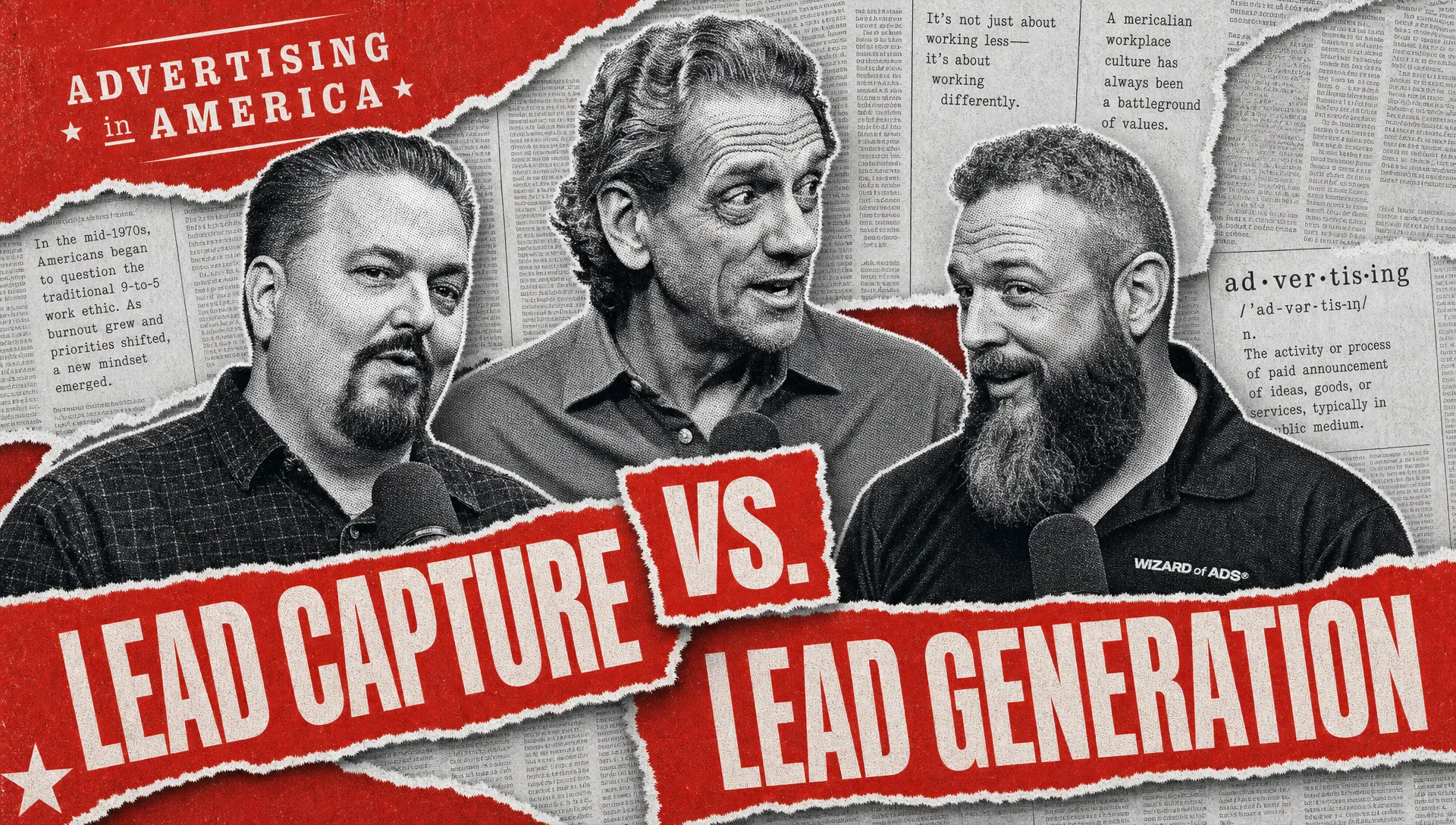
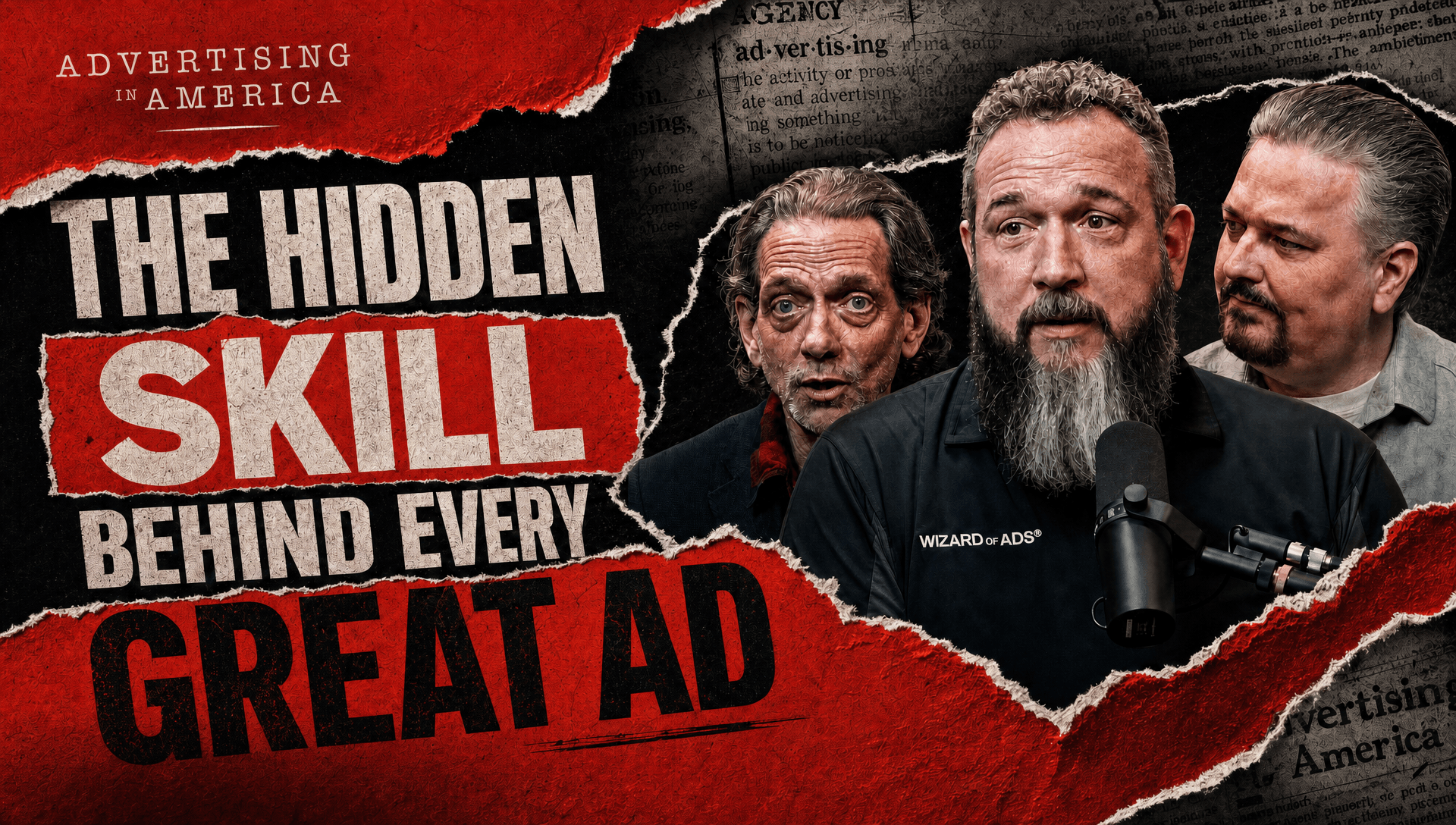
The podcast that turns marketing into magic! Hosted by the brilliant Ryan Chute and the ever-entertaining Michael Torbay & Chris Torbay, this show dives deep into the world of American advertising, revealing the secrets behind the most successful campaigns and exploring the latest trends.
Share this:








Nothing to see here!
Nothing to see here!